


Today, invasive alien plant species are among the gravest ecological threats worldwide, altering landscapes, suffocating native biodiversity, destabilising economies, and reshaping cultural relationships with land. This is a story of distribution, disruption, and difficult decisions.
Invasive alien plant species are non-native plants introduced to new ecosystems where they spread aggressively, outcompeting native species and disrupting ecological balances. These plants pose severe threats to biodiversity, economies, and human health worldwide, with management requiring integrated and proactive strategies. In India, invasive flora has colonised the Western Ghats, the Himalayan foothills, the riverbanks of the Ganga and Brahmaputra, the dry scrublands of central India, agricultural landscapes, and urban wastelands.
The invasion pattern mirrors trade routes, colonial forestry practices, and modern horticultural markets. Invasive alien flora are silent transformers. They arrive quietly. They spread rapidly. They alter invisibly. Yet landscapes can recover. The story of invasive plants is not merely about ecology; it is about vigilance, humility, and stewardship. Every disturbed patch of soil is a question. Every seed is a possibility. Every restored forest is a promise. In the end, the battle against invasive alien species is not against plants; it is against neglect. And the outcome will define the future of biodiversity in India and beyond.
Defining Invasive Plants
A young girl stands before a dense stand of Japanese knotweed (Reynoutria japonica), illustrating the plant’s height and density.
Invasive alien plants (IAPs) are species moved beyond their native range by human activities like trade, travel, or intentional introductions for ornamentals, forage, or erosion control. Once established, they reproduce rapidly, either by seed or vegetatively, forming self-sustaining populations that harm local ecosystems. They differ from casual aliens, which fail to establish themselves by their ability to invade natural, semi-natural, or managed areas.
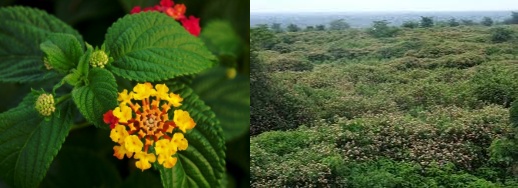
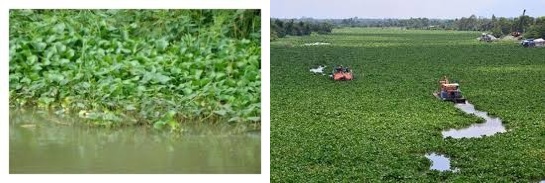
Globally, over 37,000 alien species exist, with about 6% of alien plants (over 1,000 species) classified as invasive. Common examples include Lantana camara, Prosopis juliflora, water hyacinth (Eichhornia crassipes), and Japanese knotweed (Reynoutria japonica). Japanese knotweed demonstrates dense, aggressive growth that smothers native vegetation in invaded areas.
Also Read: Chemical Ecology in the Anthropocene: The Silent Collapse of Nature’s Language
Global Patterns
Canada goldenrod (*Solidago canadensis*) with yellow flowers, is a roadside weed in Poland.
Invasive plants thrive in disturbed habitats like roadsides, riversides, and agricultural edges but penetrate forests, grasslands, and wetlands. Islands face disproportionate invasion pressure, with alien plants outnumbering natives on over 25% of them due to isolation and limited native diversity.

IPBES data shows 75% of impacts occur on land ecosystems (forests, woodlands, cultivated areas), 14% in freshwater ecosystems, and 10% in marine-adjacent zones. Regions vary: Americas (34% of impacts), Europe/Central Asia (31%), Asia-Pacific (25%), Africa (7%). Trade, travel, and climate change accelerate the spread; 37% of alien species have been recorded since 1970.
In India, species like Lantana camara and Parthenium hysterophorus dominate two-thirds of ecosystems, spreading 15,500 km² annually in natural areas. Canada goldenrod (Solidago canadensis), an invasive in Europe and Asia, forms dense stands along roadsides, reducing native plant diversity.
Regional Examples
Kudzu vines cover trees and the landscape in Atlanta, Georgia.
In Europe, Fallopia japonica alters soil chemistry via allelochemicals, damaging infrastructure and costing billions in control. North America battles kudzu (Pueraria montana), which engulfs forests and crops. Africa suffers from Opuntia stricta (US$500–1,000 household loss/year) and Prosopis glandulosa, both of which reduce grazing lands and affect rural livelihoods.
Asia has witnessed Mikania micrantha smothering tea plantations in India and China. Australia lists Lantana camara among its ten worst invasive species, while India’s invasive flora, including Chromolaena odorata, increasingly threatens the Himalayan ecosystem under changing climatic conditions. High-income regions often host more invasive species due to larger trade volumes and global connectivity.
Ecological Disruption
Invasive plants reduce native biodiversity by 20–50% in invaded sites via competition, allelopathy (chemical suppression), and habitat alteration. They contribute to nearly 60% of recorded plant extinctions globally and act as the sole driver in around 16% of cases. On islands, invasive species are linked to more than 90% of extinctions.
They also alter soil nutrient cycles, hydrology, and fire regimes. For example, Bromus tectorum increases nitrate levels in soils, while tamarisk species narrow stream channels and intensify erosion. Invasive grasses such as cheatgrass fuel more frequent and intense wildfires. Wildlife suffers through reduced forage availability, nesting habitats, and disruptions in food webs.
In India, Lantana displaces 40% of the native understory in forests. Such invasions homogenise biota, weakening ecosystem resilience against climate change.
Economic Consequences
Global economic losses from invasive species exceed $423 billion annually, with some broader estimates reaching $2.2 trillion when unreported damages are included. Costs have nearly quadrupled every decade since 1970. Invasive plants account for a significant share of crop losses, reduced agricultural productivity, and expensive control measures.

Agriculture bears almost 90% of invasion-related losses in Asia. Infrastructure damage is also substantial; for instance, Japanese knotweed repair costs in the United Kingdom exceed £165 million annually. Tourism and fisheries decline as habitats degrade.
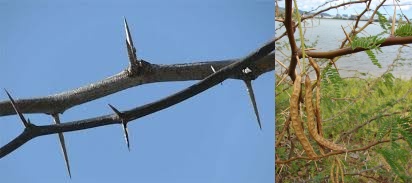
In India, Prosopis juliflora degrades pasturelands and reduces the availability of fodder and fuelwood resources. South Africa’s black wattle invasion alone has created environmental costs estimated at $2 billion. Approximately 92% of economic losses affect ecosystem services such as food, water, and livelihoods, while only 8% is currently spent on management and prevention.
Social and Health Effects
Invasive species often exacerbate poverty in rural areas by cutting livelihoods (e.g., 15,500 km² of Indian land loss/year affects millions). Indigenous communities worldwide also experience cultural erosion, with more than 2,300 invasive species recorded on Indigenous territories.

Health risks are equally significant. Species such as Ambrosia artemisiifolia trigger severe asthma and allergies, while toxic compounds like pyrrolizidine alkaloids contaminate food products such as honey. Invasive trees like Prosopis juliflora can indirectly contribute to mosquito proliferation, influencing vector-borne diseases. Southeast Asia alone records nearly $1.85 billion in health-related losses linked to invasive species. Physical injuries from thorny plants such as Opuntia stricta are also common. Indirect health effects are equally concerning; invasive pests such as the ash borer destroy ash trees that naturally filter air pollutants, thereby reducing urban air quality and increasing health risks.
Control Methods

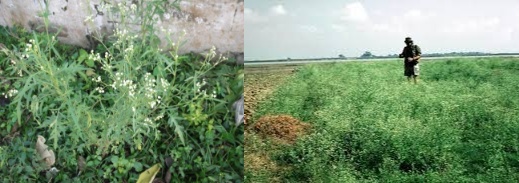
Integrated Pest Management (IPM) combines prevention, mechanical (pulling, mowing), chemical treatment (herbicides), and biological controls (e.g., rust fungi on Mikania micrantha, 60% success).
Prevention remains the most effective strategy through strong biosecurity systems, trade inspections, and quarantine measures. Eradication programmes work best when invasions are detected early and confined to small areas.
Kudzu vines blanketing trees in Atlanta, Georgia, demonstrate the scale of mechanical and chemical intervention often required in dense infestations. Several global case studies highlight the success of coordinated control programmes. In the Galápagos Islands, nearly 140,000 feral goats were removed through hunting and the “Judas goat” technique, leading to a 300% rise in tortoise populations. California successfully eradicated the Mediterranean fruit fly through sterile insect release programmes, protecting nearly $1.5 billion worth of crops. In the Aleutian Islands, black rats were removed from 11 islands using baiting programmes, resulting in a 450% increase in seabird populations. In India, farmers commonly manage Parthenium hysterophorus through uprooting and repeated cutting in agricultural fields. Australia, meanwhile, achieved notable success in controlling Opuntia stricta using cochineal insects as a biological control agent.
Challenges Ahead
At first glance, the forest seems eternal. A canopy rustles. Sunlight spills in trembling mosaics. Lianas coil around ancient trunks. Grasses sway in riverine winds. Yet beneath this calm lies a quiet insurgency, one not marked by marching armies or roaring engines, but by seeds. Carried by colonial ships, botanical curiosity, ornamental trade, cattle feed consignments, railway sleepers, and even the soles of boots, alien plants have travelled across oceans and continents. Some settled gently. Others invaded.
Today, invasive alien plant species are among the gravest ecological threats worldwide, altering landscapes, suffocating native biodiversity, destabilising economies, and reshaping cultural relationships with land. This is a story of distribution, disruption, and difficult decisions.
Climate change is expanding the geographical range of invasive plants, including poleward expansion of species such as Kalanchoe houghtonii. Yet only 17% of countries currently maintain dedicated laws addressing invasive species, and nearly 45% invest minimally in prevention and control. Interactions between invasive species, drought, and rising temperatures increasingly contribute to megafires and ecosystem collapse.
In India, climate change and land-use transformation are pushing Lantana camara further upslope into Himalayan ecosystems. Future strategies must prioritise risk assessments, GIS-based monitoring, remote sensing, and post-removal ecological restoration.
Global biodiversity goals under the Kunming-Montreal framework aim to halve invasive species introductions by 2030. Community participation, citizen science initiatives such as “check, clean, dry,” and trans-disciplinary approaches linking ecology, economics, and public health will be essential. Some researchers are also exploring controlled uses of invasive plants for bioenergy and phytoremediation.
Ultimately, success demands political will, funding, and international cooperation to safeguard ecosystems and societies.
Disclaimer: The views expressed in this article are those of the author solely. TheRise.co.in neither endorses nor is responsible for them. Reproducing this content without permission is prohibited.