


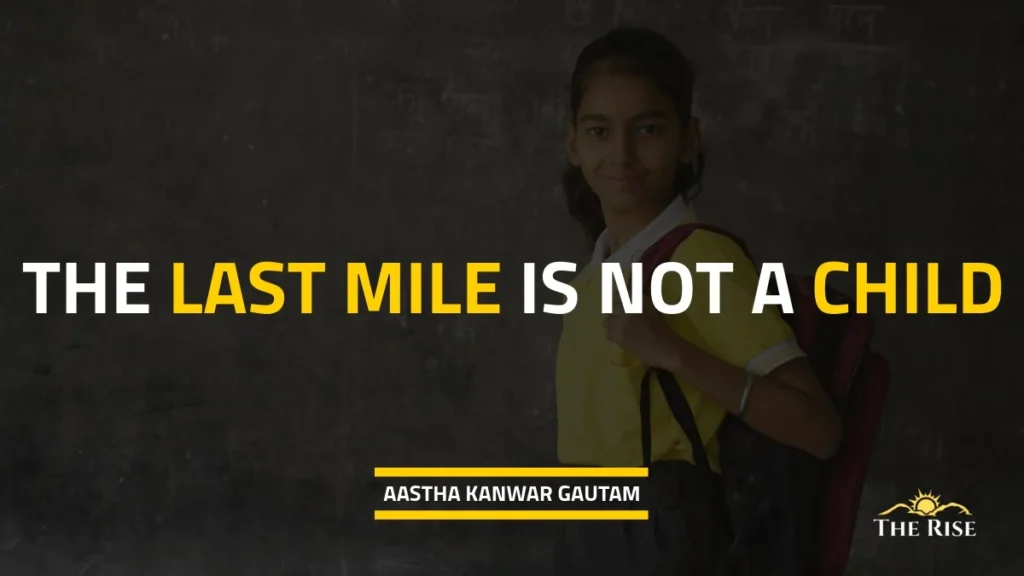
In case of pairing of schools, if the teacher is going twice a week then it has to be put in a budget but if a mother is walking her six year old to school in the morning, back home in the afternoon and then again in the evening to school again then the cost can effectively be written off the accounts. The proposal of school pairing may seem the most economical one because the most expensive element of it, which is the mother’s time, the department gets for free.
On 21st July 2025, Parliament heard that Uttar Pradesh (UP) had worked out safe school routes. A local newspaper, on the same day, went out and counted how many children from one village actually made it to the school. As Etah, a district in Uttar Pradesh, is reconstituting its school management committees, the children of Hardoi provide a telling example of how a child’s experience can challenge an administrative plan before officials go ahead and sign it off.
Mubarakpur primary school in Sitapur district, UP, had 103 students on its roll. When the state put it in partnership with the school at Bakarpur it gained another 52. The maths was perfect. Then someone did an attendance check, which revealed low attendance among the newly paired students. The two schools were about 2 km apart, of which 300 metres of the route running along the Sharda Sahayak canal, while the main road was one that was very heavily trafficked.
In a written reply, in Lok Sabha, to a question by MP Krishna Devi Shivshankar Patel as to whether any arrangements had been made for the safe transport of children whose new schools were a long way off. The UP government’s position was that the children would have access to better facilities and more peers. Schools had been mapped to ensure the journey would be within a ‘safe and feasible‘ distance. Parliament had its reassurance.
But, who knew about those 300 metres prior to the registers being amalgamated? Where, on the form which was actually recommending the move would that have been recorded? The paper did have the parents’ concerns about the safety of their children. The parliamentary answer described the process across the state. Yet the question of whom the officials actually heard in Bakarpur before they went ahead with this decision, is still very much open. India is very much in the habit of referring to rural children as the ‘last mile‘ of education.
Who gets to define ‘nearby’?
The case for clustering small schools is very much a case that can reasonably be made, particularly from the perspective of anyone whose own child has a different teacher for every subject. UDISE+ for 2025-26 had 1,00,843 single teacher schools. Imagine Class I going through the motions of sounding out a word and Class V sits there waiting for someone to explain fractions. You’ve got just one teacher, who is expected to manage both the classrooms. A parent could very reasonably be in favour of the larger school and still have something meaningful to say about the walk.
Two schools can share a teacher in a variety of ways. The children can go, the teacher can go, the science kit can go either way. The NEP 2020 speaks of school complexes which would pool staff and facilities and also requires the states to ensure that access is not compromised as a result of consolidation. While the Uttar Pradesh government has already decided to pair low-enrolment schools, but the district administration still has to work out the practical details like which children will have to travel, how they will get there, and who will bear the cost.
If the teacher is going twice a week then someone has to put the fare in a budget and the journey on a timetable. If a mother is walking her six year old to school in the morning, back home in the afternoon and then again in the evening to school again then the cost can effectively be written off the accounts. The proposal may seem the most economical one precisely because the most expensive element of it is the mother’s time which the department gets for free. The escort could be an older sister who is missing class. The family needs to be consulted before the decision is taken, because the relative cost of the two options could be very different.
In a separate case from Sitapur, Nitesh Kumar has also challenged the pairing of schools through his mother, Lalli Devi. The families have invoked the neighbourhood school provisions under the Right to Education Act. A single judge had earlier dismissed the petitions. On 24th July 2025 the Lucknow bench of the Allahabad High Court found the petitions wanting and directed that the existing arrangement in Sitapur be maintained, while asking the State to explain its position. A child whom the government has described as a beneficiary is in fact now a petitioner challenging the State of UP.
On 17th November 2025, the bench dismissed the appeals and directed the authorities to go ahead with the August circular. Pairings are to be reversed where the enrolment is over 50 and the two schools are more than a km apart. On the paper’s own figures Bakarpur appears to be in both of those categories. The order gives no school by school outcome for Bakarpur. The attendance figures remains low and it remains unclear where those 52 children were taught following the review. That’s a question which the public record referenced here provides no answer to.
Uttar Pradesh has its own rules which assign to the Gram Panchayat the responsibility of identifying a neighbourhood school for each habitation, making the information available to the public and conducting the annual school mapping. The district can of course work out the distance between two school gates. A family can work out the walk from the last house in their hamlet to the receiving school. Both of those could be correct. If the district is going to go with the shorter distance then the family at the very least should be able to see where that distance is being measured from.
The Music Teacher the Children Ask For
In Shyampur (Hardoi district, UP) the panchayat had provided the school with the musical instruments. Now post the school merger, who was going to teach the children to play these instruments? That was the question the children themselves asked. As the village was going through its next development plan in November 2019, the primary school’s Bal Sansad (children’s parliament) raised this issue before the Gram Sabha.
HCL Foundation (the Samuday team being the ones who worked with the kids) have the full story. The kids held a rally, produced posters and made their submissions at the meeting. In addition to clean water, sanitation and space to play they asked for a music teacher. The assembly did agree to take their requests on board and incorporate them into the draft plan for 2020-21. That’s it from the HCL Foundation. An appointment order would have told us whether a music teacher actually taught that year. At the draft stage the kids had already changed what the village was being asked to spend on.
Also Read: NEP 2020 & Role of NGOs: Bridging India’s Rural Education Divide
Several experts, including former Vice Chancellor Prof. Ashok Kumar have made a point that the voluntary organisations should take what they have learned in the villages and bring those lessons into the education policy. In Shyampur, the foundation knew how to get a proposal in before the assembly. The students knew what was missing from the music lesson. In Umra in Maharashtra the students had managed to get the bus half an hour earlier. Class IX student Pooja Pawar told a prominent newspaper in 2013 that “we’re always there on time“. Both of those examples predate the NEP. The committees envisaged under the new guidelines offer students another avenue to put forward proposals and influence decisions.
When Digital Homework Meets Household Realities
I co-run a private school in Jalesar (Etah district). On 20th October 2026 I asked for the lesson plans for students of Class VIII, broken down into 40-minute periods. The plans were to include explanations that a teacher could deliver in both Hindi and English, an activity to be done in class to test understanding and something very simple for the child to do at home. I was very specific about the teacher’s time. and had left entirely to the teacher to work out what ‘simple’ meant in the context of someone else’s home. A child reading those instructions would be perfectly justified in asking what the person setting the homework knew about the hours after school.
The ASER report makes the point about the significance of the wording. In the 2024 rural survey 89.1% of 14-16 year old students reported that they had a smartphone at home. When asked to bring a phone with good connectivity to do a set of digital tasks only 65.9% could. “Have” and “bring” are very different stories about digital India. A QR code in a textbook can take the learner straight to the corresponding lesson on DIKSHA (India’s digital learning platform). A teacher who has set a 7 o’clock deadline is making her own decision. Only the household will know who has the phone at 7 o’clock.
I’d tweak one line of the instructions I gave. Before getting on to the homework itself, would let the class look at the task and consider which bit they could do with what they have at home and which bit they’d prefer to do in school with the teacher and a device to hand. A pupil could ask to use the last 10 minutes of the lesson for the digital bit and take the written bit home. The teacher could still expect the same level of understanding from the class. This way, a child could have helped alter the timetable before a late submission became the first sign that something was wrong.
What goes in the minutes
In August, several newspapers reported that 1,691 council schools in Etah were going to reconstitute their School Management Committees (SMCs). In accordance with the May guidelines, the Head-teacher is to make the school’s UDISE+ report card available to the members at the first meeting of the SMC. The school is to have a suggestion box or feedback register. The committee is to go through the feedback on a quarterly basis and raise the key points in the minutes. The guidelines exempt 14 private unaided schools. Even so, lesson plans could be brought up for discussion at an SMC meeting.
There’s already a place for an objection to go. Para 7.9 of the NEP states that the school produces its own development plan in conjunction with its Management Committee. That then feeds into the school complex plan which the Department will of course go on to approve (in this case via the Block Education Officer). The policy is that the Department is the one responsible for the provision of resources. A parent could legitimately ask to see what happened to their concern as it moved from the village meeting to the desk of the official with the authority to allocate funds.
Take a proposal to share a science teacher. Ask the teacher which experiments need the lab and which she could do in a bag. In addition to the official map the children from each hamlet could themselves mark the route they would actually take. They could use the names by which the families know the crossings. A notice can be perfectly translated into Hindi and still refer to a road by a name which no one actually uses. A parent can trace it with her finger. A child in a wheelchair may be quite happy to have a private conversation about a section which everyone else would regard as perfectly passable. The teacher can take that account in advance and with the child’s permission put the obstacle on the map.
A village meeting in the middle of the day is a distinct advantage to those who can dictate their own working hours. The parent who is dependent on the day’s wages is the one most likely to be vocal in opposition and the one least likely to be there. The research from the 280 villages in Jaunpur should probably be enough to dampen expectations somewhat. Simply giving the villagers information about education and their committees in no way led to any improvement in the quality of learning in the schools or to any increase in community participation in the schools. There was an improvement in the learning of the children, who attended the reading classes run by the locally trained volunteers. A child is entitled to a teacher even if her mother never shows up to a meeting. The poorest village should have absolutely no need to produce its most persuasive speaker in order to get a basic public service.
A district could put the proposal before the family at the far end of the route whilst there is still time to alter it, name the officer who is to decide and set a date for a reply. Record what has been changed and the reason for overruling an objection. If a majority are in the favour of the proposal, even then the family at the far end of the route still deserves a written reply. Where transport is required the cost and the name of the officer responsible should be on the same sheet. The UP education rules already provide for arrangements such as free transport where a neighbourhood school is not available within the prescribed radius.18 The family can give the name of the road. Transport is still a public work.
Once a decision has gone through the receiving school could in fact keep each child’s previous school code for a term and then compare attendance before and after the move. The total could look very healthy on paper, even if children from one hamlet were effectively missing school. The actual lessons the children received and the days they were absent would still need to be examined, including through conversations with their parents. In Sitapur’s Sahinpur Kheria where classes have been temporarily brought back at the old site, one parent Ramendra Kumar has raised his concern, while talking to a prominent newspaper. The concern was a simple question of how these children would manage a three-kilometre journey on their own should have been considered when the schools were paired in the first place.
I used to edit news copy for a living. If a reporter had written that a school was ‘nearby’ I’d have put three words in the margin. Nearby for whom? The next time a district are drawing up a school map I’d have the kids look at it whilst someone still had a pencil. It should be possible to put 300 metres of canal bank in a government file before a teacher is asked to mark 36 children absent.
References
1. Samvad News Agency, “Pairing ke baad 15 se 20 feesadi bachche hi pahunch rahe school” [School attendance after pairing], Amar Ujala, 21 July 2025, Mahmudabad, Sitapur.
2. India, Lok Sabha, “Merger of Schools”, Unstarred Question No. 153, Krishna Devi Shivshankar Patel, answered by Jayant Chaudhary, 21 July 2025.
3. Government of India, Press Information Bureau, ‘Beyond the Numbers: Decoding India’s School Education Progress’, UDISE+ 2025–26 report, 17 August 2026, section on single teacher schools.
4. Government of India, Ministry of Human Resource Development, National Education Policy 2020, paras 7.4-7.7.
5. Allahabad High Court, Lucknow Bench, Master Nitesh Kumar v. State of Uttar Pradesh, Special Appeals 222 and 223 of 2025, interim order, 24th July 2025, paras 2-10.
6. Allahabad High Court, Lucknow Bench, Master Nitesh Kumar v. State of Uttar Pradesh, 2025:AHC-LKO:73922-DB, 17th November 2025, paras 5-9.
7. Government of Uttar Pradesh, The Uttar Pradesh Right of Children to Free and Compulsory Education Rules, 2011, rules 4(3) and 5(2).
8. HCL Foundation, Model Gram Panchayats: The Building Blocks of Rural India, sec. 8.3, “Small Steps, Big Initiatives”, 37-38.
9. Ashok Kumar, ‘NEP 2020 & Role of NGOs: Bridging India’s Rural Education Divide’, TheRise, 13 May 2026.
10. “Junior Change-Makers”, Hindustan Times, 18 August 2013, section “Desks, Buses, More Teachers”, on Umra, Maharashtra.
11. ASER Centre, Annual Status of Education Report (Rural) 2024, India rural findings, 62, tables 10–11 and note on the digital tasks.
12. DIKSHA, ‘Understanding the QR Code’, mobile app documentation, accessed 20 November 2026.
13. Samvad News Agency, “Parishadiya schoolon ki prabandh samitiyan 29 November ko ho jayengi bhang” [Council school management committees to be dissolved on 29 November], Amar Ujala, 20 August 2026, Etah.
14. Government of India, Ministry of Education, Department of School Education and Literacy, Guidelines for School Management Committees (SMCs), May 2026, secs 2.3(x) and 5.
15. Government of India, Ministry of Education, ‘School Management Committee (SMC) Guidelines 2026: Applicability over Differently Managed Schools’, Press Information Bureau, 21 May 2026.
16. Ministry of Human Resource Development, National Education Policy 2020, para 7.9
17. Abhijit V. Banerjee, Rukmini Banerji, Esther Duflo, Rachel Glennerster and Stuti Khemani, “Pitfalls of Participatory Programs: Evidence from a Randomised Evaluation in Education in India”, American Economic Journal: Economic Policy 2, no. 1 (2010), 1–30.
18. Government of Uttar Pradesh, Right of Children to Free and Compulsory Education Rules, 2011, rule 4(1) and (2).
19. Samvad News Agency “After pairing only 15 to 20 children are reaching school” (reporting from Sahinpur Kheria) with comment from parent Ramendra Kumar.
Disclaimer: The views expressed in this article are those of the author solely. TheRise.co.in neither endorses nor is responsible for them. Reproducing this content without permission is prohibited.