


With youth forming the backbone of India’s population and economic future, the terms under which they enter the workforce carry consequences far beyond individual paychecks. A generation growing up financially unstable, lacking healthcare access, and lacking a dependable social safety net will shape the country’s economic trajectory for decades to come.
India today stands at a demographic turning point. Nearly two-thirds of its population falls under the age of thirty-five, a statistic often celebrated as the country’s greatest economic advantage. Yet beneath this celebrated demographic dividend lies a quieter, more troubling reality. Millions of young Indians are building their working lives inside a system engineered to avoid recognizing them as workers at all.
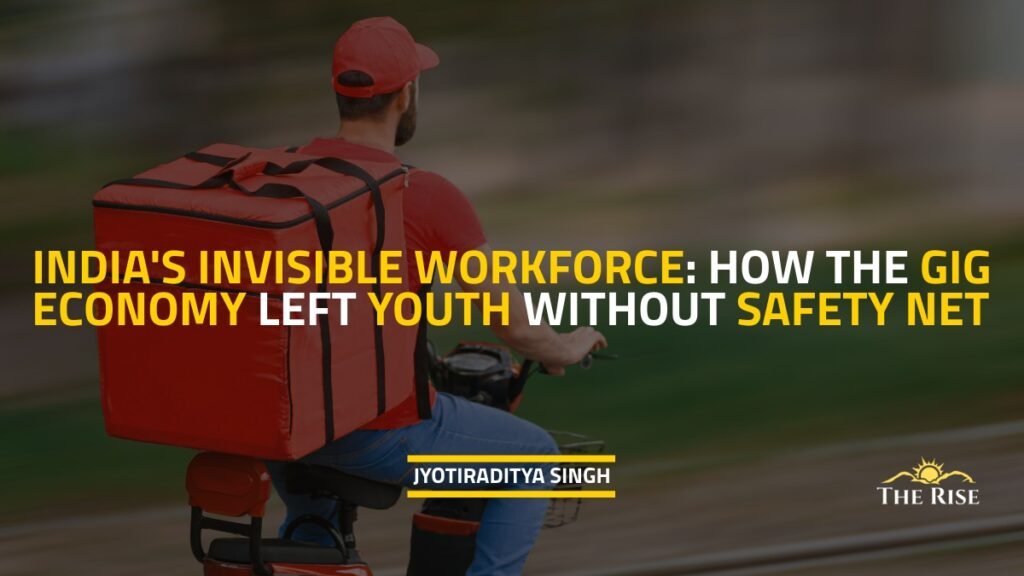
Step into any Indian city today, and the evidence surrounds you. A delivery rider weaves through traffic with a food bag on his back. A cab driver logs sixteen-hour shifts to hit a daily target set by an app. A freelance data annotator works from a small town, paid per task, earning amounts that swing wildly from month to month. These are the faces of India’s gig economy, a sector projected to employ over twenty million people within the next few years. For many young Indians, gig work has become the default entry point into employment, filling the gap left by a formal job market struggling to absorb the sheer scale of new graduates entering it each year.
Also Read: Driving Against the Odds: The Socio-Economic Realities of Women Taxi Drivers in Delhi
The appeal, on paper, seems obvious. Flexible hours. Quick onboarding. Minimal formality. But scratching the surface reveals a far harsher picture.
Companies operating in this space have built their business models around a simple legal maneuver, classifying workers as partners rather than employees. This single distinction strips millions of young workers of protections that formal employees take for granted. Their earnings carry no provident fund contribution building toward retirement. Their health has no employer-sponsored insurance backing it during an accident or illness. Their tenure carries no severance and no notice period, and account deactivations often arrive overnight, with little explanation offered.
Consider the algorithm itself, the invisible manager overseeing this entire workforce. Pay rates shift, order allocations fluctuate, and penalties get applied, all determined by systems that remain opaque to the very people whose income depends on them. A worker can watch earnings drop for weeks while the reason stays hidden. Appeals, where they exist, often vanish into automated support systems offering little beyond scripted replies.
Physical risk compounds this financial precarity. Delivery workers navigate monsoon floods, extreme heat, and chaotic traffic for hours daily, carrying the full weight of that risk themselves. A road accident becomes a personal financial catastrophe rather than a covered workplace incident, since these workers, by legal classification, technically work for themselves.
Also Read: Gig Economy: The New Disruptor of Education, Jobs & Social Security
Recognition of this crisis has entered Indian policy circles, most notably through the Code on Social Security passed in 2020, which acknowledged gig and platform workers as a distinct category deserving welfare coverage for the first time. The intent marked genuine progress. Execution, however, has lagged far behind the legislation, and implementation has moved at a pace that leaves millions still waiting for tangible benefits years after the law’s passage.
Other countries offer instructive comparisons. British courts ruled that Uber drivers qualify as workers entitled to minimum wage and holiday pay, a landmark decision that reshaped labor protections across Europe’s gig sector. India’s youth deserve a similarly serious reckoning with what fair treatment in this new world of work should look like.
With youth forming the backbone of India’s population and economic future, the terms under which they enter the workforce carry consequences far beyond individual paychecks. A generation growing up financially unstable, lacking healthcare access, and lacking a dependable social safety net will shape the country’s economic trajectory for decades to come.
The gig economy will keep growing; that trajectory looks certain. The real question facing policymakers, companies, and citizens alike centers on whether this growth arrives paired with dignity and security for the young people powering it, or whether India allows an entire generation to build its future on ground this unstable.
Disclaimer: The views expressed in this article are those of the author solely. TheRise.co.in neither endorses nor is responsible for them. Reproducing this content without permission is prohibited.