


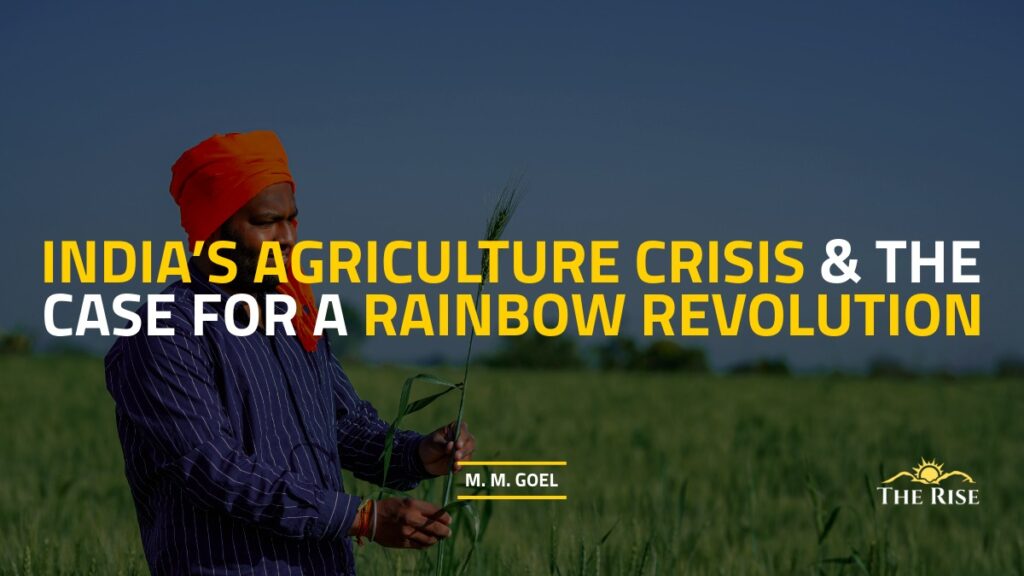
While India’s overall GDP growth hovers around 7.4 percent, agricultural growth remains lower at about 4.4 percent. The gap widens income inequality between rural and urban Bharat, reinforcing migration pressures and agrarian distress. If the 21st century is to be Bharat’s century, agricultural transformation must be inclusive, remunerative, and farmer-centric. A Rainbow Revolution powered by processing, storage ownership, and global value integration offers a sustainable pathway.
Needonomics School of Thought (a Kurukshetra based Think Tank) firmly believes that safeguarding the interests of Bharat’s nearly 15 crore farmers is not merely an economic obligation but a moral duty. Food security is inseparable from national security. A nation that cannot protect its food producers cannot ensure sovereign stability. In the Indian context, the bond between the Kisan (farmer) and the Jawan (soldier) is civilizational as well as strategic — Kisan and Jawan together win the wars. While the Jawan defends the borders, the Kisan sustains the nation from within.
Significantly, a large proportion of India’s armed forces personnel come from rural backgrounds, carrying farmer identities and agrarian roots. This organic linkage between agriculture and defence deepens the argument that farmer welfare is integral to national strength. Weakening agriculture, therefore, risks both food security and social stability.
Agriculture: Misunderstood, Not Unproductive
Agriculture in Bharat is often labeled an “unproductive” sector in conventional economic discourse. Needonomics School of Thought challenges this perception. Agriculture is not unproductive — it is under-remunerative. The distinction is crucial.
The sector directly supports about 45 percent of India’s population, making it the largest livelihood provider in the country and home to the world’s largest farmer population. Yet income levels remain disproportionately low compared to industry and services. This structural imbalance calls not for sympathy but for empathy-driven policy design — policies that recognize dignity, risk, and contribution.
Agriculture feeds 1.4 billion people, sustains agro-industries, supports rural demand, and stabilizes inflation. Its multiplier effects far exceed its measured GDP share. Judging agriculture purely by output metrics ignores its social, ecological, and strategic value — a narrow lens that Needonomics seeks to correct.
Global Comparisons: A Structural Reality Check
A comparative global perspective sharpens the concern. While in the United States, agriculture accounts for roughly 1.2 percent of employment and about 1 percent of GDP, in the European Union, it contributes around 1.6 percent of GDP.
However, in Bharat, agriculture constitutes about 16.3 percent of GDP while supporting nearly half the population. This stark asymmetry reflects disguised unemployment, small landholdings, and inadequate value realisation rather than inefficiency alone. It also signals the urgency of structural transformation without social disruption.
Further, while India’s overall GDP growth hovers around 7.4 percent, agricultural growth remains lower at about 4.4 percent. The gap widens income inequality between rural and urban Bharat, reinforcing migration pressures and agrarian distress.
FTA Concerns: Livelihood vs Liberalization
From a Needonomics standpoint, several Free Trade Agreements (FTAs) need to be viewed with caution. While trade liberalization may benefit export-oriented industries, it can expose small and marginal farmers to volatile global price regimes, subsidised imports, and restrictive non-tariff barriers.
Indian farmers compete not merely with foreign producers but with heavily subsidised agricultural systems in developed economies. Without equivalent domestic support, FTAs risk becoming livelihood threats rather than growth opportunities.
Thus, trade policy must integrate livelihood security impact assessments before market access commitments are finalized.
Case for a Rainbow Revolution
The solution does not lie in protectionism alone but in transformation — what the Needonomics School calls a Rainbow Revolution in Agriculture.
This goes beyond the earlier Green, White, Blue, and Yellow Revolutions. A Rainbow framework integrates:
- Productivity enhancement through technology, irrigation, and climate-resilient seeds
- Crop diversification toward high-value horticulture, floriculture, pulses, and oilseeds
- Allied sectors — dairy, fisheries, poultry, beekeeping
- Agro-processing and value addition
- Branding, packaging, and global marketing
- Agri-exports linked to GI tags and regional specialties
The real income leap for farmers will come not from raw produce alone but from processed and value-added agro-products. Tomato to ketchup, milk to cheese, wheat to nutraceuticals -value chains multiply incomes.
Storage, MSP, and the FCI Reform Debate
One of the structural bottlenecks in Indian agriculture is post-harvest management — especially storage. The Food Corporation of India (FCI) has historically played a central role in procurement and buffer stocking. However, the Needonomics School proposes a bold structural reform, which includes gradually winding up FCI’s centralised ownership model and transferring storage ownership to farmer collectives, cooperatives, and FPOs (Farmer Producer Organisations).
Such decentralised ownership would not only expand scientific storage capacity at the grassroots but also reduce wastage and transit losses. This would strengthen farmers’ bargaining power. Further, NST suggests enabling warehouse receipt financing and easing MSP procurement pressures, thereby promoting localised food security systems.
When farmers control storage, they gain the ability to time the market rather than engage in distress sales.
From Sympathy to Structural Justice
The Needonomics framework emphasizes empathy, not sympathy. Sympathy is emotional; empathy is policy-driven. Farmers do not seek doles — they seek dignity, fair pricing, risk coverage, and institutional support.
Key empathy-based interventions include:
- Remunerative MSP linked to cost + dignity margins
- Income insurance and climate risk cover
- Affordable agri-credit
- Digital market access
- Farmer-owned processing units
- Export facilitation cells
Securing Those Who Secure Us
To conclude, Bharat’s farmers stand at the intersection of food security, livelihood security, and national security. Their contribution cannot be measured merely in GDP percentages but in civilizational continuity and sovereign resilience.
If the 21st century is to be Bharat’s century, agricultural transformation must be inclusive, remunerative, and farmer-centric. A Rainbow Revolution powered by processing, storage ownership, and global value integration offers a sustainable pathway.
In the final analysis, protecting farmers is not sectoral policy — it is national policy. When the Kisan prospers, the Jawan stands stronger, and Bharat stands secure.
Disclaimer: The views expressed in this article are those of the author solely. TheRise.co.in neither endorses nor is responsible for them. Reproducing this content without permission is prohibited.