


Both from a geo-political and economic standpoint the BRICS Summit held in New Delhi was important. The Iranian President’s visit gave a chance to New Delhi and Tehran to engage on important bilateral issues. The Iranian President also made important interventions regarding trade in local currencies and the need for the NDB to play a more proactive role in financing important development projects in the Global South.
The BRICS Summit 2026 held in New Delhi on September 12 and 13 was significant for several reasons. Firstly, despite several obstacles, the members were able to arrive at a consensus and unanimously pass the New Delhi declaration (which has been acknowledged as major diplomatic achievement for India as Chair of BRICS). Second, Chinese President Xi Jinping and Russian President Vladimir Putin attended the Summit.
Modi-Pezeshkian meeting: Key issues discussed
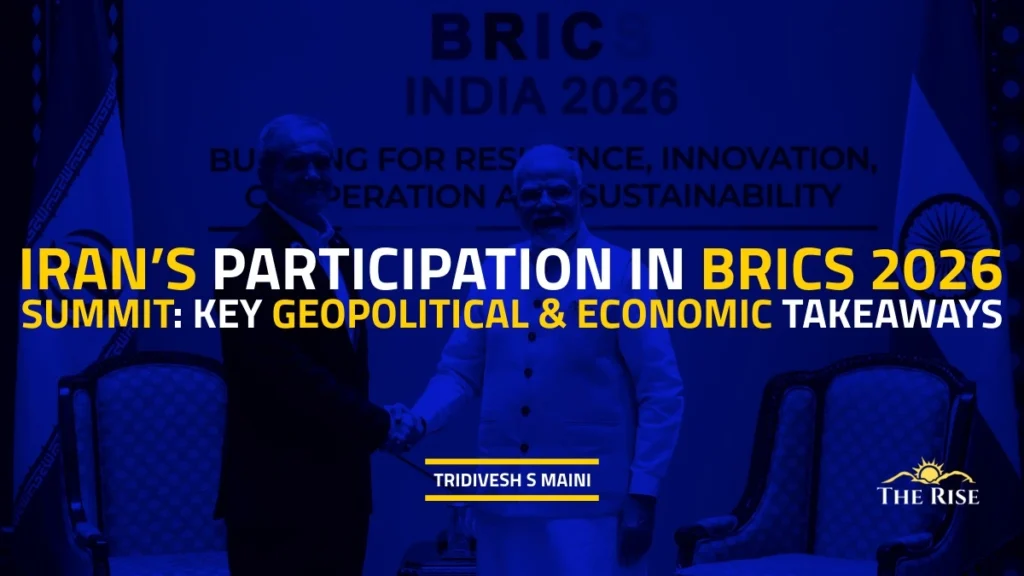
The presence of Iranian President Masoud Pezeshkian, at the BRICS Summit, despite the conflict in West Asia was significant. PM Modi met with Iranian President on the sidelines of the Summit. Pezeshkian and Modi had met days earlier, on August 31, on the sidelines of the Shanghai Cooperation Organisation (SCO Summit) held in Bishkek, Kyrgyzstan.
During his meeting with Pezeshkian, while pushing for resolution of the West Asia conflict via dialogue, PM Modi reiterated the need for freedom of navigation via the Strait of Hormuz. Like several other countries, India’s energy supplies have been impacted by the uncertainty pertaining to the Strait of Hormuz. The Houthi takeover of strategically important stretches of the Red Sea coast, including the Port of Mokha which overlooks the Bab El Mandab strait, is also being closely observed by India. MEA spokesperson Randhir Jaiswal while commenting on this said: “Such attacks undermine regional stability and threaten freedom of navigation through the Bab-el-Mandeb Strait.”
Further, Petroleum Minister, Hardeep Singh Puri, while speaking at an event on September 28, acknowledged the challenges posed by the West Asia conflict to India’s energy security but underscored the fact that India had diversified it’s crude import basket and is importing from 41 countries as opposed to 27 earlier.
Also Read: Can India Navigate China-Russia Dynamics in BRICS?
From an Iranian perspective, a few points stood out. First, the New Delhi declaration issued after the Summit clearly criticised the conflict in West Asia, though the US was not explicitly mentioned. Israel was criticised for the violence in Gaza.
Second, the Iranian President met with Crown Prince of Abu Dhabi, Sheikh Khaled bin Mohamed bin Zayed Al Nahyan on the sidelines of the BRICS Summit and this marked the first high level meeting between leaders of both countries. The meeting was important, because during a BRICS Foreign Ministers meeting held in May 2026, the Iranian Foreign Minister, Seyed Abbas Araghchi and UAE Deputy Foreign Minister, Khalifa Shaheen Al Marar had heated exchanges. While commenting on the meeting between the Iranian President and the Crown Prince of Abu Dhabi, US President Donald Trump said, “I don’t care”.
Third, Pezeshkian raised important issues beyond the West Asia conflict, pertaining to the challenges which the Global South is facing. He criticised US sanctions and unequivocally pushed for trade in local currencies between BRICS members. “One of the most important steps is to expand the use of national currencies in trade among the members. This step must be accompanied by the establishment of the necessary instruments for managing currency risks and reciprocal settlements,” he said. Iran’s annual trade with BRICS countries is estimated at $60 billion according to figures released by the Iran’s Trade Promotion Organisation.
Iran’s application for membership of NDB
Pezeshkian also called for the New Development Bank (NDB) to play a greater role for financing infrastructural projects in developing countries. Pezeshkian said, “..the New Development Bank must become the principal engine for financing infrastructure and energy in member countries through dedicated credit lines, financing in local currencies and guarantee instruments for attracting private capital.” The NDB President, Dilma Rousseff while speaking at the BRICS Summit stated that almost 46 per cent of all loans approved by NDB were in national currencies of its member countries.
Iran which became a member of BRICS in 2024 has applied for membership of the NDB. Iran’s central bank governor announced the country’s bid for membership in August. NDB membership is open to countries which are not members of BRICS. The NDB President said that it was essential to expand the bank’s membership to increase its operations. Currently, the NDB consists of 11 members, which includes the five founding members of BRICS -Brazil, Russia, India, China and South Africa – and six non-members – Bangladesh, United Arab Emirates, Egypt, Algeria, Uzbekistan and Colombia.
Both from a geo-political and economic standpoint the BRICS Summit held in New Delhi was important. The Iranian President’s visit gave a chance to New Delhi and Tehran to engage on important bilateral issues. The Iranian President also made important interventions regarding trade in local currencies and the need for the NDB to play a more proactive role in financing important development projects in the Global South.
Disclaimer: The views expressed in this article are those of the author solely. TheRise.co.in neither endorses nor is responsible for them. Reproducing this content without permission is prohibited.