


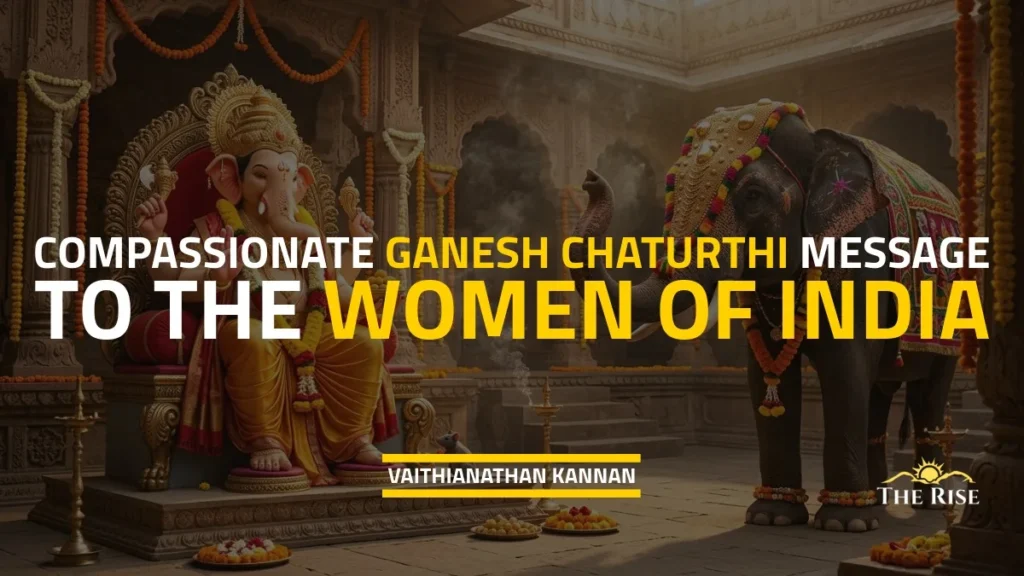
On the sacred occasion of Ganesh Chaturthi, let our devotion become a promise to protect the living elephant
Dear Mothers, Sisters, Daughters, Grandmothers, and Women of India, as India prepares to celebrate Ganesh Chaturthi, homes, streets, temples, and communities come alive with devotion, music, flowers, lamps, and beautifully decorated images of Lord Ganesha.
For millions of Indian families, this festival is much more than a religious celebration. It is a time when families come together, children learn traditions from elders, neighbours share happiness, and communities express gratitude, hope, and reverence. Lord Ganesha, with the head of an elephant and the body of a human being, occupies a uniquely beloved place in Indian cultural imagination. The elephant-headed form reminds us of wisdom, strength, patience, compassion, and the ability to overcome obstacles.
But there is another question we can gently ask ourselves during this sacred festival: What can we do to protect the real elephants who still walk through India’s forests, grasslands and landscapes? The image of the elephant is worshipped in our homes. The living elephant, however, needs forests, food, water, safe movement corridors and peaceful coexistence with people.
This Ganesh Chaturthi can therefore become an opportunity for a beautiful connection between devotion and conservation. We do not have to change the spiritual meaning of the festival. We do not have to abandon our traditions. Instead, we can enrich them. We can celebrate Ganesha while also teaching our children to respect the living elephant. We can decorate our homes without damaging nature. We can choose environmentally responsible materials. We can reduce plastic and unnecessary waste. We can avoid activities that disturb wildlife. We can support legitimate elephant conservation and habitat-restoration programmes. And, above all, we can cultivate a culture of compassion in our families.
The Elephant Behind the Symbol
The Asian elephant is an extraordinary animal. It is intelligent, socially complex, highly sensitive, and deeply connected to the ecosystems in which it lives. Elephants live in family groups, communicate through a remarkable variety of sounds and physical signals, remember landscapes and water sources, and travel considerable distances in search of food and water.

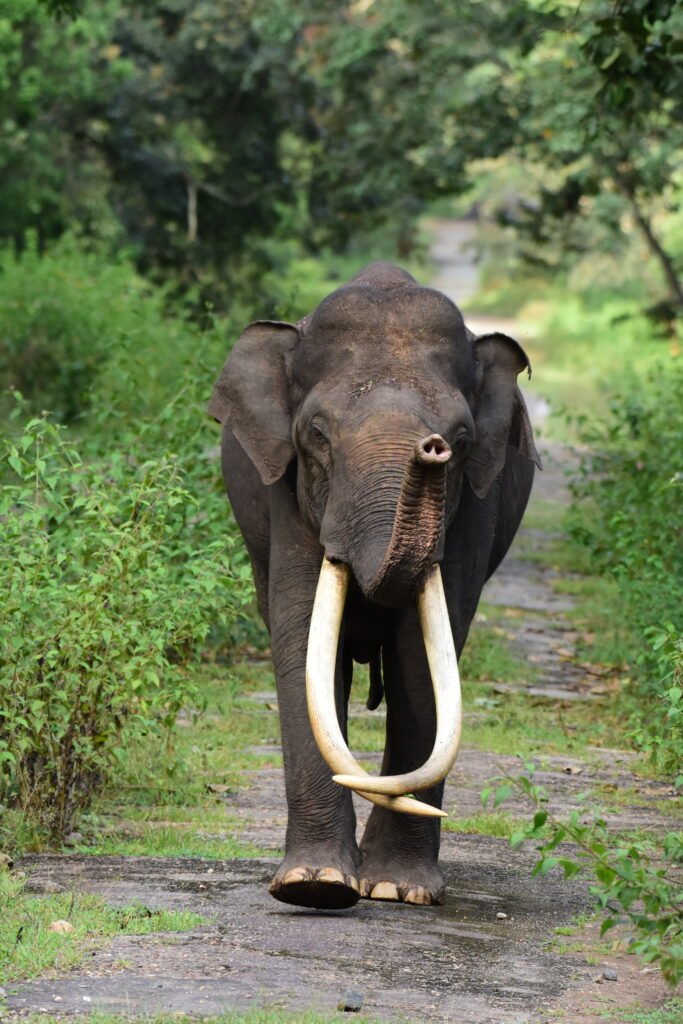
An elephant is not merely a large animal occupying a forest. It is part of an ecological system. Elephants influence vegetation, disperse seeds, create pathways, and contribute to the movement of nutrients through ecosystems. Their presence can therefore have effects far beyond the individual animal. India is home to a significant population of Asian elephants.
Yet elephants face serious challenges, including loss and fragmentation of habitat, conflict between elephants and people, railway and road accidents, electrocution, poaching and the illegal ivory trade, and other forms of human disturbance. The conservation of elephants is consequently not only a wildlife issue. It is also a question of land use, agriculture, infrastructure, education, community participation and responsible citizenship. And this is where the women of India have an enormously important role.
Why Address Women During Ganesh Chaturthi?
Women have historically played a central role in preserving family traditions. In many Indian households, mothers and grandmothers are the first teachers of children. They introduce them to festivals, stories, prayers, food traditions, family values, and customs. A child often learns environmental behaviour not from a textbook, but by watching what happens at home. If a mother carefully separates household waste, a child learns responsibility. If a grandmother explains why flowers should not be unnecessarily wasted, a child learns respect for nature. If parents choose an environmentally responsible Ganesha idol, children learn that tradition and environmental responsibility can coexist. If a family refuses to purchase products associated with illegal wildlife trade, children learn that compassion is stronger than consumerism. This is why the home can become the first school of conservation. The woman who prepares the festival meal, arranges the puja, teaches the children the significance of the celebration, and welcomes relatives in the home also has an opportunity to introduce one additional lesson: “We worship the elephant-headed Lord Ganesha; therefore, we must also respect and protect the living elephants of India.” It is a simple message, but its influence can last a lifetime.
Ganesh Chaturthi and Environmental Responsibility
Festivals are celebrations of life and community. They should not become occasions for unnecessary environmental damage. Fortunately, many environmentally responsible choices are simple.
1. Choose a natural idol
Families can consider idols made from natural clay or other environmentally appropriate traditional materials, rather than idols containing materials that may pollute water during immersion. The purpose is not to criticise anyone’s faith or artistic preference. It is simply to recognise that our rivers, lakes, ponds and seas are also part of the natural world that sustains us. A beautiful festival can therefore be accompanied by a beautiful environmental decision.
2. Avoid unnecessary plastic decoration
Plastic decorations may be inexpensive and attractive, but large quantities of single-use plastic can become a serious waste problem. Instead, families can use cloth decorations; reusable torans; natural flowers; leaves; paper decorations; traditional handicrafts; reusable lamps; locally made decorations. This can also provide opportunities for children to make their own decorations. A handmade decoration carries something that a mass-produced object often cannot: family participation.
Let Children Become Young Elephant Ambassadors
One of the most powerful things a mother can do is to transform a festival into a learning experience. During Ganesh Chaturthi, parents can spend a few minutes explaining elephants to children. Ask them: Where do elephants live? What do elephants eat? How do elephant families communicate? Why do elephants need large areas of forest? Why do elephants sometimes enter agricultural fields? What happens when roads and railway lines cut through elephant habitats? How can people and elephants live more safely together? These questions can lead to meaningful family conversations. Children can draw elephants. They can make posters. They can write poems. They can learn about India’s elephant reserves and wildlife corridors. They can read about forest ecosystems. They can create a small “Save the Elephant” corner in their home or school. A five-minute conversation during a festival can sometimes influence a child’s values for decades.
Teach the Difference Between Worshipping an Image and Protecting a Living Animal
There is a profound lesson here. An idol represents an idea, a spiritual principle, or a divine form. A living elephant is a sentient being. It experiences hunger, thirst, fear, pain, comfort, family attachment, and environmental stress. Therefore, our respect for Ganesha should inspire us to develop greater compassion toward living beings. This does not require complicated philosophy. A child can understand it through a simple sentence: “If we love the elephant form of Ganesha, we should also care for real elephants.” That thought can become an important foundation for environmental ethics.

Elephant Conservation Begins with Habitat Protection
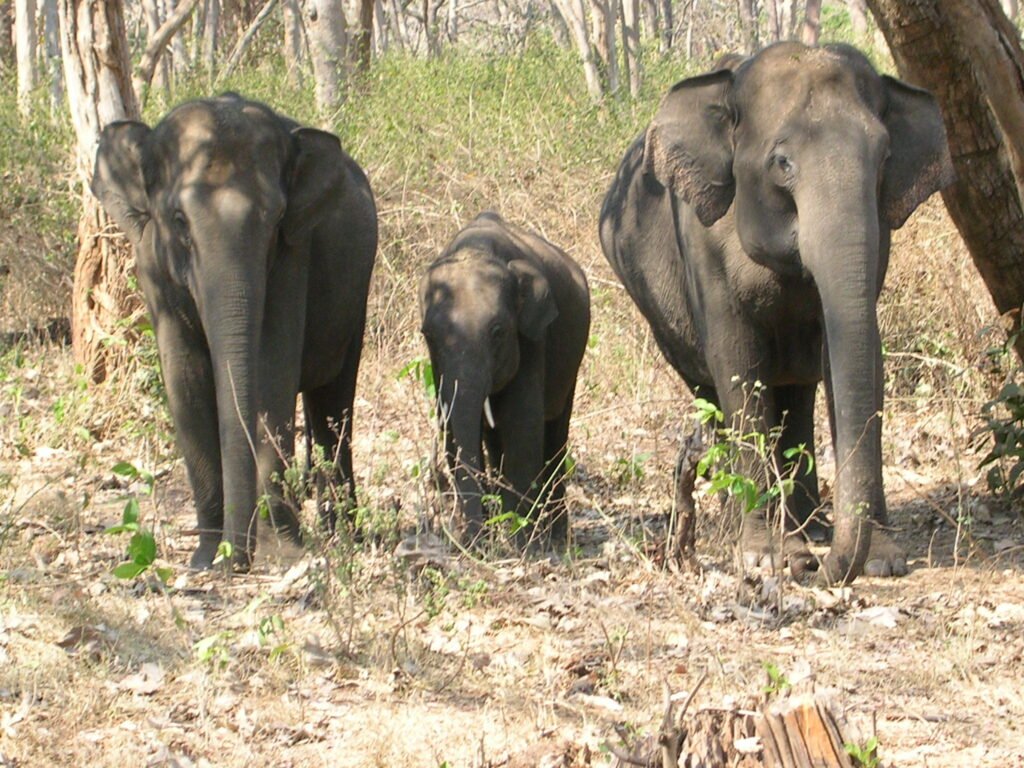
Many people think that saving elephants simply means protecting individual animals. In reality, conservation must also protect the landscapes on which elephants depend. Elephants require access to forests, grasslands, water sources, feeding areas, seasonal habitats, traditional movement routes, breeding areas, and safe corridors between fragmented habitats. When natural landscapes become divided by roads, railways, settlements, mines, industrial projects, and other developments, elephants may find it increasingly difficult to move between important areas. This can bring elephants closer to villages and farms. The resulting encounters may be frightening and sometimes tragic for both people and elephants. Therefore, protecting elephant habitat can also help protect human communities.
Understanding Human–Elephant Conflict with Compassion
The expression “human–elephant conflict” is widely used, but it is worth thinking carefully about what it means. An elephant does not enter a crop field because it wants to create trouble. It may be following an ancient movement route. It may be searching for food or water. Its forest habitat may have become fragmented. A traditional path may now pass through farmland, a road, or a settlement. Similarly, farmers cannot simply be blamed when elephants damage crops.
For a farmer, a destroyed field may represent months of labour and a family’s economic security. Therefore, the solution cannot be to ask people to choose between elephants and human livelihoods. The goal must be coexistence. That requires better land-use planning, early-warning systems, community participation, compensation mechanisms, safe infrastructure, habitat restoration and scientific conservation approaches. Women living in rural and forest-fringe communities can become especially important participants in such programmes.
The Powerful Role of Rural Women
Conservation should not be limited to cities. Millions of Indian women live in or near agricultural landscapes and forests. Women often possess detailed knowledge of local seasons, water sources, crops, wild plants, and changes in the surrounding environment. Their observations can be valuable.
A woman who notices changes in elephant movement near a village may possess information that is useful to local conservation teams. Women’s self-help groups can participate in environmental education. Schools can involve mothers in conservation programmes. Village communities can develop local awareness initiatives. Women can help children understand why certain areas should not be entered when elephants are nearby. They can encourage families to follow instructions issued by forest and wildlife authorities during elephant movements. Conservation becomes stronger when local communities are not treated merely as beneficiaries but as partners.
Let Our Kitchens Also Become Places of Conservation
Environmental responsibility does not end at the puja room. It extends into the kitchen. During festival celebrations, families can consciously reduce food waste. We can prepare food according to the number of people expected rather than excessively overproducing it. Leftovers can be stored safely and used responsibly. Vegetable peels and other suitable organic materials can be composted where practical. Reusable utensils can be preferred over disposable plastic plates and cups. Water can be used carefully during cleaning. These may appear to be small decisions. But environmental conservation is made from millions of small decisions. A river is not polluted by one household alone, and a forest is not protected by one household alone. Our collective behaviour matters.
A Festival Without Excessive Noise
Festivals are naturally joyful. Music, drums, and community gatherings are part of India’s cultural richness. At the same time, we should remember that wildlife does not understand our celebrations in the way humans do. Excessive noise can disturb animals and birds. Therefore, communities can seek a reasonable balance between celebration and consideration for people and wildlife. Particularly near forests, wildlife habitats, hospitals, schools, and residential areas, responsible sound practices are an expression of social sensitivity. Celebration does not become less joyful when it becomes more considerate.
Never Support the Illegal Wildlife Trade
Another important lesson that can be introduced during Ganesh Chaturthi concerns wildlife trafficking.
The elephant’s tusks are made of ivory, and the illegal ivory trade has historically contributed to the killing of elephants. We should therefore teach children and remind ourselves that wildlife belongs in nature, not in illegal markets. Families should never purchase suspicious wildlife products, ivory ornaments, or objects whose origin cannot be legally established. We should be cautious about romanticised wildlife products marketed as souvenirs or status symbols. A truly beautiful elephant souvenir should be one that does not require an elephant to suffer or die. Children should understand that owning something made from a wild animal does not demonstrate love for wildlife. Protecting the animal demonstrates love.
Do Not Turn Wild Elephants Into Entertainment
Elephants are sometimes used in tourism, religious activities, processions, or entertainment. This subject requires sensitivity because elephants also have long cultural associations in India. Nevertheless, cultural traditions should evolve with our understanding of animal welfare. A wild animal should not be subjected to unnecessary suffering for human entertainment. When families encounter elephants in captivity or in tourism settings, they should think about the conditions under which the animal is being kept. Is it receiving appropriate food and veterinary care? Does it have sufficient space? Is it being subjected to painful or coercive practices? Is the activity legal and responsibly managed? Children can learn an important principle: Respecting an animal means caring about its welfare, not simply enjoying its presence.
A Green Ganesh Chaturthi at Home
Families can create a simple, environmentally responsible celebration.
Before the festival
- Choose an environmentally responsible idol.
- Avoid unnecessary plastic decorations.
- Plan the quantity of food carefully.
- Prepare reusable decorations.
- Discuss elephant conservation with children.
- Consider supporting a credible conservation organisation.
During the festival
- Keep the celebration respectful and safe.
- Minimise unnecessary waste.
- Use water carefully.
- Avoid disturbing wildlife.
- Encourage children to learn about elephants.
- Share conservation information with relatives and friends.
After the festival
- Follow appropriate local guidance for idol immersion.
- Avoid polluting natural water bodies.
- Reuse or recycle suitable decorations.
- Separate waste responsibly.
- Discuss with children what they learned.
The festival then becomes more than a one-day celebration. It becomes an environmental lesson for the entire family.
A Special Message to Mothers
Dear mothers of India, you do not need to be a wildlife scientist to teach your child to love wildlife. You do not need to live beside a forest. You do not need to make a large donation. You do not need to become an environmental activist overnight. You can begin with a conversation. When your child sees the elephant-headed form of Ganesha, tell them: “Elephants are living beings. They have families just like we do. They need forests, water, and food. We should help keep them safe.” That may be enough to begin. The values taught at home influence the decisions children make when they become adults. Today’s child becomes tomorrow’s farmer, engineer, teacher, doctor, forest officer, entrepreneur, architect, policymaker, journalist or scientist. If today’s children grow up with respect for nature, tomorrow’s India can make better environmental decisions.
A Message to Grandmothers
Dear grandmothers, you are among India’s most important custodians of cultural memory. You have seen traditions change across generations. During Ganesh Chaturthi, you can tell children stories about nature, animals, forests, rivers, and the importance of compassion. Tell them that devotion is not merely about asking for blessings. It is also about developing good qualities. If Ganesha represents wisdom, let us use wisdom. If Ganesha represents the removal of obstacles, let us help remove the obstacles that threaten wildlife. If Ganesha represents compassion and understanding, let us extend compassion to animals. In this way, traditional wisdom can become environmental wisdom.
A Message to Young Women
Dear daughters and young women of India, you are growing up in an era of enormous environmental change. You have access to knowledge that previous generations could only dream of. Use that knowledge. Learn about India’s wildlife. Follow reliable conservation organisations and scientific institutions. Question misleading information about animals. Use social media responsibly. Share educational material rather than sensational images. Support responsible environmental initiatives. If you are studying science, geography, agriculture, engineering, law, economics, education, social sciences, journalism, or technology, remember that every profession can contribute to conservation.
Environmental protection is not the responsibility of wildlife biologists alone. India needs engineers who design wildlife-sensitive infrastructure. It needs teachers who inspire children. It needs lawyers who understand environmental legislation. It needs economists who recognise the value of healthy ecosystems. It needs journalists who report responsibly. It needs administrators who listen to communities. It needs scientists who develop evidence-based solutions. And it needs citizens who care.
Ganesh Chaturthi as a Lesson in Sustainable Living
Perhaps the greatest opportunity offered by the festival is the chance to reconsider what we mean by prosperity. Does a successful celebration require enormous decorations? Does happiness require excessive consumption? Does devotion require waste? Does beauty require plastic? Does celebration require pollution? The answer can be no. We can create celebrations that are joyful without being wasteful. We can celebrate generously without consuming irresponsibly. We can maintain tradition while embracing environmental knowledge. This is not a rejection of culture. It is an example of culture adapting responsibly to the needs of the present.
Our Rivers Also Need Protection
Ganesh Chaturthi often reminds us of the close relationship between religious traditions and water. Rivers, lakes, ponds, and coastal waters are not simply places where we dispose of things after a celebration. They are living ecological systems. They provide drinking water, irrigation, habitat and livelihoods. They support fish, birds, aquatic plants, microorganisms and countless other forms of life. Therefore, responsible immersion practices are an important part of an environmentally conscious festival. Families should follow the rules and guidance applicable in their local area and use designated immersion facilities wherever provided. A clean river is itself a blessing.
Elephants Need Corridors, Not Just Sympathy
It is easy to say: “Save the elephant.” But conservation requires more than emotional support. Elephants need functioning landscapes. They need safe routes between forests. They need access to food and water. They need communities willing to participate in coexistence programmes. They need infrastructure planning that takes wildlife movement into account. They need scientific monitoring. They need effective enforcement against wildlife crime. They need public understanding. Most importantly, they need us to recognise that human development and wildlife conservation must be planned together. A forest isolated like an island may not be sufficient for an animal that naturally moves over large areas. Therefore, the protection of wildlife corridors and connected habitats is crucial.
A Family Pledge for Ganesh Chaturthi
This year, families can make a simple pledge. Parents can ask children to repeat it. Grandparents can join. Neighbours can join. Schools can adopt a similar pledge.
Our Ganesh Chaturthi Elephant Pledge: We celebrate Lord Ganesha with devotion and gratitude. We respect the living elephants of India. We will not support illegal wildlife trade. We will not buy ivory or products derived illegally from wildlife. We will reduce unnecessary plastic and festival waste. We will protect water bodies from pollution. We will teach our children to respect animals and nature. We will support peaceful coexistence between people and elephants. We will respect forests and wildlife habitats. We will celebrate with joy, responsibility and compassion. May our devotion inspire us to protect life.
From Puja to Purpose
Every festival eventually comes to an end. The flowers fade. The decorations are removed. The music becomes quiet. The idol is taken for immersion or otherwise respectfully handled according to local practice. But the values we learn from the festival do not have to disappear. This is perhaps the most important idea we can give our children. A festival should leave behind something more valuable than decorations. It should leave behind a value. A thought. A responsibility. A memory. A commitment. If this Ganesh Chaturthi teaches one child to love elephants, one family to reduce plastic, one community to protect a water body, one consumer to reject illegal wildlife products, or one young person to pursue a career in conservation, then the festival has created a legacy extending far beyond the celebration itself.
Women Can Lead the Culture of Conservation
India’s environmental future will be influenced not only by governments and institutions but also by households. And households are powerful. The decisions made in kitchens, markets, schools, neighbourhoods and family gatherings collectively shape society. Women can therefore become powerful ambassadors of environmental responsibility. A mother can teach. A grandmother can inspire.
A sister can influence. A daughter can question. A teacher can educate. A professional woman can innovate. A farmer can participate in coexistence programmes. A community leader can mobilise people. A young woman can use technology to spread scientific awareness. There is no single definition of environmental leadership. Sometimes leadership begins with something as simple as saying: “Let us celebrate differently this year.”
The Elephant and the Future of India
The future of the elephant is closely connected with the future of India’s landscapes. A country that protects its forests, rivers and biodiversity also protects the ecological foundation upon which human society depends. Elephant conservation is therefore not simply about saving one species. It is about protecting ecosystems. When we conserve elephant habitat, we also protect countless other animals and plants. When we protect forests, we protect watersheds. When we maintain ecological corridors, we protect landscape connectivity. When we reduce pollution, we protect both wildlife and people. When communities and wildlife coexist successfully, we create a more sustainable future. The elephant can therefore become a symbol not only of wisdom and strength but also of ecological responsibility.
Let This Ganesh Chaturthi Be Different
Dear women of India, this Ganesh Chaturthi, when you light a lamp before Lord Ganesha, take a moment to think about an elephant somewhere in an Indian forest. Perhaps it is walking with its family.
Perhaps a mother elephant is guiding her calf. Perhaps an old elephant remembers a water source that has existed for generations. Perhaps a herd is moving along a traditional route that existed long before a modern road or railway was built. These animals have their own lives. They belong to India’s natural heritage. They deserve space, safety, and respect. Our reverence for Ganesha can remind us of that responsibility.
Let our children grow up knowing that an elephant is not merely a picture on a festival poster. It is a living, intelligent, and magnificent creature. Let them understand that conservation is not something that happens only inside distant forests. It begins with our choices. It begins with our homes. It begins with our families. It begins with education. It begins with compassion. And it begins with the willingness to connect our cultural traditions with the environmental realities of our time.
Let Our Devotion Become Compassion
Ganesh Chaturthi is a celebration of wisdom, hope, auspicious beginnings, and the overcoming of obstacles. What greater obstacle can we help overcome than the growing pressure placed upon the natural world? What greater expression of wisdom can there be than learning to live responsibly with other species? What greater beginning can we offer our children than a commitment to protect India’s biodiversity? And what greater form of compassion can we show than extending our concern beyond ourselves? The elephant-headed form of Ganesha has inspired generations of Indians. Let the living elephant inspire us too. Let us celebrate without unnecessary waste. Let us protect our rivers. Let us respect forests. Let us reject illegal wildlife products. Let us encourage responsible tourism. Let us teach our children. Let us listen to communities living alongside wildlife. Let us support credible conservation efforts. Let us make environmentally responsible choices in our homes. And let us remember that true reverence is expressed not only through prayer, but also through responsible action.
This Ganesh Chaturthi, let us make a simple promise: We will worship Ganesha with devotion. We will protect elephants with compassion. We will respect nature with responsibility. We will educate our children with wisdom. And we will leave behind an India in which both people and elephants can flourish. May Lord Ganesha bless every family with wisdom, compassion, prosperity, and good health. May our celebrations be joyful, our homes be peaceful, our rivers remain clean, our forests remain living, and the elephants of India continue to walk safely across the landscapes that have been their home for generations.
Happy Ganesh Chaturthi. Let us celebrate Ganesha and help protect the living elephants of India.
Disclaimer: The views expressed in this article are those of the author solely. TheRise.co.in neither endorses nor is responsible for them. Reproducing this content without permission is prohibited.