


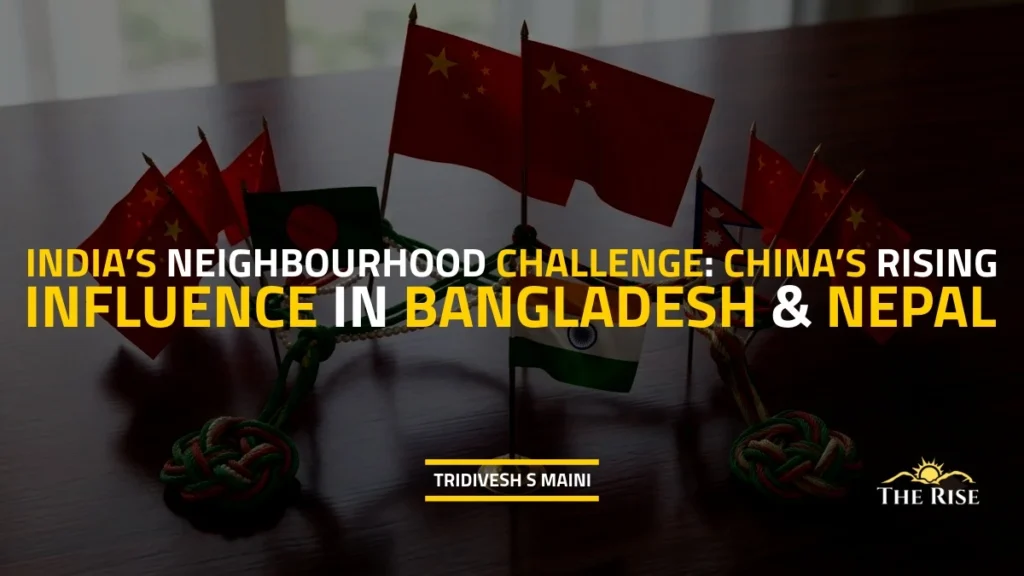
While India should be watchful of China’s role in the neighbourhood, it also needs to understand that other countries will prioritise their interests. Neighbours like Nepal and Bangladesh should focus on their economic interests rather than getting embroiled in zero-sum geopolitics. India and neighbouring countries in South Asia should work towards strengthening economic cooperation and finding common ground to establish cooperation and collaboration.
In recent weeks, several important developments have taken place in the context of India’s ties with neighbouring countries. Chinese President Xi Jinping, who is likely to visit India in connection with the BRICS+ summit (September 12-13, 2026) to be held in New Delhi, has understandably drawn immense attention. This will be the Chinese President’s first visit to India after a period of 7 years (the Chinese President’s last visit to India was in 2019).
President Xi’s delegation is expected to consist of 400 officials. In the last two years, some progress has been made in the bilateral relationship, with the major steps including the relaxation of Foreign Direct Investment (FDI) rules by the Government of India for Chinese investments in India, and the resumption of direct flights between both countries in October 2025. Differences do persist, however, on the border issues as well as India’s trade deficit vis-à-vis China, though there has been substantial engagement on both issues in the run-up to the BRICS summit.
On August 25, National Security Adviser Ajit Doval and Chinese foreign minister Wang Yi held the 25th round of Special Representatives’ talks on the India-China boundary question in Beijing. During his two-day China visit – August 24 and August 25 – Doval also met with Chinese Vice President Han Zheng (Doval visited China at the invitation of Wang Yi).
Important developments in the context of the immediate neighbourhood
In the immediate neighbourhood, several important developments have taken place. The Mecca defense agreement – signed by Pakistan, Saudi Arabia and Turkey – has understandably drawn attention. According to this agreement, an armed attack against any of the three countries will be considered as an attack against all three. On August 27, Pakistan and Kuwait signed a defence cooperation protocol, formally referred to as the “Protocol Agreement-2026.” This agreement will include: joint military training, education, intelligence sharing, and logistics. Pakistan will train Kuwait’s troops and assist in border management.
Further, Bangladesh has been giving mixed signals vis-à-vis India in the past few months. There have been several meetings between senior officials of both countries ever since the Bangladesh Nationalist Party (BNP) dispensation led by Tarique Rahman came to power. The extradition of former Bangladesh PM Sheikh Hasina – who has been living in exile in Delhi since 2024 is proving to impede any major progress in the bilateral relationship. Bangladesh PM Tarique Rahman cancelled his India visit in August 2026 (Bangladesh reacted strongly to a virtual address delivered by Hasina on August 5 – India had distanced itself from Hasina’s virtual interaction organised by the Foreign Correspondents’ Club (FCC) of South Asia, New Delhi). Rahman is also unlikely to visit India for the BRICS Summit, despite India issuing an invitation to the Bangladesh PM (Bangladesh is also the current Chair of BIMSTEC (Bay of Bengal Initiative for Multi-Sectoral Technical and Economic Cooperation)).
Bangladesh-China ties
India, on its part, is watching Bangladesh’s foreign policy moves, specifically its decisive pivot towards China. A strong reiteration of this is Bangladesh’s MoU with China for developing an SEZ at the strategically important Mongla Port (earlier Bangladesh had signed an agreement with India for developing the same), and the South Asian nation pushing for expediting the Teesta River project – which is close to the strategically important Chicken’s Neck of India. Recently, Bangladesh has also expressed its interest in joining the Mecca Defence Agreement.
India-Nepal-China triangle
While the drift between India and Nepal seems to have been growing, the new dispensation led by Nepal PM Balendra Shah seems to be adopting a pragmatic stance. The Nepal PM met with the Indian and Chinese envoys in Kathmandu on August 10. During his meeting with the Indian envoy, Naveen Srivastava, the Nepal PM discussed ways to give a fillip to the bilateral relationship and strengthen the development partnership.
In the aftermath of the recent floods, PM Modi spoke to Nepal’s PM and expressed solidarity. India was also prompt in providing humanitarian aid to the South Asian nation. During a Nepal-India dialogue organised by NDTV, when asked about ties with India and China, the Nepal Foreign Minister, Shishir Khanal, refused to take sides and stated, “… what I would like to say is as two important neighbours, we have a wonderful relationship that we would like to maintain with both India and China. But we do not want to supplement one with the other,” emphasizing that each relationship is unique and his primary focus is furthering Nepal’s interests. The Nepal Foreign Minister also said two-thirds of Nepal’s trade was with India and the South Asian nation had received no investment in BRI projects.
Senior Congress leader and Member of Parliament, Shashi Tharoor, while commenting on India’s ties with Nepal, highlighted the strong people-to-people linkages, while also stating that India should not be too concerned about Nepal’s growing ties with China. He said, “We are in a good place today. I am much less worried about the relationship than I was a few years ago. Today the body language on both sides is positive, and the latest evidence is India’s immediate relief on Wednesday after the floods.”
In conclusion, while the focus of most commentators and analysts is on the events in West Asia, the upcoming BRICS Summit and India-China relations, several important developments in the neighbourhood have taken place in recent months and weeks. These reiterate the complex nature of the bilateral relationships between India and its immediate neighbours in South Asia and the important role of external players – especially China. While India should be watchful of China’s role in the neighbourhood, it also needs to understand that other countries will prioritise their interests. Neighbours like Nepal and Bangladesh should focus on their economic interests rather than getting embroiled in zero-sum geopolitics. India and neighbouring countries in South Asia should work towards strengthening economic cooperation and finding common ground on common challenges posed by an uncertain geopolitical and economic landscape.
Disclaimer: The views expressed in this article are those of the author solely. TheRise.co.in neither endorses nor is responsible for them. Reproducing this content without permission is prohibited.