


Plants excrete through stomata, hydathodes, salt glands, root exudates, and dead tissues. These plants do not merely eliminate waste. They transform waste into ecology. Their discarded substances nourish soils, defend tissues, attract pollinators, shape climate, and sustain entire food webs. In many ways, plants are not just organisms. They are planetary recyclers.
At first glance, the question sounds almost absurd. Do plants excrete? Children laugh at it in classrooms. Adults pause awkwardly. Even many educated people assume that plants are somehow “cleaner” than animals- silent green beings that absorb sunlight, drink water, and magically produce oxygen without creating waste. But nature is never that simple. Every living organism must deal with the same fundamental problem: survival creates waste. Life itself is a chemical process, and chemistry always leaves leftovers. Whether it is a tiger in the forests of India, a whale in the ocean, a fungus inside a decaying log, or a neem tree standing beside a village road, every organism must somehow manage the unwanted by-products of living. Animals move around carrying organs dedicated to this purpose: kidneys, lungs, skin, liver, intestines.
Plants, however, live rooted to one place. They cannot walk away from their wastes. They cannot visit a toilet. They cannot cough, spit, or sweat in the way humans do. And yet they survive for centuries. Some trees live for thousands of years. How? The answer lies in one of the most fascinating and underrated stories in biology: plants possess extraordinarily sophisticated systems of excretion, detoxification, storage, recycling, and disposal. Their methods are subtle, elegant, and deeply intertwined with ecology itself. Understanding plant excretion means recognizing that plants are not passive decorations of Earth. They are master chemists, silent engineers, and patient strategists.
What Exactly Is Excretion?
Before exploring plants, we must first understand what excretion means. Excretion is the removal of metabolic waste products produced inside the body during normal life processes. These wastes may be toxic if allowed to accumulate. In animals, examples include carbon dioxide released from the lungs, urea excreted through urine, sweat from the skin, excess salts and water, and digestive wastes. Excretion is different from simple elimination of undigested food. It specifically refers to the disposal of substances produced during metabolism. Plants also perform metabolism continuously. They respire day and night. They synthesize proteins. They break down sugars. They manufacture defensive chemicals. They absorb minerals from soil. They fight infections. They repair damaged tissues. All these activities generate wastes. So yes, plants do excrete. But they do it in ways completely different from animals.
The Great Difference Between Animals and Plants
Animals evolved mobility. Plants evolved patience. A deer can run away from danger. A bird can migrate. A human can seek shade, water, or medicine. Plants cannot move from their location. Their evolutionary success therefore depended on internal efficiency rather than escape. This immobility shaped their excretory strategies. Animals often eliminate waste quickly because carrying toxins is dangerous during movement. Plants, however, developed multiple alternative solutions, recycling wastes, storing wastes safely, converting wastes into harmless compounds, locking wastes into dead tissues, releasing wastes slowly into the environment, and using some wastes as defensive weapons. In many cases, what appears to us as “plant waste” later becomes ecologically valuable. Nature wastes very little.
Plants Breathe Too — And Carbon Dioxide Is a Waste
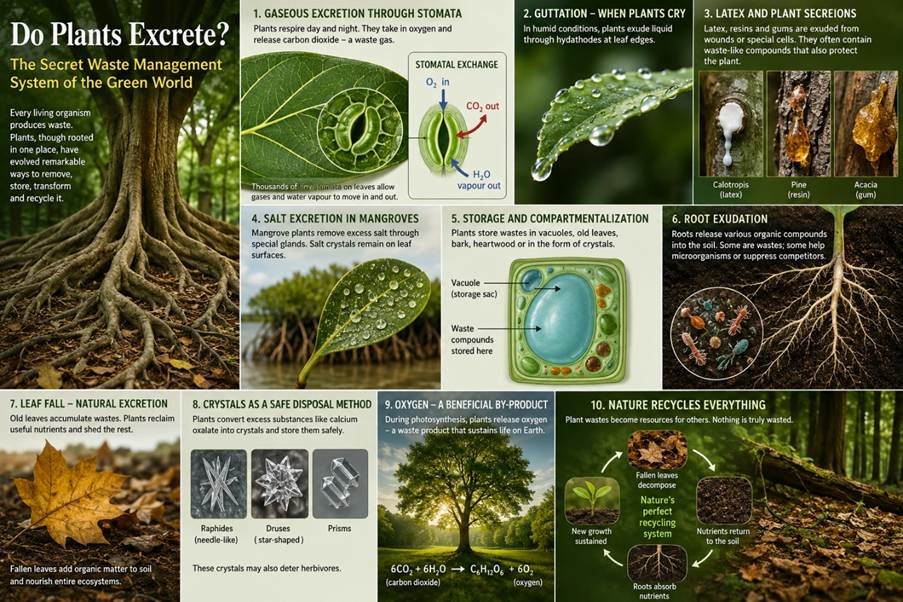
One of the simplest examples of plant excretion involves respiration. Many people mistakenly believe plants only absorb carbon dioxide and release oxygen. That is only partly true. During photosynthesis, plants absorb carbon dioxide and release oxygen. But during respiration, which occurs day and night, plants consume oxygen and release carbon dioxide, just like animals. Carbon dioxide produced during respiration is a metabolic waste product. How do plants remove it? Mostly through tiny openings called stomata present on leaves. These microscopic pores allow exchange of gases between the plant and atmosphere. Through stomata, oxygen enters, carbon dioxide exits, and water vapour escapes. These openings are like countless miniature mouths spread across the leaf surface. A single leaf may contain thousands of stomata. Thus, one major excretory pathway in plants is simply gaseous diffusion.
Sweating Without Sweat Glands
Humans sweat through glands. Plants “sweat” through transpiration. Transpiration is the loss of water vapour from plants, mainly through stomata. At first glance, it may not seem like excretion. Yet it serves important waste-removal and regulatory functions. Plants absorb huge quantities of water from soil. Only a small fraction is used in photosynthesis and metabolism. The excess must be removed. Imagine a massive banyan tree absorbing hundreds of litres of water. Without proper elimination, its tissues would burst under internal pressure. Transpiration helps plants remove excess water, maintain temperature, transport minerals, and balance internal chemistry. In tropical India, one large tree may release astonishing amounts of water vapour into the atmosphere daily, influencing local climate and humidity. Forests are therefore not merely collections of trees. They are giant biological fountains continuously cycling water between land and sky.
Guttation — When Plants Cry
Sometimes, especially in humid mornings, droplets appear at the edges of leaves. Many people think this is dew. But sometimes it is not. It is guttation. In guttation, plants exude liquid water through special structures called hydathodes. This usually occurs when soil moisture is high, and transpiration is low. The droplets may contain salts, sugars, minerals, and organic compounds. In other words, plants may remove dissolved substances through these droplets. Rice plants, grasses, and many herbaceous species commonly show guttation. In agricultural fields at dawn, one may witness thousands of tiny shining droplets on leaf tips, silent evidence that plants are managing their internal chemistry through controlled excretion.
The Problem of Toxic Chemicals
Plants manufacture enormous numbers of chemicals. Some are useful. Some become toxic if accumulated excessively. For instance, excess salts, heavy metals, oxalates, tannins, alkaloids, resins, latex, and phenolic compounds. Many of these compounds originated evolutionarily as waste products or metabolic by-products. Over time, however, plants turned several of them into defensive tools. This is one of the greatest stories in evolution, turning waste into weaponry.
Latex — More Than White Milk
Break a leaf of Calotropis or pluck a fig leaf, and a white sticky fluid emerges. This is latex. Latex contains complex mixtures of chemicals including alkaloids, resins, proteins, and toxic compounds. Originally, many such substances may have represented unwanted metabolic products. But plants evolved to use them defensively. Latex can deter herbivores, trap insects, prevent infection, and seal wounds. The rubber tree produces latex in abundance. So do euphorbias and many tropical plants. To grazing animals, latex often tastes bitter or poisonous. Thus, what begins as metabolic waste may become biological armour.
Neem, Tobacco, and Chemical Warfare
Plants are chemical factories engaged in constant warfare. Neem produces azadirachtin. Tobacco synthesizes nicotine. Chilli produces capsaicin. Tea and coffee contain caffeine. Many such compounds function as deterrents against insects, fungi, bacteria, or herbivores. Interestingly, several are technically secondary metabolites, chemicals not directly required for basic survival but important ecologically. These substances may accumulate in leaves, bark, seeds, or fruits. In some cases, plants isolate potentially harmful compounds into special cells or tissues to avoid poisoning themselves. Humans later discovered medicinal, narcotic, stimulant, or industrial uses for many of these “waste-like” chemicals. A plant’s excretion became humanity’s pharmacy.
Also Read: Can Biodiversity Net Gain Transform India’s Development Model?
Storage: The Plant Strategy of “Locking Away”
Animals often excrete quickly. Plants frequently store. One elegant solution to toxic buildup is compartmentalization, locking harmful substances into safe locations. Plants may store wastes in vacuoles, bark, old leaves, fruits, heartwood, and dead tissues. This strategy is remarkably efficient. Instead of expending energy to remove every substance immediately, plants isolate many wastes where they cannot interfere with metabolism. When leaves fall, the wastes leave with them. Autumn therefore is not merely seasonal beauty. It is also sanitation.

Why Leaves Fall
Leaf fall is partly an excretory phenomenon. As leaves age, plants transport useful nutrients away from them before shedding. But certain wastes remain trapped inside the dying leaf. The fallen leaf may contain calcium oxalate crystals, tannins, excess minerals, and metabolic residues. By discarding old leaves, plants eliminate accumulated unwanted substances. This process becomes ecologically significant. The forest floor receives these discarded materials, where fungi, bacteria, termites, and invertebrates decompose them into nutrients once again. Thus, plant excretion feeds ecosystems. The “waste” of one organism becomes food for another.
Bark as a Dustbin
Tree bark often acts like a biological dumping ground. As trees age, wastes may accumulate in outer bark tissues that later crack, peel, or fall away. Observe eucalyptus, guava, or plane trees shedding bark. This is not merely cosmetic. The outer bark often contains dead cells, resins, toxins, and excess minerals. By isolating wastes in expendable tissues, trees protect their living inner layers. Nature repeatedly demonstrates a profound principle: survival is not only about acquiring resources but also about safely handling waste.
Crystals Inside Plants
Many plants produce crystals of calcium oxalate. These crystals appear in fascinating forms: needles, stars, prisms, and bundles. Why? One reason is excretion. Excess calcium can be harmful. Plants therefore convert it into insoluble crystals and store it safely. These crystals may also deter herbivores because they irritate tissues when eaten. Some plants, like Dieffenbachia, can cause severe burning sensations due to needle-like crystals called raphides. Again, waste becomes defense.
Salt Excretion in Coastal Plants
Mangroves and salt-tolerant plants face a special challenge. They grow in saline environments where salt concentrations can become toxic. How do they survive? Some species possess specialized salt glands that actively excrete excess salt onto leaf surfaces. If you touch certain mangrove leaves, you may feel salt crystals. This is genuine excretion. Mangroves are extraordinary examples of physiological adaptation. Living between land and sea, they constantly battle dehydration and salt toxicity. Their survival mechanisms protect coastlines, nurture fisheries, store carbon, and buffer storms. Yet many people pass them without realizing that these silent forests are among the most advanced biological systems on Earth.
Resins, Gums, and Plant Tears
Many trees exude sticky substances such as resin, gum, and mucilage. Examples include pine resin, gum arabic, and acacia exudates. These substances may originate from metabolic processes associated with injury response, storage, or excretion. Resins can seal wounds, prevent microbial infection, trap insects, and reduce water loss. Ancient humans discovered uses for them in medicine, incense, varnish, perfumes, and adhesives. Interestingly, amber fossilized tree resin preserved prehistoric insects for millions of years, giving scientists remarkable windows into ancient ecosystems. Even plant excretion can become a time capsule.
Oxygen — A Waste That Changed Earth
Perhaps the greatest excretory event in planetary history was produced by plants. Billions of years ago, early photosynthetic organisms began releasing oxygen as a by-product of photosynthesis. At that time, oxygen was actually toxic to many ancient anaerobic organisms. But this “waste gas” transformed Earth forever. It changed atmospheric chemistry. It enabled ozone formation. It paved the way for complex life. It allowed the evolution of animals, forests, birds, mammals, and eventually humans. Every breath we take today is linked to this ancient biological revolution. What was once waste became the foundation of civilization.
Plants and Heavy Metal Pollution
Modern industrial pollution created new challenges. Some plants absorb toxic metals such as lead, cadmium, mercury, and arsenic. Certain species can tolerate astonishing concentrations by storing these substances in tissues or vacuoles. These plants are called hyperaccumulators. Scientists now use them in phytoremediation to clean polluted soils through plants. In a remarkable twist, plants help detoxify environments polluted largely by humans. The green world quietly repairs the mistakes of the industrial world.
Carnivorous Plants and Waste
Carnivorous plants like pitcher plants and sundews digest insects for nutrients, especially nitrogen. After digestion, indigestible remnants remain. Even these plants must manage wastes. Some residues accumulate within traps until the structures die and are replaced. Again, the principle remains universal: life always produces leftovers.
The Forest Has No Garbage Bin
Human civilization produces mountains of non-biodegradable waste. Plastic islands float in oceans. Landfills expand endlessly. Rivers choke with industrial discharge. Forests operate differently. In natural ecosystems, almost everything is recycled. Dead leaves become humus. Animal droppings nourish soil. Fallen wood feeds fungi. Plant wastes become nutrients. Ecological systems function through circular economies. Human economies often function linearly: extract, consume, discard. Perhaps this is why ecological crises intensify globally. Nature teaches recycling. Humanity often practices accumulation.
Are Flowers Also Excretion?
In a poetic sense, yes. Flowers are metabolically expensive structures filled with pigments, fragrances, sugars, and volatile chemicals. Some botanists note that floral scents involve the release of organic compounds into the atmosphere. These compounds attract pollinators. What begins as biochemical production becomes ecological communication. A jasmine flower perfuming the night is participating in a complex exchange involving chemistry, evolution, insects, and reproduction. Plants constantly release substances into the environment. Some are wastes. Some are signals. Some are weapons. Some are invitations.
Underground Excretion — The Secret Life of Roots
Roots release numerous compounds into soil. These include sugars, organic acids, amino acids, enzymes, and secondary metabolites. This process is called root exudation. Why do plants do this? Sometimes it helps absorb nutrients. Sometimes it alters soil microbes. Sometimes it suppresses competing plants. Sometimes it represents disposal of excess metabolites. The region around roots, the rhizosphere, is among the most biologically active zones on Earth. Billions of microorganisms interact there continuously. A tree is therefore not merely an isolated organism. It is a biochemical civilization connected to fungi, bacteria, insects, and soil processes.
The Human Bias Against Plants
Humans often underestimate plants because they move slowly. We associate intelligence and complexity with visible action. Animals roar, run, hunt, migrate, and display emotions. Plants stand quietly. But silence is not simplicity. Inside a tree, water columns rise against gravity, sugars travel long distances, hormones coordinate growth, chemical defenses activate, wastes are neutralized, signals travel between tissues, and environmental conditions are constantly monitored. Plants solve life’s problems differently from animals. Not inferior. Different.
Ancient Indian Observations
Indian traditions often treated plants as living, responsive beings. Sacred groves, tree worship, herbal medicine traditions, and agricultural practices reflected deep ecological observation. Ancient healers understood that plants contained potent substances, some medicinal, some toxic. Ayurveda recognized plant secretions, resins, gums, oils, and latex long before modern biochemical explanations emerged. Even today, rural communities identify plants by smell, sap, bitterness, or exudates. Traditional knowledge frequently observed biological truths centuries before laboratory science explained them.
Lessons from Plant Excretion
The story of plant excretion offers profound lessons.
- Waste Is Inevitable: No system can function without producing by-products. The question is not whether waste exists. The question is how intelligently it is managed.
- Recycling Is Superior to Disposal: Forests recycle continuously. Human systems often merely relocate waste.
- Toxicity Depends on Context: A harmful substance in one context may become useful in another. Nicotine deters insects. Latex seals wounds. Oxygen transformed Earth.
- Patience Can Be Powerful: Plants survive not through speed but through efficiency, adaptation, and resilience.
So, Do Plants Excrete?
Absolutely. They excrete through stomata, hydathodes, salt glands, root exudates, bark shedding, leaf fall, resins and gums, storage in vacuoles, and dead tissues. But plants do more than merely eliminate waste. They transform waste into ecology. Their discarded substances nourish soils, defend tissues, attract pollinators, shape climate, and sustain entire food webs. In many ways, plants are not just organisms. They are planetary recyclers.
Final Thoughts: The Green Alchemy of Survival
The next time you walk beneath a tree, pause for a moment. That tree is breathing. Sweating. Managing salts. Neutralizing toxins. Transporting water. Communicating chemically with soil microbes. Recycling nutrients. Discarding wastes with astonishing precision. And it is doing all this silently. Human civilization often celebrates speed, noise, and visible power. Plants represent another form of greatness: slow intelligence. They survive cyclones, droughts, floods, insects, pollution, and centuries of environmental change without moving an inch. Perhaps the most extraordinary thing about plants is not that they excrete. It is that they turned excretion into art. The forest floor, rich with fallen leaves, is not a symbol of decay. It is the signature of nature’s perfect recycling system. Nothing truly ends there. Everything becomes something else.
Disclaimer: The views expressed in this article are those of the author solely. TheRise.co.in neither endorses nor is responsible for them. Reproducing this content without permission is prohibited.