


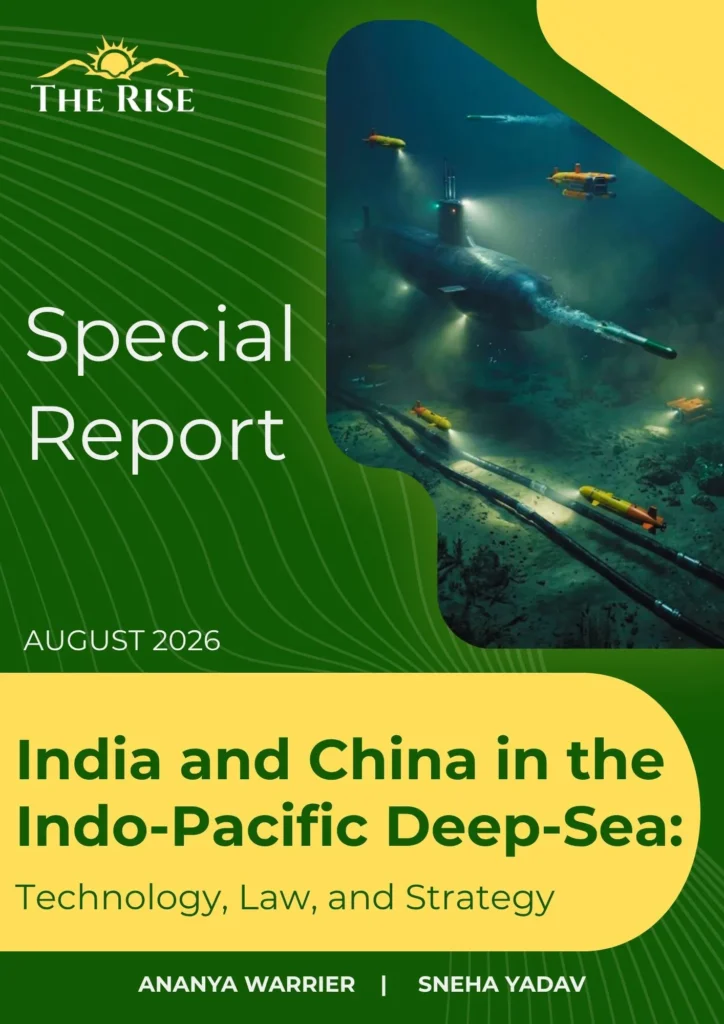
The strategic importance of the Indo-Pacific is no longer confined to its surface waters. It is also being shaped by what lies beneath it. The seabed is no longer merely the ocean floor; it is fast becoming a strategic battlespace where science, law, and security converge. Submarine navigation, underwater domain awareness, seabed mapping, and the protection of undersea cables have all made the seabed an important part of contemporary Indo-Pacific competition. Within this context, India and China have emerged as the two most consequential Asian powers shaping the future of the Indo-Pacific seabed.
On the one hand, China has expanded its capabilities through deep-sea submersibles such as Fendouzhe, an extensive fleet of research and survey vessels, multiple International Seabed Authority (ISA) exploration contracts across different oceanic zones, and a model of military-civil fusion that often blurs the line between scientific research and strategic intent. India, on the other hand, has also started to expand its deep-sea initiatives through the Deep Ocean Mission launched in 2021, and the development of its first manned deep-sea submersible, Matsya 6000, which is expected to be deployed by 2027.
At the same time, both countries are engaging with the seabed through the framework of the international maritime legal order, anchored by the United Nations Convention on the Law of the Sea (UNCLOS), which lays down a comprehensive regime governing the world’s oceans by establishing rules on States; rights and jurisdiction in maritime spaces, ensuring peaceful use of the oceans, and the sustainable management of marine resources.
While China has come up with a series of laws consistent with the provisions of the UNCLOS, its broader maritime strategy seems to focus more on establishing an ‘influence-based’ order, where strategic presence and economic dependence reinforce its regional position. India, on the other hand, has consistently sought to promote a “rules-based maritime order” and has been championing the idea of the Free and Open Indo-Pacific.
The existing literature on the Indo-Pacific tends to be fragmented, often treating technology, maritime security, and international law regarding the Indo-Pacific seabed as separate domains.
Thus, this report aims to address these gaps by analysing the intersection of technological capabilities, legal ambiguities, and the strategic competition between India and China, thereby filling the information deficit in an area that remains crucial to future maritime strategies.
Get a hard copy delivered at your doorstep:
Terms & Conditions:
- Order cancellation procedure: Mail at support@therise.co.in requesting order cancellation with a valid reason within the first 24 hours of order placement. The payment receipt must be mandatorily attached, without which no order cancellation request will be entertained.
- Returns/Replacement: No return/replacement is possible
- Refunds: The complete amount is refundable if the order cancellation request is received at support@therise.co.in within the first 24 hours of the order placement. Refund will be issued in 5-7 working days.