


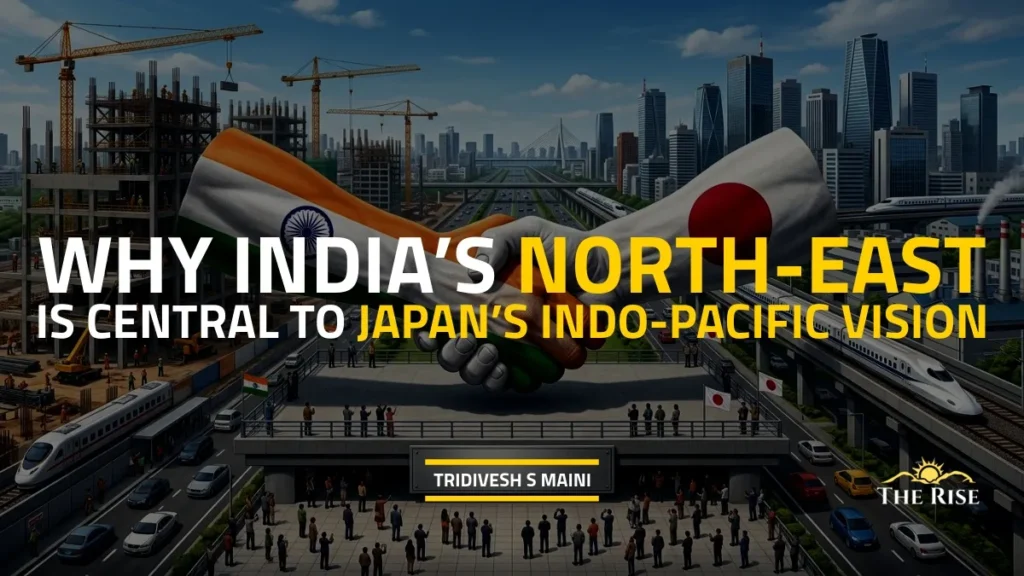
In a changing geopolitical and economic situation, India-Japan ties are likely to witness an upswing – especially under the umbrella of the FOIP. The role of India’s North-East in ties with Japan is likely to grow significantly due to various underlying economic and strategic factors.
Japan PM Sanae Takaichi visited India (July 1-3). During her visit, the first since assuming office as Prime Minister of Japan, she participated in the 16th India-Japan Annual Summit. Prime Minister Narendra Modi and the Japanese Prime Minister held talks on a gamut of issues during the Summit.
The Japanese PM, during a media interaction, highlighted the importance of her India visit in a changing global environment. She said that her visit would help in: “deepening the Japan-India strategic partnership in light of the current international situation; promoting cooperation in economic security; and strengthening collaboration between businesses of the two countries in investment and innovation”.
One of the focus areas during the Japanese PM’s visit was the Free and Open Indo-Pacific (FOIP). While welcoming Sanae Takaichi to India, PM Modi in a post on social media said that India and Japan “…will continue to advance peace, stability and prosperity in the Indo-Pacific and beyond”.
A joint statement titled “Advancing a Partnership of Strategic Convergence and Trust for Shared Growth, Prosperity and Resilience” was adopted by both sides. Agreements were signed for strengthening bilateral ties in defence, artificial intelligence (AI), and economic security – with a focus on diversifying supply chains, energy, and enhancing people-to-people linkages. The two leaders also signed an MOC (Memorandum of Cooperation) for strengthening bilateral linkages and cooperation at the global level.
The Bay of Bengal-North-East India Industrial Value Chain
The Industrial Value Chain, referred to as the Bay of Bengal–Northeast India Corridor Initiative, was first proposed by former Japanese PM Fumio Kishida as part of Japan’s Free and Open Indo-Pacific strategy during his India visit in March 2023. The initiative also found mention in the joint statement issued after the 16th India-Japan Annual Summit, which reaffirmed both sides’ “commitment” to developing industrial value chains across North-Eastern India and the Bay of Bengal in “collaboration” with other stakeholders, including regional organisations like BIMSTEC.
The important components of this vision include: development of strategic projects – especially the Matarbari Sea Port in Bangladesh, infrastructure development and upgradation in North-Eastern India, to strengthen connectivity with Bangladesh and greater Japanese involvement in India’s North-East, by way of creation of manufacturing hubs.
Growing role of India’s North-East in ties with Japan
In recent years, there has been a growing realisation in both India and Japan that India’s North-East plays an important role in ties with Japan. In this context, both countries launched the India-Japan Act East Forum in September 2017, with a focus on the development of the region. Stronger ties between India’s North-East and Japan also dovetail with the latter’s idea of a ‘Free and Open Indo-Pacific’, India’s Act East Policy and its MAHASAGAR (Mutual and Holistic Advancement for Security and Growth Across Regions) vision.
While for India, the North-Eastern region is an important gateway to South-East Asia, for Japan, the region is strategically important.
While speaking at the Sixth India Japan Intellectual Conclave – KIZUNA held at Shillong, Japan’s State Minister for Foreign Affairs Horii Iwao said: “As part of Japan’s FOIP initiative, we will work towards realising the concept of an industrial value chain connecting the Bay of Bengal and Northeast India.”
Japan International Cooperation Agency (JICA) – the Japanese government’s official lending arm – along with the Government of India, has been funding infrastructural projects in several parts of India. JICA’s participation in important projects in North-East India has increased in recent years. It has funded important projects in Assam and Meghalaya, which have played an important role in the economic growth of the North-Eastern region and have sought to strengthen connectivity.
One of the important projects is the “North East Road Network Connectivity Improvement Project,” which aims to enhance connectivity across the North-Eastern region – especially Assam, Meghalaya and Tripura. Some of the important Infrastructural projects in which JICA is involved are the Dhubri-Phulbari bridge connecting Assam and Meghalaya (once built, the bridge will connect Bhutan and Bangladesh) and the Shillong-Dawki road, which will connect Meghalaya and the rest of the North-East to Bangladesh.
In an opinion piece for the Times of India, the Japanese PM highlighted the importance of the “Industrial Value Chain” concept and underscored the point that it seeks to enhance connectivity from Assam to various parts of North-Eastern India and Bangladesh, ultimately facilitating access to the Indian Ocean. She also said that important infrastructural projects “will extend industrial value chains not only within North-East but also across India and onward to ASEAN and beyond”.
Growing economic linkages between Japan and the North-East
Japanese investments in Assam have also increased. One of the important areas is semiconductors. Tokyo Electron and Tata Electronics have signed an agreement under which they will collaborate on semiconductor equipment infrastructure for India’s first semiconductor fab and the assembly and testing facility at Jagiroad.
Educational linkages between Japan and the North-East are also increasing, with institutions like IIT Guwahati strengthening research collaborations and student exchange programmes. North-Eastern states of Assam and Meghalaya are also providing skills and Japanese language training to youth to improve the employment prospects of these students in Japan.
The India-Japan Annual Summit was to be held in Guwahati, but later the venue was shifted to Delhi. Meanwhile, the Chief Ministers of North-Eastern states – Meghalaya, Assam, Nagaland, and Arunachal Pradesh visited Japan.
The Joint Statement issued after the Summit also highlighted the “strategic importance” of the North-Eastern region in the context of the Act East Policy and FOIP and highlighted the multi-layered linkages between Japan and the North-East.
Regional dynamics
A few points need to be borne in mind.
First, India’s ties with Bangladesh have witnessed some deterioration in recent years. The Bangladesh National Party (BNP) dispensation has sent mixed signals. During Bangladesh Prime Minister Tarique Rahman’s first state visit to China, an MoU was signed with China Civil Engineering Construction Corporation for the development of the China-Bangladesh Mongla Port Economic Zone adjoining Mongla Port. This project was awarded to India in 2015.
Second, the India-Myanmar-Thailand trilateral highway, which is important for India’s connectivity with South-East Asia, has remained stalled due to the situation in Myanmar.
In a changing geopolitical and economic situation, India-Japan ties are likely to witness an upswing – especially under the umbrella of the FOIP. The role of India’s North-East in ties with Japan is likely to grow significantly due to economic and strategic factors as mentioned earlier. While the Industrial Value Chain project is important, its implementation faces significant challenges, particularly the regional constraints discussed above.
Disclaimer: The views expressed in this article are those of the author solely. TheRise.co.in neither endorses nor is responsible for them. Reproducing this content without permission is prohibited.