


While the US views trade in local currencies from a zero-sum perspective, with US President Donald Trump having issued repeated warnings to BRICS+ member states that the US would impose massive tariffs on countries seeking to undermine the US Dollar. It is not just BRICS members, but several other countries that have good ties with the US, which are exploring trade in local currencies.
During Indian PM Narendra Modi’s visit to Indonesia (July 6-8, 2026), several important agreements were signed to give a fillip to the economic and strategic relationship, which many argue has not been able to meet its potential despite historical linkages and increasing convergences in a changing world order.
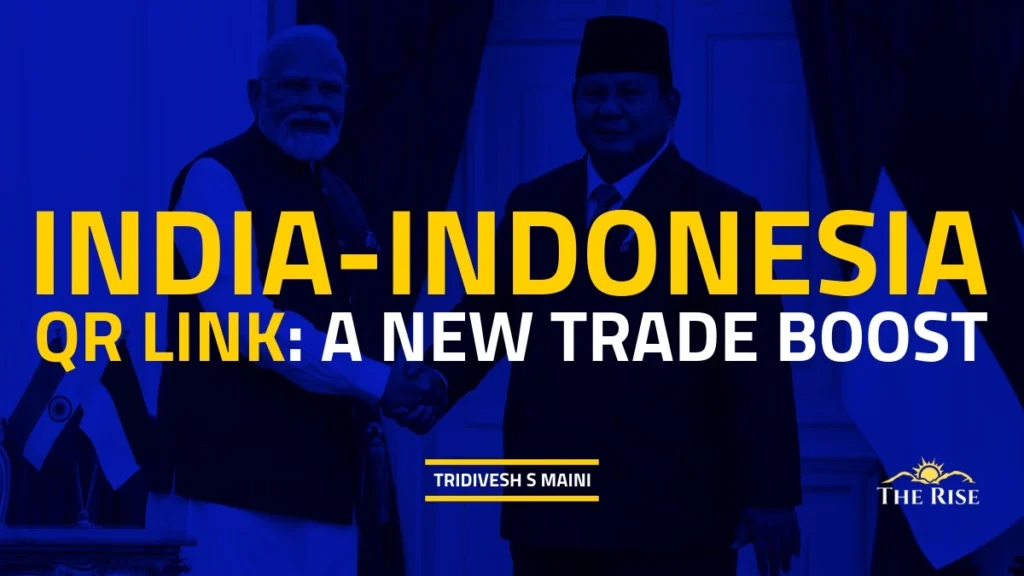
On the sidelines of the meeting between PM Modi and Indonesian President Prabowo Subianto, it was stated that the QR systems of both countries would be linked by the end of 2026. Indonesia’s QR system is the Quick Response Code International Standard (QRIS), while India’s QR system is the Unified Payments Interface (UPI).
UPI is currently operational in 10 countries – Singapore, United Arab Emirates (UAE), Bhutan, Nepal, Sri Lanka, Qatar, Cambodia, France, Greece, and Mauritius.
Also Read: Iran, BRICS and the Push for De-Dollarization
Indonesian President Prabowo Subianto, while commenting on the linking of the QR systems of both countries, said, “This partnership is expected to boost transaction efficiency, while making our financial sector more resilient.”
PM Modi, on his part, said that the linking of QR systems of both countries would: “improve ease of doing business and make traveling more convenient.”
Linking of QR codes and people-to-people linkages
The QR linking will help businesses and travellers. In 2024-2025, bilateral trade between India and Indonesia was estimated at $28.15 billion. The total number of Indian tourists who visited Indonesia in 2025 was 734,490. Indonesia has set a target of over 8,00,000 (8,20,000) tourists in 2026.
Tourism Minister Widiyanti Putri Wardhana highlighted the close linkages between both countries and said that Prambanan Temple, located in Yogyakarta, which PM Modi visited along with the Indonesian President during his trip, could be an important link between the two countries.
During his visit to the temple, PM Modi said, “People of Indonesia took care of this sacred temple. I thank the people of Indonesia. President Prabowo has asked me to come back in 2029 to inaugurate this temple.”
India-Indonesia trade in local currencies: Steps taken so far
It would be pertinent to point out that in March 2024, the Reserve Bank of India (RBI) and Bank Indonesia signed a Memorandum of Understanding (MoU) for setting up a Local Currency Settlement (LCS) framework (also referred to as Local Currency Transaction, LCT), which allows bilateral trade to be invoiced and settled directly in Indian Rupees and Indonesian Rupiah.
India and Indonesia – both members of G20 and BRICS – have been seeking to reduce their dependence upon the US Dollar and pushing for trade in local currencies.
India has signed agreements for trade in local currencies with around 20 countries. In recent years, trade between Russia and India has risen significantly in local currencies (it is estimated at 90%). Apart from this, India’s trade with the UAE in local currencies has also significantly risen in recent years after they signed an agreement for promoting trade in local currencies. Approximately 15% of bilateral trade between the two countries has risen after both countries signed an agreement.
During Japanese Prime Minister Sanae Takaichi’s India visit, the issue of trade in local currencies between the two countries was also discussed.
Indonesia has an LCT arrangement with China, under which trade between both countries is conducted in Indonesia Rupiah and Chinese Renminbi. While the trade settled under the arrangement reached $18 billion in 2025, it has already touched $13 billion in the first few months of 2026.
In June 2026, Bank Indonesia Governor Perry Warjiyo highlighted the point that settling trade in local currencies reduced the dependence on the US Dollar. ASEAN member states have also been promoting trade in local currencies with two ASEAN neighbours – Malaysia and Thailand and other countries.
Conclusion
While the US views trade in local currencies from a zero-sum perspective, with US President Donald Trump having issued repeated warnings to BRICS+ member states that the US would impose massive tariffs on countries seeking to undermine the US Dollar. It is not just BRICS members, but several other countries that have good ties with the US, which are exploring trade in local currencies.
At the same time, countries including those in BRICS understand that the prediction of the decline of the US Dollar is premature. Several of the BRICS+ nations have distanced themselves from the BRICS common currency.
Trade in local currencies could also give a further boost to economic linkages between India and Indonesia. The linking of QR codes will also strengthen people-to-people ties and tourism linkages between the two countries.
Disclaimer: The views expressed in this article are those of the author solely. TheRise.co.in neither endorses nor is responsible for them. Reproducing this content without permission is prohibited.