


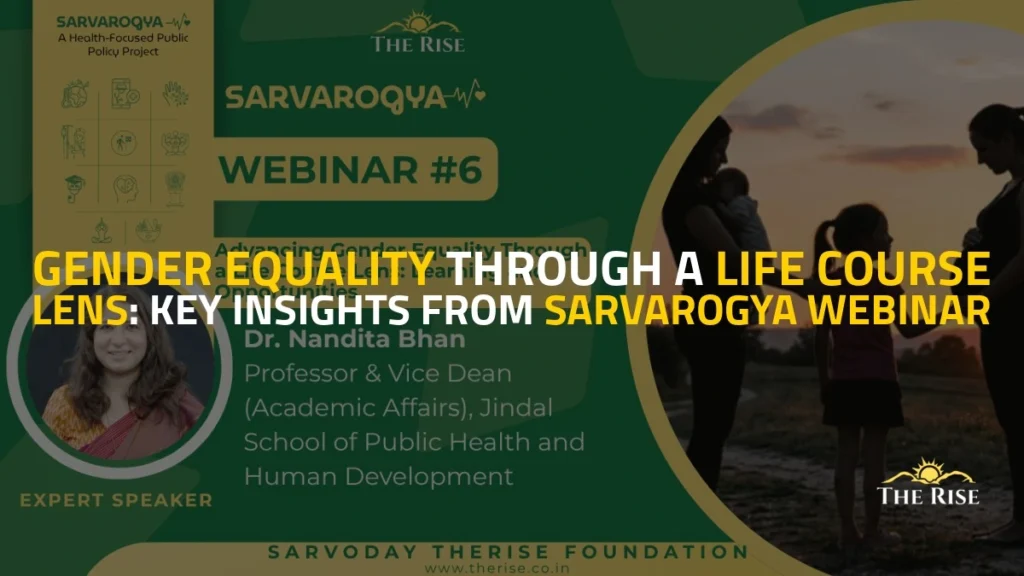
The webinar titled “Advancing Gender Equality Through a Life Course Lens: Learnings and Opportunities” was organized by Sarvoday TheRise Foundation, a public-policy think tank based in Lucknow, under its initiative SarvArogya, which is a public-health-focused research initiative.
Gender Inequality has been a lived reality for millions of women. It is this inequality that determines who gets enough food. Who goes to school? Who can speak about their health? Who can seek medical care? And at times, who survives? That is why gender inequality does not just remain a social issue. It has become a public health issue.
This was the core argument at the webinar titled “Advancing Gender Equality Through a Life Course Lens: Learnings and Opportunities” organized by Sarvoday TheRise Foundation, a public-policy think tank based in Lucknow under its initiative SarvArogya, which is a public-health-focused research initiative. Prof. (Dr.) Nandita Bhan, Professor and Vice Dean at Jindal School of Public Health and Human Development, graced the webinar as an expert speaker. The webinar was attended by the Project Director, Sneha Yadav, and the foundation’s interns.
The webinar began with a key emphasis on how health is affected by gender inequality. Dr. Bhan started her talk by explaining basic concepts like the difference between sex and gender, power, patriarchy, and gender norms. “Equality between men and women in a total sense may not be possible. We are not competing with each other. What we are competing for is equality in terms of opportunities men and women have,” said Dr. Bhan. While presenting, she also pointed to the fact that while women are the backbone of the health system, with most of the community workers being women but tragedy is that “we don’t give them decent salaries and we don’t have dignified conditions of work for these women,” emphasizing that we need investment in supporting women in health services.
Dr. Bhan further pointed to various concerns persisting in society that impact women across their life course. Highlighting the changing reality of women’s lives and emerging issues, Dr. Bhan also pointed to the issue of child and early marriage and its impact on the life course journey of a woman. “Child marriage is associated with loss of schooling, and that sets the trajectory for the future, which means that this young girl is left with no way to reclaim any economic rights in the future. These married girls get isolated as they lose their friends and family networks. Also, there is pressure for early-pregnancy”, she said, pointing to the data that 6 percent of the girls in the age group 15-19 years are already pregnant or mothers, which in turn has major physical and mental health consequences. Further, Dr. Bhan emphasized that according to NFHS (National Family Health Service), the rate of child marriage in India is now 20 percent, which is quite remarkable given the fact that the rate ten years ago was around 40 percent. However, she also added, “work still needs to be done.”
Continuing the discussion on reproductive health, Dr. Bhan further highlighted the issue of fertility pressure, pointing to the pressure that women face to achieve fertility early in marriage, why pronatalism continues to be a dominant social norm, and the concurrent trend of infertility. She also emphasized the need for reproductive agency. “Bodily integrity is fundamental. If you can’t control your body, what can you control?” she said.
Building on the need for reproductive agency, Dr. Bhan also drew attention to whether “our health systems are really responsive and respectful to women, and how this traumatic experience at a healthcare facility affects their health outcomes,” pointing to the issue of obstetric violence, which is the physical or verbal abuse faced by women during delivery and antenatal care within the health system.
The webinar concluded with a question-and-answer session where the interns had the opportunity to ask their questions. This included detailed discussions on issues like postpartum depression, further underscoring the need to view women’s health beyond isolated stages of life.
Reiterating the central message of the webinar, Dr. Bhan emphasized that addressing these challenges requires moving beyond focusing on a particular phase of a woman’s life and instead adopting a life course approach.
(Edited by TheRise Team)