


Donations are not merely about money; they are a bond of faith, responsibility, and trust between contributors and institutions. Protecting this bond requires transparency, integrity, and a commitment to ethical management.
The Needonomics School of Thought (NST) emphasizes that resources received through public trust carry a moral responsibility that extends beyond legal obligations. Donations made for religious, social, and public causes are not merely financial contributions; they represent the faith, emotions, sacrifices, and expectations of people. Therefore, safeguarding such offerings is essential for preserving the dignity of both the purpose for which they are given and the institutions entrusted with their management.
From the Needonomics perspective, ethical conduct, responsible resource utilization, and accountability are the foundations of good governance. Any concern regarding the misuse of donations, if established through due legal process, must be addressed with seriousness because it has the potential to weaken public confidence and affect the credibility of institutions managing sacred and social resources.
NST believes that donations are not merely about money; they are a bond of faith, responsibility, and trust between contributors and institutions. Protecting this bond requires transparency, integrity, and a commitment to ethical management.
1. Misuse of Donations: A Legal Concern and Moral Responsibility
Misuse of donations is not only a legal concern but also a moral issue reflecting the importance of honesty, integrity, and social responsibility. When individuals contribute their hard-earned money towards a religious or public cause, they do so with the expectation that their contribution will be utilised sincerely and transparently for the intended purpose.
Any allegation of diversion or mismanagement of such funds raises important questions about institutional responsibility, ethical behaviour, and accountability. The sensitivity becomes greater when donations are connected with religious sentiments because they carry both economic value and spiritual significance.
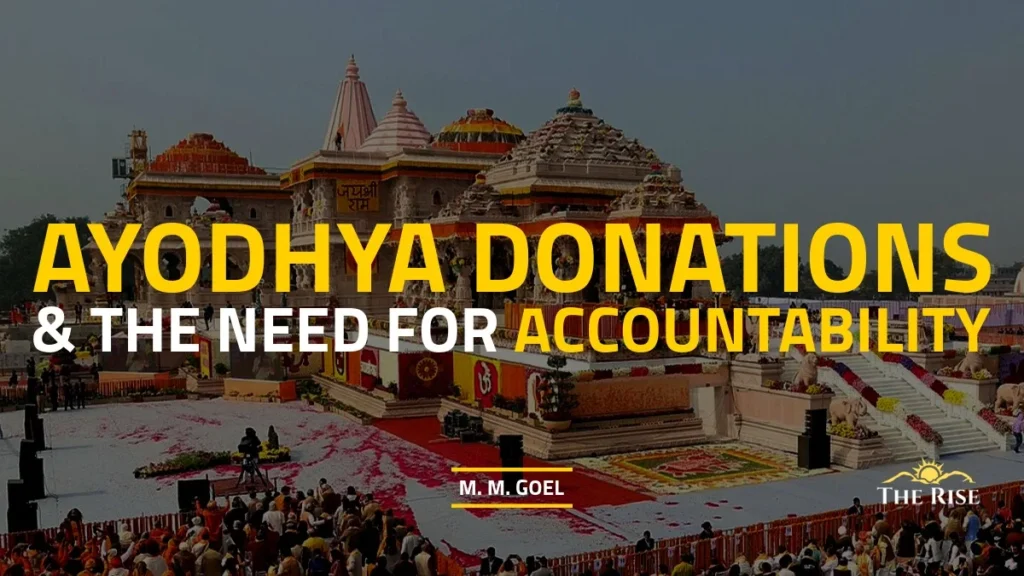
Concerns regarding donations associated with the construction of the Ram Mandir highlight the need for every institution handling public contributions to follow the highest standards of financial transparency and accountability. Such matters should always be examined through an impartial investigation and established legal procedures so that truth and justice prevail.
2. Needonomics Perspective: Accountability as the Foundation of Trust
Needonomics advocates a need-based approach to life and emphasizes that resources gain true value when they are utilized responsibly for legitimate purposes and social welfare. In this framework, accountability becomes the strongest guarantee of integrity.
Faith-based donations require exemplary systems of financial management, including transparent accounting practices, regular audits, clearly defined responsibilities, and effective monitoring mechanisms. The objective should be to ensure that every contribution reaches its intended destination and fulfills the purpose behind the act of giving.
Trust is the invisible wealth of any institution. Once public confidence is weakened, restoring it becomes difficult. Therefore, protecting donations requires not only legal compliance but also a culture of morality, self-discipline, and ethical governance.
3. Beyond Political Differences: Collective Responsibility for Public Trust
Issues concerning public faith and donations should not become instruments for political blame games or unnecessary conflicts between those in power and the opposition. Such approaches may divert attention from the fundamental issue of accountability and weaken public confidence.
All stakeholders must rise above partisan considerations and support a fair, transparent, and time-bound process of inquiry wherever concerns arise. The objective should be to establish facts, protect institutional credibility, and ensure justice through due process.
A mature democracy requires responsible dialogue, respect for institutions, and a commitment to the rule of law. Political differences should not overshadow the collective responsibility of safeguarding public trust.
4. Strengthening Systems to Prevent Future Misuse
Preserving public confidence requires more than addressing individual instances of alleged wrongdoing; it requires creating systems that prevent misuse in the future. Institutions managing donations should adopt modern practices of financial transparency, digital record-keeping, independent auditing, and appropriate disclosure mechanisms.
Those found responsible for wrongdoing after an impartial inquiry must face appropriate action to uphold the principle that public trust cannot be compromised. At the same time, institutional frameworks must be strengthened to minimize opportunities for misuse.
The culture of accountability must become an integral part of governance across religious institutions, charitable organisations, and public bodies. Transparency is not merely a procedural requirement; it is an ethical commitment towards society.
Conclusion
For preserving donations as sacred trust, the Needonomics mandate is clear: resources received through public trust must be managed with honesty, humility, and accountability. Donations are sacred expressions of faith, generosity, and social responsibility, and their sanctity must be protected through ethical governance. Safeguarding Ayodhya donations is not only a matter of financial management but also a responsibility towards preserving public confidence and institutional credibility. A transparent and accountable system ensures that faith remains strong, institutions remain respected, and contributors continue to believe in the value of collective participation. The true measure of governance is not only how resources are collected but how responsibly they are utilised. In the spirit of Needonomics, every donation must be treated as a sacred trust, every contributor must be respected, and every institution entrusted with public resources must remain accountable to society.
Disclaimer: The views expressed in this article are those of the author solely. TheRise.co.in neither endorses nor is responsible for them. Reproducing this content without permission is prohibited.