


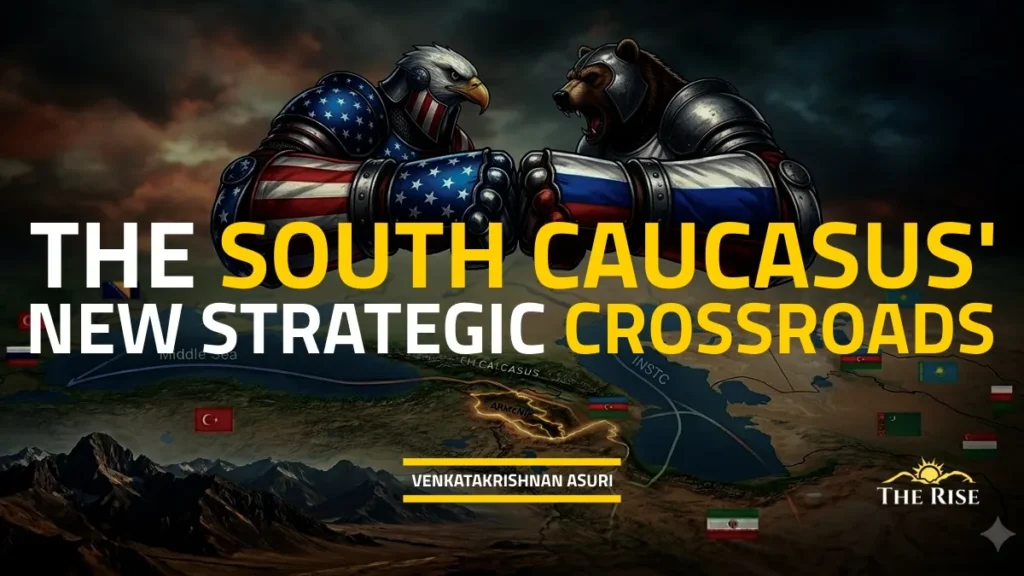
The South Caucasus is emerging as a key arena for great power competition, with the United States expanding its presence in a region historically considered part of Russian and Iranian spheres of influence. While Armenia’s reorientation towards the West continues, its dependence on Russia constrains its pace of diversification. Though the corridor remains in its early stages, its development could become a flashpoint for geopolitical rivalry in Eurasia.
In August 2025, the United States positioned itself as one of the most contested geographical points in Eurasia. At a summit in Washington, the Zangezur Corridor, a 43-kilometre transit route across Armenia’s Syunik province, was rebranded the “Trump Route for International Peace and Prosperity”, or TRIPP[1]. While the corridor connects Azerbaijan to its Nakhchivan exclave, its importance has reemerged in recent times. This can be owed to several factors, including the conflict in Ukraine weakening Russia’s traditional sphere of influence, Armenia’s drift towards the EU, and Washington’s renewed interest in Eurasia amidst growing Chinese influence.
The Importance
The strategic value of the route lies in its geographical position, right at the intersection of two competing connectivity corridors.

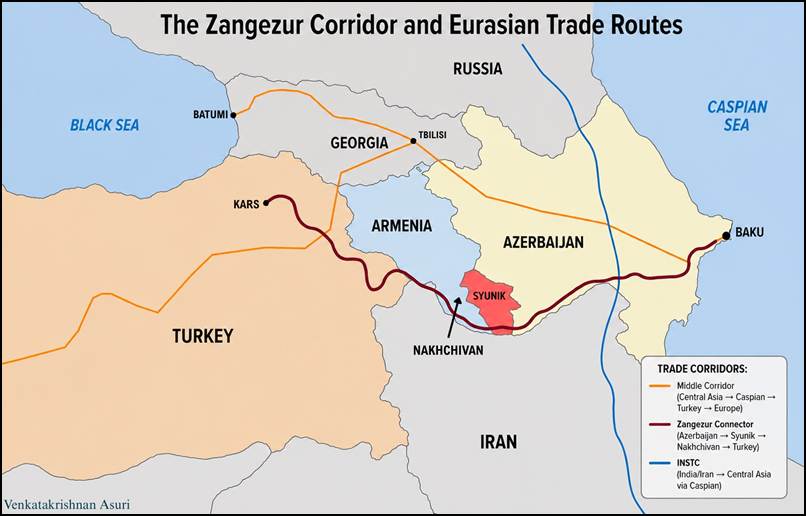
The east-west Middle Corridor serves as an alternative for Central Asian goods across the Caspian, through Azerbaijan and Turkey to Europe, thereby bypassing Russia. The International North-South Transport Corridor (INSTC), favoured by Russia and Iran, links the Persian Gulf to Russia through the Caspian Sea. And therefore, control over the Zangezur Corridor confers considerable influence over the direction of trade and thereby a significant footprint in the Eurasian landmass. Until recently, the control of this corridor was assumed to rest with Moscow, after the ceasefire over Karabakh in November 2020 assigned oversight of the corridor to Russia’s Federal Security Service[2]. However, the Washington-brokered truce between Armenia and Azerbaijan, coupled with the TRIPP, appears to supersede that arrangement.
The American Role
Under the implementation framework released in January 2026, a US-linked entity is to hold a 74 percent stake in the corridor’s development[3] for an initial 49-year term, extendable to 99 years. A US official described the objective, quite unambiguously: to diminish Iranian, Chinese, and Russian influence in the region[4]. This represents the first concrete projection of American power into the South Caucasus, a region long shaped by Russian dominance and Iranian influence, in which Washington has historically maintained a very limited footprint.
Structurally, the corridor mirrors the Chinese approach to influence through infrastructure, where private capital and developmental finance substitute for security commitments, something which the United States has been rescinding quite lately. The corridor is made consequential due to the fact that this framework dovetails with Washington’s broader effort to court Central Asian states. This was evident in the C5+1 summit in November last year[5], where Kazakhstani uranium and Uzbek rare earths were discussed in the context of routing them to Western markets, independent of Moscow.
What are Armenia’s cards?
The most striking feature of the arrangement is how little of it Armenia controls. Yerevan’s reorientation towards the West has been genuinely accelerating. Following Azerbaijan’s September 2023 offensive in Nagorno-Karabakh[6], as Russian peacekeepers stood aside, Prime Minister Nikol Pashinyan suspended Armenia’s Collective Security Treaty Organization (CSTO) participation[7], and in March 2025, enacted legislation initiating accession to the EU[8]. The rupture with Moscow was further underscored when, in May 2026, Yerevan hosted the eighth European Political Community Summit[9], the first time a CSTO member convened a major European security gathering explicitly excluding Russia. This was followed by a joint France-Armenia declaration establishing a strategic partnership[10].
However, one must be cautious in overestimating Yerevan’s reorientation, as exiting Moscow’s traditional sphere of influence involves more than mere political signaling. For example, approximately 85 percent of Armenia’s natural gas originates in Russia, and Gazprom controls the domestic distribution network till 2043[11]. The Metsamor nuclear plant generates roughly one-third of the nation’s electricity[12], which depends on Russian fuel. Between 1.2 and 2.5 million ethnic Armenians reside in Russia[13], against a domestic population of approximately 3 million. This, alongside trade dependencies and high remittances, places a ceiling on Yerevan’s pace of disengagement.
The Turkish Hand
For Turkey, the corridor has been a long-awaited one. It would establish an uninterrupted land link between Turkey and the Turkic states of Central Asia, circumventing Iran and Georgia. At the Organization of Turkic States summit in October 2025, President Aliyev noted that Middle Corridor freight volumes had risen by roughly 90 percent since 2022[14]. Turkey has begun constructing the rail infrastructure[15] to meet the route at its border.
The energy angle is worth looking at. The Trans-Caspian Gas Pipeline, which would carry Turkmen gas to Europe via Azerbaijan while bypassing Russia and Iran, has been obstructed for three decades[16] by Iran and Russia on ostensibly environmental grounds. The EU’s commitment to terminate Russian gas imports by end-2027, combined with the Hormuz disruptions from the Iran conflict, has increased the pipeline’s strategic value multifold. Turkey’s energy minister declared in December 2025 that the project had entered its “concrete steps”[17]; this pipeline mutually reinforces the Zangezur Corridor, strengthening Turkish strategic and economic influence in the region.
Moscow’s Leverage
Russia’s retreat at the political and security level is very real. It failed its CSTO commitments in 2020 and 2023 and has now lost its role on the Zangezur corridor under the TRIPP.

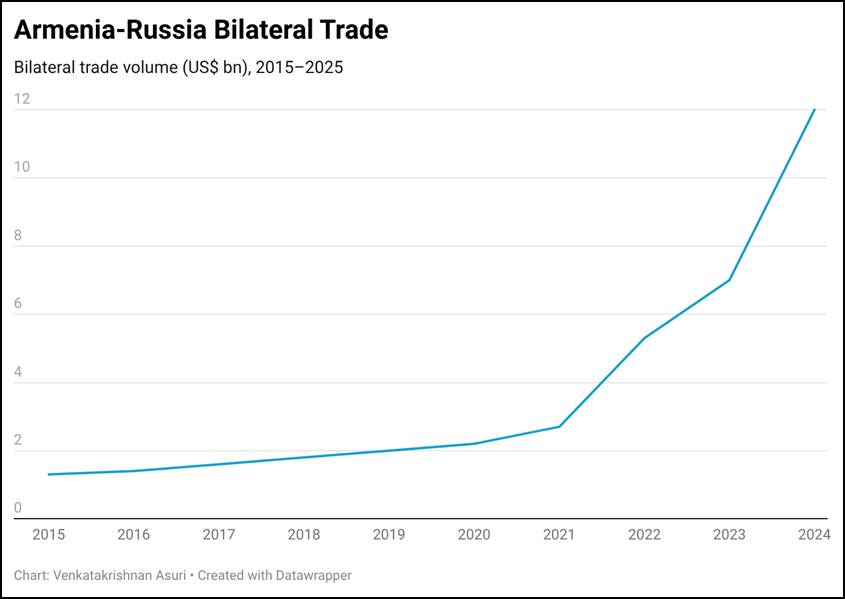
However, one must not underestimate Moscow’s willingness to deploy its economic leverage. In late May 2026, Russia threatened to withdraw from the 2013 agreement[18] guaranteeing Armenia duty-free gas and simultaneously restricted Armenian agricultural exports[19]. This paradox has been increasingly visible since 2022, with bilateral trade and remittances surging, with Armenia serving as an intermediary for Russian gold, diamond and sanctioned goods[20].
Yet Russia retains influence over Armenia not only through economic ties but also through its residual military presence.Militarily, while the 102nd Military Base at Gyumri[21] remains with a lease extended to 2044, much of its complement has been redeployed to Ukraine, leaving it as a mere political instrument.
Conclusion
The Zangezur Corridor embodies the fundamental reordering in the global order, particularly surrounding trade routes in Eurasia. Armenia remains caught between its structural dependence on Russia and its reorientation towards the EU. Washington’s strategy remains straightforward, intent on displacing Russian and Iranian influence over trade and energy flows in the region. While the corridor is yet to materialise fully, the power struggle it represents also points to this region emerging as a potential flashpoint for great power competition in the future.
Disclaimer: The views expressed in this article are those of the author solely. TheRise.co.in neither endorses nor is responsible for them. Reproducing this content without permission is prohibited.
REFERENCES
[1] Andrew D’Anieri and Joseph Epstein, “How Trump’s ‘TRIPP’ triumph can advance US interests in the South Caucasus,” Atlantic Council, January 20, 2026, https://www.atlanticcouncil.org/dispatches/how-trumps-tripp-triumph-can-advance-us-interests-in-the-south-caucasus/.
[2] International Crisis Group, “Getting from Ceasefire to Peace in Nagorno-Karabakh,” November 10, 2020, https://www.crisisgroup.org/europe-central-asia/caucasus/nagorno-karabakh-conflict/getting-ceasefire-peace-nagorno-karabakh.
[3] “US and Armenia Unveil TRIPP Development Blueprint,” Eurasianet, January 12, 2026, https://eurasianet.org/us-and-armenia-unveil-tripp-development-blueprint.
[4] “Rewiring the South Caucasus: TRIPP and the New Geopolitics of Connectivity,” Carnegie Endowment for International Peace, March 2026, https://carnegieendowment.org/russia-eurasia/research/2026/03/rewiring-the-south-caucasus-tripp-and-the-new-geopolitics-of-connectivity.
[5] “US Counter-China, Russia Strategy in the South Caucasus and Central Asia,” Just Security, 2026, https://www.justsecurity.org/125271/us-counter-china-russia-south-caucasus-central-asia/.
[6] “Armenia Passed Point of No Return with CSTO,” OC Media, 2025, https://oc-media.org/armenia-passed-point-of-no-return-with-csto/.
[7] “Armenia Suspends CSTO Participation,” Armenpress, October 2025, https://armenpress.am/en/article/1206671.
[8] “Armenian Parliament Greenlights EU Accession Bill,” Brussels Signal, March 2025, https://brusselssignal.eu/2025/03/armenian-parliament-greenlights-eu-accession-bill/.
[9] “World Leaders Arrive in Armenia for Eighth EPC Summit,” Euronews, May 3, 2026, https://www.euronews.com/my-europe/2026/05/03/world-leaders-arrive-in-armena-for-eighth-epc-summit.
[10] “Joint Declaration by Prime Minister Nikol Pashinyan and President Emmanuel Macron on Strategic Partnership,” Office of the Prime Minister of the Republic of Armenia, May 5, 2026, https://www.primeminister.am/en/press-release/item/2026/05/05/Nikol-Pashinyan-Emmanuel-Macron-Declaration/.
[11] “Armenia Says It Expects Russia to Keep Gas Prices Low Despite Worsening Ties,” CivilNet, 2025, https://www.civilnet.am/en/news/768171/armenia-says-it-expects-russia-to-keep-gas-prices-low-despite-worsening-ties/.
[12] “Russia to Revamp Armenia’s Nuclear Power Plant,” Eurasianet, 2025, https://eurasianet.org/russia-to-revamp-armenias-nuclear-power-plant.
[13] “Challenges to Russia’s Influence in the South Caucasus,” Nest Centre, 2025, https://nestcentre.org/challenges-to-russias-influence-in-the-south-caucasus/.
[14] “Opinion: The Twelfth Summit of the Organization of Turkic States – A Turning Point for Regional Peace and Integration,” The Times of Central Asia, October 2025, https://timesca.com/opinion-the-twelfth-summit-of-the-organization-of-turkic-states-a-turning-point-for-regional-peace-and-integration/.
[15] “Hopes and Hurdles: Takeaways from the OTS Summit in Gabala,” Caspian Policy Center, October 2025, https://www.caspianpolicy.org/research/middle-corridor/hopes-and-hurdles-takeaways-from-the-ots-summit-in-gabala.
[16] “Trans-Caspian Pipeline Momentum,” Geopolitical Intelligence Services (GIS), 2025, https://www.gisreportsonline.com/r/trans-caspian-pipeline-momentum/.
[17] “Türkiye’s 30-Year Trans-Caspian Gas Link Dream Enters Concrete Phase,” Daily Sabah, December 2025, https://www.dailysabah.com/business/energy/turkiyes-30-year-trans-caspian-gas-link-dream-enters-concrete-phase.
[18] “Russia Warns Armenia: Choose the EU and Lose Our Oil and Gas,” Meduza, May 26, 2026, https://meduza.io/amp/en/news/2026/05/26/russia-warns-armenia-choose-the-eu-and-lose-our-oil-and-gas.
[19] “Gazprom Trying to Squeeze Armenia,” Eurasianet, May 2026, https://eurasianet.org/gazprom-trying-to-squeeze-armenia.
[20] Andrew D’Anieri and Joseph Epstein, “How Trump’s ‘TRIPP’ triumph can advance US interests in the South Caucasus,” Atlantic Council, January 20, 2026, https://www.atlanticcouncil.org/dispatches/how-trumps-tripp-triumph-can-advance-us-interests-in-the-south-caucasus/.
[21] “Russia Out, India & France Storm Armenia as Top Defense & Security Partners in South Caucasus Shake-Up,” The Eurasian Times, 2026, https://www.eurasiantimes.com/russia-out-india-france-storm-armenia-as-top-defense-security-partners-in-south-caucasus-shake-up/.