


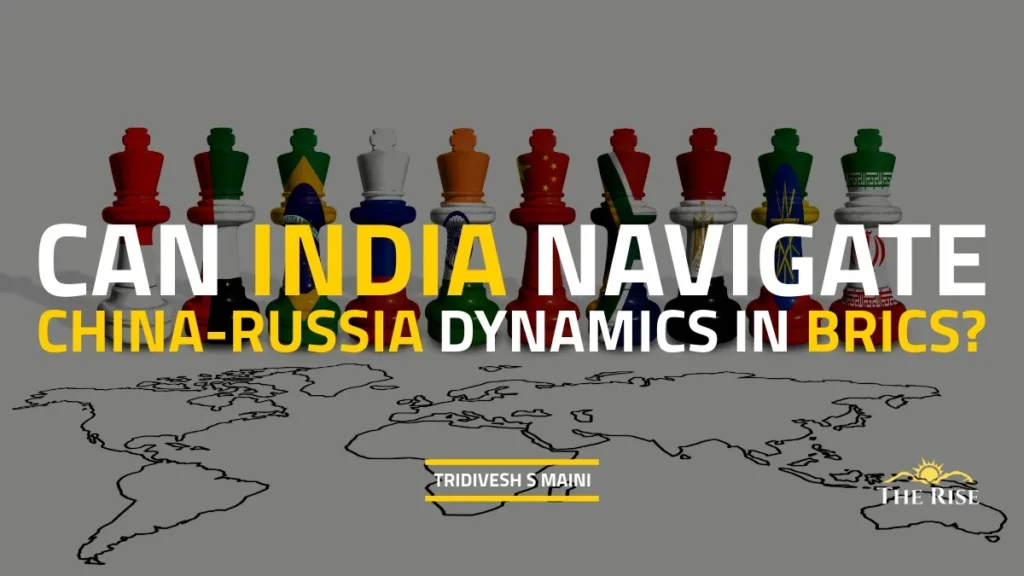
As the current chair of BRICS, India will likely pay close attention to Wang Yi’s remarks pertaining to Russia-China cooperation in BRICS+. The organisation is likely to face many challenges. Most significantly, due to differences between BRICS+ members – especially the UAE and Iran, which are parties to the conflict in West Asia.
During his meeting with Russia’s Secretary of the Security Council, Sergei Shoigu, on the sidelines of the BRICS National Security Advisor (NSA) meeting, the Chinese Foreign Minister, Wang Yi, called for Russia and China to enhance cooperation for further strengthening the BRICS+ grouping.
The Chinese Ambassador to India, Xu Feihong, who had also attended the meeting, in a post said: “Noting BRICS’s role as an important platform for the international community to practice multilateralism, uphold fairness and justice, and promote peace and security, Wang urged China and Russia to strengthen coordination and cooperation for the strengthening and expansion of the BRICS mechanism, making it a leading force of the Global South.”
Also Read: The South Caucasus’ New Strategic Crossroads
The statement comes at an important time. First, Russia-India ties remain robust across several spheres. India’s crude oil imports from Russia have risen significantly in June 2026. It is estimated that for the month of June, India’s oil imports from Russia would reach 2.55 million barrels per day (bpd). By comparison, India’s oil imports from Russia were 2.13 million bpd in May 2026 and 2.16 million bpd in May 2023.
In an interview with the Indian Express on June 22, 2026, the Russian Ambassador to India, Denis Alipov, highlighted the fact that India remained an “indispensable strategic partner” for Russia, just as Russia was to India. The Russian diplomat pointed to some important developments that reiterate cooperation not just in the sphere of defence, but also in the banking sector. While categorically stating that Western sanctions should not interfere with ties between India and Russia, he also underscored the point that Russia’s ties with China would not impact Russia-India relations. Alipov said, “Russia maintains independent and self-sustaining relationships with both China and India, as well as with many other countries. India remains one of the highest priorities in our foreign policy and economic engagement.”
Also Read: Myanmar’s Strategic Shift Towards India
Second, China-India ties, which had deteriorated in the aftermath of the Galwan clashes in 2020, have witnessed some important developments in recent years. PM Modi visited Tianjin (China) in 2025 for the Shanghai Cooperation Organisation (SCO) summit and met with Chinese President Xi Jinping on the sidelines of the summit. The Chinese President told PM Modi that China and India should be “partners” not “rivals”. While several issues were discussed during the meeting, PM Modi highlighted the need for “peace and tranquility” along the borders.
Some of the steps that reiterate the reduction in tensions between both countries include the resumption of direct flights between both countries in October 2025 (after a hiatus of five years). Second, India has also eased out certain restrictions related to Chinese investments in India that had been introduced in the aftermath of the 2020 border tensions.
Some of the important changes are: First, Chinese companies can acquire up to 10% stake in Indian companies, without seeking New Delhi’s approval. Second, Chinese investments in Indian companies will be processed within a specific time frame – 60 days – provided the majority ownership remains with Indian shareholders.
China’s support for India’s Chairmanship of BRICS
China has also expressed its support for India’s BRICS+ Presidency. Wang Yi met with National Security Advisor (NSA) Ajit Doval on the sidelines of the BRICS+ meeting, and the Ministry of External Affairs (MEA) described the discussions as “positive” and “constructive”. During his meeting with PM Modi, the Chinese Foreign Minister highlighted the point that Beijing was ready to work with New Delhi to strengthen bilateral relations and take forward the “consensus” reached between Xi and Modi.
Despite some positive developments, important differences over bilateral issues along with China’s growing influence in South Asia cannot be overlooked.
Russia-India-China trilateral?
In June 2026, China spoke about the need for closer cooperation between China, Russia and India under the umbrella of the Russia-India-China (RIC) framework. It remains to be seen if Moscow, which has strong ties with both China and India, can play a role in easing tensions between both countries.
While interacting with the media in June 2026, on the sidelines of the St. Petersburg Economic Forum, Russian President Vladimir Putin categorically stated that Russia would not “interfere” in the delicate relationship between both countries and that both sides were trying to resolve differences. He did, however, say that Moscow remained in touch with its friends in both countries and referred to his suggestion that the Indian and Chinese leaders meet in Russia.
Conclusion
As the current chair of BRICS, India will likely pay close attention to Wang Yi’s remarks pertaining to Russia-China cooperation in BRICS+. The organisation is likely to face many challenges. Most significantly, due to differences between BRICS+ members – especially the UAE and Iran, which are parties to the conflict – regarding the situation in West Asia. India will also have to be deft in advancing initiatives related to trade in local currencies between BRICS+ member states, since the United States has been opposing such attempts. Above all, it would be important to see how Russia, China and India coordinate during India’s chairmanship of BRICS+.
Disclaimer: The views expressed in this article are those of the author solely. TheRise.co.in neither endorses nor is responsible for them. Reproducing this content without permission is prohibited.