


The Arctic, once viewed as a region of cooperation, is increasingly developing as a stage of rivalry, with authority over resources, routes, and infrastructure emerging as key to national plans.
The growing interest of US President Donald Trump in obtaining or enhancing his influence in Greenland is sometimes considered an odd geopolitical move. However, when viewed from a strategic and analytical lens, it signals a more fundamental shift in how the United States approaches the Arctic. When Trump nominated a special envoy to Greenland, Washington showed its interest in the country. The emphasis is on an amalgamation of resource security, military positioning, and long-term geopolitical competition.[i]
At the core of this interest is the Arctic Region’s massive, undiscovered resource base. The region is expected to contain over 90 billion barrels of undiscovered oil, 1,669 trillion cubic feet of natural gas, and 44 billion barrels of natural gas liquids, accounting for nearly 13% of the world’s undiscovered oil and 30% of natural gas.[ii]
Greenland itself is believed to contain significant deposits of rare earth elements, uranium, zinc and iron ore. According to the European Commission, Greenland has access to 25 of the EU’s 34 critical raw materials, making it a key node in future supply chains.[iii]

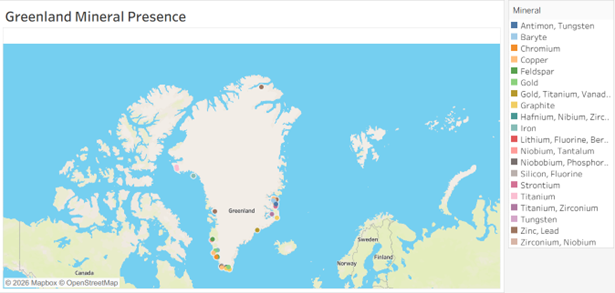
This resource potential becomes even more strategic in the context of global supply chain competition. China currently dominates rare earth production, contributing nearly 70% of global output, giving it significant leverage over critical technologies.[iv]
Beijing’s interest in Greenland’s mining sector has already been visible through attempts to finance and develop mining infrastructure, highlighting the island’s growing importance in global resource politics. For Washington, Greenland represents both an opportunity to secure resources and a necessity to limit strategic space for competitors.[v]
The rare earths that are found beneath the ice are not the only reason for the interest in Greenland, though it serves as a natural focal point for the development of Arctic Sea Routes because of its location between North America, Europe, and the Arctic Ocean. This transition is being accelerated by climate change. In recent decades, the amount of Arctic sea ice has drastically decreased, creating previously unreachable marine passages.[vi]
These routes have huge economic significance. The Northern Sea Route can cut maritime durations from East Asia and Northern Europe by roughly 40% when compared to the existing Suez Canal route. At the exact same time, Arctic shipping traffic has significantly risen, with cargo volumes via Russia’s Northern Sea Route reaching 34 million tonnes in 2022, compared to barely 4 million tonnes in 2014.[vii]
With this advantage, the US Military financed and built the Pituffik Space Base (previously Thule Air Base), which is controlled by the United States Space Force and serves as a crucial node in missile warning and space surveillance systems. It is part of a global network of satellite monitoring stations that offer telemetry, tracking, and controlling services for the US and its alliances’ satellite projects. It monitors thousands of objects in orbit, adding to the space domain awareness.[viii]
These advancements have far-reaching consequences for countries beyond the Arctic Circle. Australia has built economic interests in Greenland through investments in rare earth mining, such as Perth-based Energy Transition Minerals (ETM) and its involvement in the Kvanefjeld deposit.[ix]
In March 2026, the US and Australia further advanced cooperation under the United States–Australia Framework for Securing Supply Chains in the Mining and Processing of Critical Minerals and Rare Earths. This was done to secure and diversify critical minerals and rare earth supply chains.[x]
The United States’s intentions in Greenland have complicated its relationship with Denmark, which holds authority over the island. Trump’s previous effort to acquire greater access to Greenland was strongly rejected, indicating concerns about territorial integrity. However, sustained US strategic interest suggests that Greenland will remain a source of interaction and potential tension between Washington and Copenhagen.[xi] Here, growing assertiveness by the US can compel the European Union to develop its own Arctic presence or emerge as an individual pole, potentially changing the balance within NATO.[xii]
These trends are very crucial for Russia. The Arctic region has become vital to Russia’s long-term economic and strategic interests. The Northern Sea Route is a significant component of this program, with goals to boost cargo volume to 200 million tonnes per year by 2030.[xiii]
Taken together, these trends suggest to a significant shift in the Arctic’s geopolitical landscape. The Arctic, once viewed as a region of cooperation, is increasingly developing as a stage of rivalry, with authority over resources, routes, and infrastructure emerging as key to national plans.[xiv]
In this wider context, Trump’s interest in Greenland appears to be a precursor to a greater strategic shift rather than an isolated proposal. The United States is positioning itself to gain influence in a region that will affect future global trade, energy security, and military dynamics.[xv]
Finally, Greenland is no longer merely a distant, ice-covered region. It is emerging as a crucial crossroads in 21st-century geopolitics, where resources, trade routes, and great power rivalry converge. As rivalry heats up, the Arctic, with Greenland at its centre, is set to turn into the next major battleground.
Disclaimer: The views expressed in this article are those of the author solely. TheRise.co.in neither endorses nor is responsible for them. Reproducing this content without permission is prohibited.
REFERENCES
[i] Roy, D., & Masters, J. (2026, January 22). The Trump Administration’s Push for Greenland: What to Know. https://www.cfr.org/articles/greenlands-independence-what-would-mean-us-interests
[ii] Raspotnik, A. (2012, February 21). No Race for Arctic Hydrocarbon Resources? https://www.thearcticinstitute.org/race-arctic-hydrocarbon-resources/
[iii] EU and Greenland sign strategic partnership on sustainable raw materials value chains. (2023, November 30). https://ec.europa.eu/commission/presscorner/detail/en/ip_23_6166
[iv] Ang, A. (2026, March 11). Beijing’s dominance in rare earth processing leaves others scrambling to close the gap: ‘China is the leader, and the U.S. is far behind.’ https://fortune.com/2026/03/11/china-us-rare-earth-processing-critical-minerals/
[v] Schwartz, M., & Baskaran, G. (2026, January 8). Greenland, Rare Earths, and Arctic Security. https://www.csis.org/analysis/greenland-rare-earths-and-arctic-security
[vi] Meredith, M., & Sommerkorn, M. (n.d.). Special Report: Special Report on the Ocean and Cryosphere in a Changing Climate. https://www.ipcc.ch/srocc/chapter/chapter-3-2/
[vii] The Maritime Executive. (2023, May 24). Russia Details NSR Growth with Year-Round Service to Begin in 2024. https://maritime-executive.com/article/russia-details-nsr-growth-with-year-round-service-to-begin-in-2024
[viii] Diaz, L. (2026, January 17). The US Air Force Base In Greenland & Its Strategic Role. https://simpleflying.com/us-air-force-base-greenland-strategic-role/
[ix] Greenland might open a vast uranium deposit to mining. Locals say it could alter their way of life. (2025, March 20). https://www.theguardian.com/world/ng-interactive/2025/mar/20/greenland-australian-mining-company
[x] Australian Government – Department of industry, Science and Resources. (2026, April 13). Australia and United States advance cooperation on critical minerals and rare earths supply chains. https://www.industry.gov.au/news/australia-and-united-states-advance-cooperation-critical-minerals-and-rare-earths-supply-chains
[xi] Madhani, A., Cook, L., & Pylas, P. (2026, January 22). Denmark and Greenland say sovereignty is not negotiable after Trump’s meeting with Rutte. https://www.pbs.org/newshour/world/denmark-and-greenland-say-sovereignty-is-not-negotiable-after-trumps-meeting-with-rutte
[xii] Blockmans, S. (2026, January 19). Grabbing Greenland: Impact on NATO and the EU. https://icds.ee/en/grabbing-greenland-impact-on-nato-and-the-eu/
[xiii] Russia’s Northern Sea Route Cargo Volumes Fall for Second Straight Year. (2026, February 9). The Moscow Times. https://www.themoscowtimes.com/2026/02/09/russias-northern-sea-route-cargo-volumes-fall-for-second-straight-year-a91895
[xiv] Parkash, D. (2025). Arctic as a New Geopolitical Hotspot. International Journal for Multidisciplinary Research (IJFMR). https://www.ijfmr.com/papers/2025/2/39483.pdf
[xv] Niblett, S. R. (2026, January 14). Trump’s Greenland Ambition Is About U.S. Power, Not Alliances. https://www.csis.org/analysis/trumps-greenland-ambition-about-us-power-not-alliances