


The present global uncertainty should also be viewed as an opportunity for accelerating long-term structural reforms in renewable energy, public transport systems, local manufacturing, rural self-reliance, and sustainable production practices. Economic self-reliance does not imply isolationism or disengagement from the global economy. Rather, it signifies the ability of a nation to withstand external shocks with confidence, balance, adaptability, and internal strength.
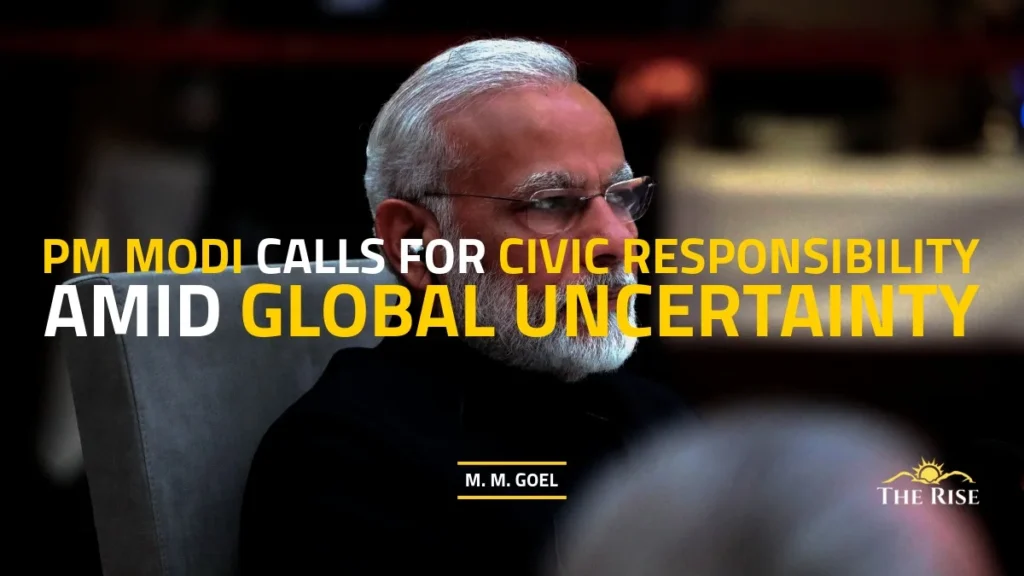
The recent appeals made by Prime Minister Narendra Modi to the nation regarding economic self-reliance, civic responsibility, and disciplined public conduct deserve serious attention and thoughtful reflection. At a time when geopolitical tensions in West Asia are generating uncertainty in global energy markets, trade flows, and economic stability, the Prime Minister’s emphasis on national preparedness, restraint, and collective responsibility is both timely and statesmanlike.
The Needonomics School of Thought (NST) strongly supports the call for disciplined public participation and “Civic Satyagraha” in response to emerging global challenges. Such an appeal is not merely administrative advice; rather, it reflects a deeper moral and national necessity in an increasingly interdependent and vulnerable global economy.
India today confronts a complex international environment marked by fluctuating crude oil prices, supply-chain disruptions, inflationary pressures, and strategic uncertainties. Under such circumstances, economic resilience cannot be achieved solely through government policies, fiscal measures, or monetary interventions. National strength also depends upon the conscious participation of citizens through responsible behavior, moderation in consumption, and commitment to collective national priorities.
The Needonomics School of Thought advocates the principle of “Needo-consumption,” which emphasizes mindful, judicious, and righteous use of goods, services, and natural resources. Needonomics clearly distinguishes between genuine human needs and excessive, wasteful, or status-driven consumption. In periods of international uncertainty and economic stress, this distinction becomes even more significant for maintaining national economic stability and social balance.
The Prime Minister’s appeal for fuel conservation and reduction in unnecessary imports reflects not merely economic prudence but also patriotic responsibility. Excessive and wasteful consumption weakens national resilience, increases dependence on imports, and places avoidable pressure on foreign exchange reserves and public finances. A society guided by moderation and necessity develops stronger foundations for long-term sustainability, self-reliance, and economic discipline.
Equally important is the Prime Minister’s appeal urging citizens to remain alert, aware, and awake to the seriousness of evolving global developments. Democracies function effectively only when citizens move beyond passive expectation and become active participants in national responsibility. Civic awareness, disciplined consumption, and energy conservation should not be viewed merely as temporary responses to crises; they must become enduring habits for building a resilient, responsible, and mature nation.
India’s civilizational ethos has always emphasized restraint, balance, simplicity, and ethical living. The philosophy of Mahatma Gandhi regarding simplicity, self-discipline, and moral responsibility remains profoundly relevant even in the contemporary global economy. The concept of “Civic Satyagraha” can therefore emerge as a powerful moral instrument for promoting responsible citizenship, reducing wasteful lifestyles, conserving national resources, and strengthening social unity during challenging times.
The present global uncertainty should also be viewed as an opportunity for accelerating long-term structural reforms in renewable energy, public transport systems, local manufacturing, rural self-reliance, and sustainable production practices. Economic self-reliance does not imply isolationism or disengagement from the global economy. Rather, it signifies the ability of a nation to withstand external shocks with confidence, balance, adaptability, and internal strength.
Needonomics further emphasizes that true development lies not in unlimited consumption but in balanced well-being. A nation becomes genuinely strong when its citizens voluntarily practice moderation, conserve resources, avoid extravagance, and place collective welfare above narrow individual indulgence. Sustainable prosperity emerges not from reckless accumulation but from disciplined and ethical living.
The Prime Minister’s seven appeals should therefore be viewed not merely as policy suggestions but as the foundation of a broader national ethical framework for responsible citizenship in uncertain times. If sincerely embraced by society, these principles can strengthen India’s economic stability, reduce external vulnerabilities, and promote a culture of disciplined and sustainable development.
The Needonomics School of Thought believes that crises often provide opportunities for moral awakening and institutional reform. The present moment calls for unity, awareness, restraint, and constructive public participation. Citizens, industries, educational institutions, local governments, and civil society organizations all have important roles to play in strengthening national resilience.
India has repeatedly demonstrated its ability to overcome difficult challenges through collective wisdom, discipline, and social solidarity. With responsible leadership and conscious citizenship, the country can successfully navigate present global uncertainties and emerge stronger, more self-reliant, and more sustainable in the years ahead.
The message underlying the Prime Minister’s appeals is ultimately a call for national character-building. Economic resilience is not merely an outcome of production and consumption statistics; it is equally the result of ethical conduct, civic discipline, and social responsibility. A nation that learns to balance aspiration with restraint and growth with sustainability creates a durable foundation for long-term peace, prosperity, and collective well-being.
Disclaimer: The views expressed in this article are those of the author solely. TheRise.co.in neither endorses nor is responsible for them. Reproducing this content without permission is prohibited.