


The moment that defined her place in history came on September 29, 1942, during the Quit India Movement, where she led a massive group of about six thousand people, mostly women and local volunteers, toward the Tamluk police station. The goal was to take over government buildings as a show of defiance against colonial rule.
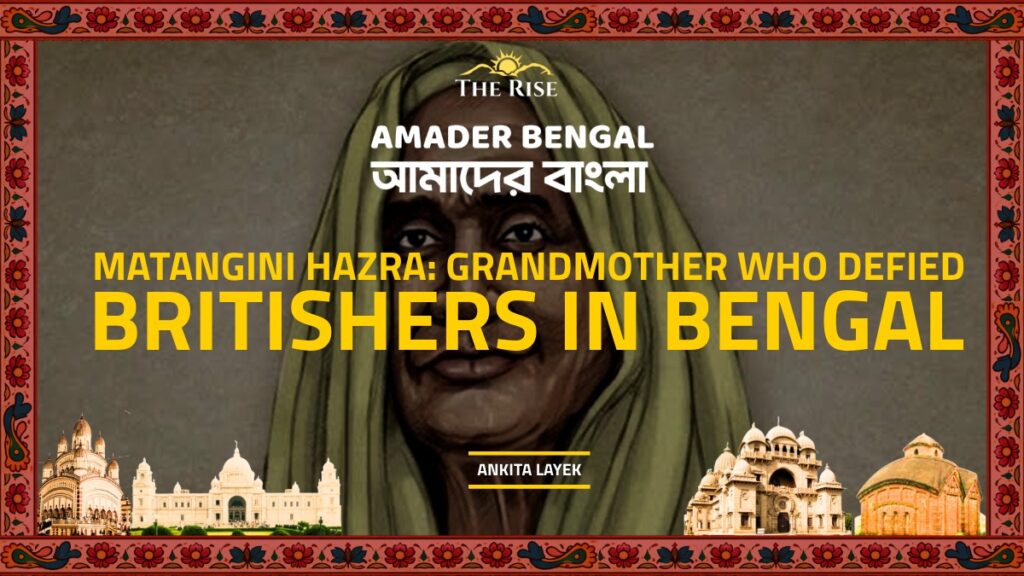
When we create an image of the Indian freedom struggle in Bengal, we often picture student rallies or secret revolutionary societies. But one of the most powerful stories comes from a much more unlikely source: a 72-year-old widow from a small village who the local people called “Gandhi Buri.” Matangini Hazra wasn’t a politician or a scholar. She was a woman who lived through decades of quiet hardship before becoming the face of a rebellion that would shake the Midnapore district (in present-day Purba Medinipur) to its core.
Matangini was born on 19 October 1870 in Hogla village, near Tamluk. Her early life was a series of struggles. Coming from a poor peasant family, she never had the chance to go to school. By the age of twelve, she was married off to a much older man, Trilochan Hazra, and by eighteen, she was already a widow. With no children and very little to her name, she spent the next several decades of her life essentially alone, in poverty.
The moment that defined her place in history came on September 29, 1942, during the Quit India Movement, where she led a massive group of about six thousand people, mostly women and local volunteers, toward the Tamluk police station. The goal was to take over government buildings as a show of defiance.
What followed turned her into a martyr of the Quit India Movement. Police opened fire. Matangini was hit multiple times, reportedly in the forehead and both hands, but she continued to move forward. Eyewitnesses at the time described an incredible sight: even as she was bleeding and collapsing, she refused to let the flag touch the ground. She kept chanting “Vande Mataram” until her very last breath. Her death wasn’t just a tragedy; it was a spark. Her martyrdom became a part of the wider uprising, which later led to the formation of the Tamralipta Jatiya Sarkar, a parallel independent government that challenged the colonial authority in the region for nearly two years.
Her move into politics didn’t happen overnight. It was more of a slow-burning awakening that started with the nationalist ferment in Bengal during the early 1900s. By 1930, at an age when most people would be staying far away from trouble, she was right in the middle of the Salt Satyagraha. She was arrested for making salt and spent time in prison, but that didn’t slow her down. A year later, she was arrested again for protesting against the Chowkidari tax. She even faced a brutal baton charge by the police during a meeting in Serampore. Through all of this, she stuck to the Gandhian way, spinning her own clothes and living a life of absolute simplicity while organizing other local women to join the cause.
Today, Matangini Hazra is a household name in Bengal, with schools and roads named after her, and a famous statue in Kolkata’s Maidan. But her real relevance lies in the lesson she left behind about courage. Matangini showed that the strongest weapon against an empire isn’t always a gun; sometimes, it’s just the refusal of a grandmother to let go of a flag.
Ankita Layek is an intern under Amader Bengal
Mentored and Edited by Sneha Yadav