


Russia’s Arctic military expansion has been driven by more than just resource interests. It reflects a combination of the logic of sovereign protection, homeland defence, second strike nuclear capacity, and anxiety regarding NATO’s northern position. Moscow has rebuilt Arctic airfields, increased radar coverage, and deployed layered air defence equipment in places such as Novaya Zemlya.
Due to its vital mineral resources, the Arctic region has garnered considerable attention lately. These resources, located both on land and on the ocean floor within the sovereign territories of some Nordic countries, are crucial for renewable energy technologies. The discovery of new resource frontiers and diversification options, like the Arctic, has been spurred by the rapidly increasing demand for critical minerals in industrialized nations, such as rare earth elements and lithium, as well as geostrategic factors and efforts to reduce reliance on external actors. (Heggelund, n.d.)
In addition to minerals, the area contains roughly 13% of the world’s undiscovered oil and 30% of its undiscovered natural gas, which makes it one of the last significant unexplored hydrocarbon frontiers. (Science, 2009). As climate change accelerates sea-ice retreat, the Arctic is becoming increasingly accessible for commercial navigation and resource extraction (Melia et al., 2016). According to studies, compared to conventional southern corridors, Arctic routes can reduce travel times between Europe and Asia by about 30%, reduce travel distance by about 40%, and shorten transit times by nearly 10 days. Due to its location at the centre of Russia-US nuclear deterrence, the Arctic has long had strategic military significance. However, the region has become more securitized due to growing resource competition and deteriorating relations between Russia and the West. (Regehr, 2019)
Also Read: West Asia Conflict, Chabahar Port & India-Afghanistan Relations
Due to its location at the nexus of offshore energy development, the security of fossil fuels, and the minerals demands of the energy transition, the Arctic region is significant economically. Under a fossil fuel development scenario, its offshore oil and gas remain commercially relevant despite changing ice conditions. Future Arctic offshore extraction could contribute between 0.8 and 2.6 EJ annually to the global oil and gas markets up to the year 2100, and overall Arctic offshore oil production in some assessment units could reach about 70 EJ by the end of the century. (Waldhoff et al., 2024) This is significant because the global energy transition is materially intensive, with mining affecting 50 million square kilometres of the Earth’s land surface and 82% of mining areas targeting materials required for renewable energy production, highlighting how decarbonization is increasing pressure to secure new mineral frontiers. (Sonter et al., 2020). The Arctic’s sustainable energy potential is also expanding, with power-generating capacity projected to increase from 2.2 GW in 2020 to 7.5 GW by 2050, with wind power leading the way and levelized electricity costs declining to Euro 28.2/MWh in a 100% renewable system. (Breyer et al., 2025)
The region is of strategic importance not just because of its resources, but also because it is located at the intersection of North America, Europe, and Russia, making it essential to maritime lanes of communication, submarine operations, missile warning, and nuclear deterrent. The region north of the Greenland-Iceland-United Kingdom gap continues to be regarded as one of the most prominent pathways for strategic nuclear exchange between Russia and the United States, which is why it became a key site for early warning and air defence networks during the Cold War and remains militarily significant today. (Childs, 2022)
This geopolitical weight has only increased, as shown with the Northern Fleet headquartered on the Kola peninsula, which has been important to Russia’s military modernization in the Arctic. The Northern Fleet and the Kola Peninsula, which house the majority of Russia’s naval and strategic capabilities, remain key to this posture. This demonstrates that Moscow views this area as critical to deterrence, maritime access, and the defence of offshore energy and transportation arteries (SIPRI & Klimenko, 2016). It is documented that Russia upgraded the Northern Fleet to the category of a military district in 2021, highlighting how resource competition in the Arctic region is now being added to an already important military geography. (Childs, 2021)
Russia’s Arctic military expansion has been driven by more than just resource interests. It reflects a combination of the logic of sovereign protection, homeland defence, second strike nuclear capacity, and anxiety regarding NATO’s northern position. (Boulègue, 2019) Since the early 2010s, Russia has resumed a variety of Soviet-era sites, refurbished airfields and radar installations throughout the Russian Arctic, and modernized sea-based nuclear forces linked to the Northern Fleet on the Kola Peninsula. Russia planned 13 air bases, 10 radar stations, and 20 border outposts along its northern shore, demonstrating that military action was geographically diverse and infrastructure-intensive rather than symbolic. (Wezeman, 2016) Moscow has rebuilt Arctic airfields, increased radar coverage, and deployed layered air defence equipment in places such as Novaya Zemlya, where the Rogachevo air base has received S-400 systems as part of a larger effort to enhance control over the Western Arctic approaches. (Bermudez et al., 2020)

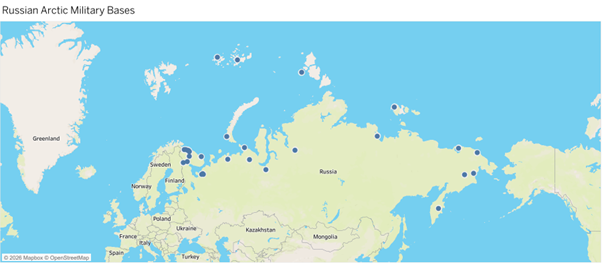
Image Source – American Security Project

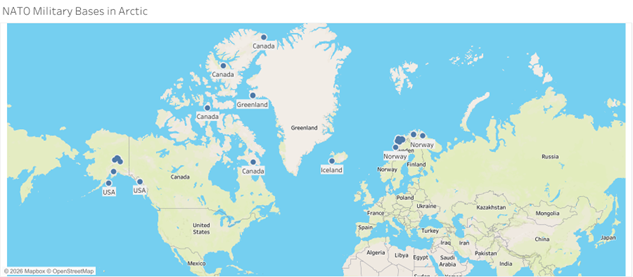
Image Source – FP Analytics – Special Report: Arctic Competition
NATO’s role in the North Pole has grown as the region has been more closely linked to alliance defence, deterrence, and security of the North Atlantic High North Corridor. With the recent accession of Finland and Sweden, the regional balance has shifted to seven NATO Arctic states and Russia, providing the NATO alliance with a significantly wider land, air, and intelligence footprint in the European Arctic while also creating new avenues for domain awareness and intelligence-based sharing. (Gricius, 2024)
This tactical change is also illustrated in the 2024 U.S. Department of Defence Arctic Strategy, which clearly connects the Arctic’s changing security architecture to Russia’s full-fledged invasion of Ukraine, NATO expansion, and increased Russia-China cooperation, while noting that seven of the eight Arctic states are now NATO members. (U.S. Department of Defence 2024 Arctic Strategy, n.d.) The alliance’s flexibility is seen both in strategy and in operational practice. The Steadfast Defender activities in the Nordic theatre involved around 10,000 personnel on the land, as well as over 100 aircraft and 50 ships, reflecting an increasing focus on cold-weather readiness, monitoring, and interoperability in the High North. (Hughes, 2024)
The Arctic could evolve into a future zone of strategic contestation not only owing to its hydrocarbon and mineral reserves, but also because rivalry over access to seabed authority, shipping routes, ports, and key infrastructure is growing. Several analysts suggest that the advent of the Northern Sea Route will have global ramifications because new sea lanes typically draw in port competition, sovereignty issues, and naval positioning, making Arctic access a geopolitical as well as economic concern. (Blunden, n.d.)
As the economic importance of Arctic shipping grows, studies have highlighted the impact of Arctic Maritime Routes across 968 port nodes in the global container system and discovered that fuller integration of these routes increases network interconnectivity. This explains why states view Arctic chokepoints and maritime corridors as essential assets. (Yang et al., 2024) The greatest threat, however, is not an immediate large-scale battle, but rather a more contested grey zone. The maritime hybrid operations exploit infrastructure vulnerabilities and plausible deniability, which has heightened concerns in the Arctic following sabotage incidents in surrounding waters. In that sense, the Arctic is more likely to become a militarized resource frontier than a conventional battleground. (Stensrud & Østhagen, 2024)
The region may not become a literal second Middle East, but it is quickly becoming one of the world’s most contentious strategic economic domains. The area is significant not only for hydrocarbons and minerals, but also for control over sea access, infrastructure, and strategic placement in the face of great power conflict. All of these patterns indicate that the Arctic region’s fate will be shaped by major world powers battling for resources such as vital minerals and hydrocarbons, rather than sea ice melting. (Gricius, 2021)
Disclaimer: The views expressed in this article are those of the author solely. TheRise.co.in neither endorses nor is responsible for them. Reproducing this content without permission is prohibited.
Reference
1. Heggelund, G. M. (n.d.). Critical Minerals in the Arctic: Challenges and Perspectives for the Nordic Countries (CRIMINA). https://www.nordforsk.org/projects/critical-minerals-arctic-challenges-and-perspectives-nordic-countries-crimina
2. Science. (2009, May 29). Assessment of undiscovered oil and gas in the Arctic. https://www.science.org/doi/10.1126/science.1169467?
3. Melia, N., Hawkins, E., & Haines, K. (2016, August 23). Sea ice decline and 21st century trans-Arctic shipping routes. https://agupubs.onlinelibrary.wiley.com/doi/full/10.1002/2016GL069315
4. Regehr, E. (2019, June 28). Cooperative Security and Denuclearizing the Arctic. https://www.tandfonline.com/doi/full/10.1080/25751654.2019.1631696
5. Waldhoff, S., Zhang, Y., Msangi, S., & Edmonds, J. (2024, March 20). Limited increases in Arctic offshore oil and gas production with climate change and the implications for energy markets. https://www.nature.com/articles/s41598-024-54007-x
6. Sonter, L. J., Dade, M., Watson, J., & Valenta, R. (2020, September 1). Renewable energy production will exacerbate mining threats to biodiversity. https://www.nature.com/articles/s41467-020-17928-5?
7. Breyer, C., Bogdanov, D., & Satymov, R. (2025, October 30). From winter wind to summer sun: unlocking the Arctic region’s sustainable energy potential. https://www.sciencedirect.com/science/article/pii/S036054422503748X
8. Childs, N. (2022, April). Gauging the gap: The Greenland–Iceland–United Kingdom Gap – A Strategic assessment. https://www.iiss.org/globalassets/media-library—content–migration/files/research-papers/2022/05/gauging-the-gap_the-greenlandicelandunited-kingdom-gap_a-strategic-assessment.pdf
9. SIPRI, & Klimenko, E. (2016). RUSSIA’S ARCTIC SECURITY POLICY. In SIPRI Policy Paper (p. 45). SIPRI. https://www.sipri.org/sites/default/files/SIPRIPP45.pdf?
10. Childs, N. (2021, December). Security and the Arctic: Navigating between cooperation and competition. https://www.iiss.org/globalassets/media-library—content–migration/files/research-papers/2021/security-and-the-arctic.pdf
11. Boulègue, M. (2019, June). Russia’s military posture in the Arctic managing hard power in a ‘Low tension’ environment. https://www.chathamhouse.org/sites/default/files/2019-06-28-Russia-Military-Arctic_0.pdf
12. Wezeman, S. (2016, October). MILITARY CAPABILITIES IN THE ARCTIC: A NEW COLD WAR IN THE HIGH NORTH? https://www.sipri.org/sites/default/files/Military-capabilities-in-the-Arctic.pdf
13. Bermudez, J., Conley, H., & Melino, M. (2020, March 30). ICE Curtain: S-400 deployments and enhanced defense of Russia’s Western Arctic (Rogachevo Air Base). https://www.csis.org/analysis/ice-curtain-s-400-deployments-and-enhanced-defense-russias-western-arctic-rogachevo-air
14. Gricius, G. (2024, June 7). NATO in the Arctic. https://www.naadsn.ca/wp-content/uploads/2024/10/24_Jun_Gricius_Policy-Primer-NATO-Arctic.pdf
15. U.S. Department of Defense 2024 Arctic Strategy. (n.d.). https://media.defense.gov/2024/Jul/22/2003507411/-1/-1/0/DOD-ARCTIC-STRATEGY-2024.PDF
16. Hughes, T. (2024, December 20). Defence in the Arctic in 2024. https://www.naadsn.ca/wp-content/uploads/2025/01/Hughes_Arctic-Defence-in-2024.pdf
17. Blunden, M. (n.d.). Geopolitics and the Northern Sea Route. Global Maritime Hub. https://globalmaritimehub.com/wp-content/uploads/attach_260.pdf
18. Yang, Z., Pong Poo, M. C., Jarumaneeroj, P., & Lau, Y. (2024, September 11). Assessing the impact of Arctic shipping routes on the global Container Shipping Network’s connectivity. https://pmc.ncbi.nlm.nih.gov/articles/PMC11441395/
19. Stensrud, C. J., & Østhagen, A. (2024, July 5). Hybrid Warfare at Sea? Russia, Svalbard and the Arctic. https://sjms.nu/articles/10.31374/sjms.233
20. Gricius, G. (2021, December 22). Conceptualising the Arctic as a zone of conflict. https://cejiss.org/conceptualising-the-arctic-as-a-zone-of-conflict