


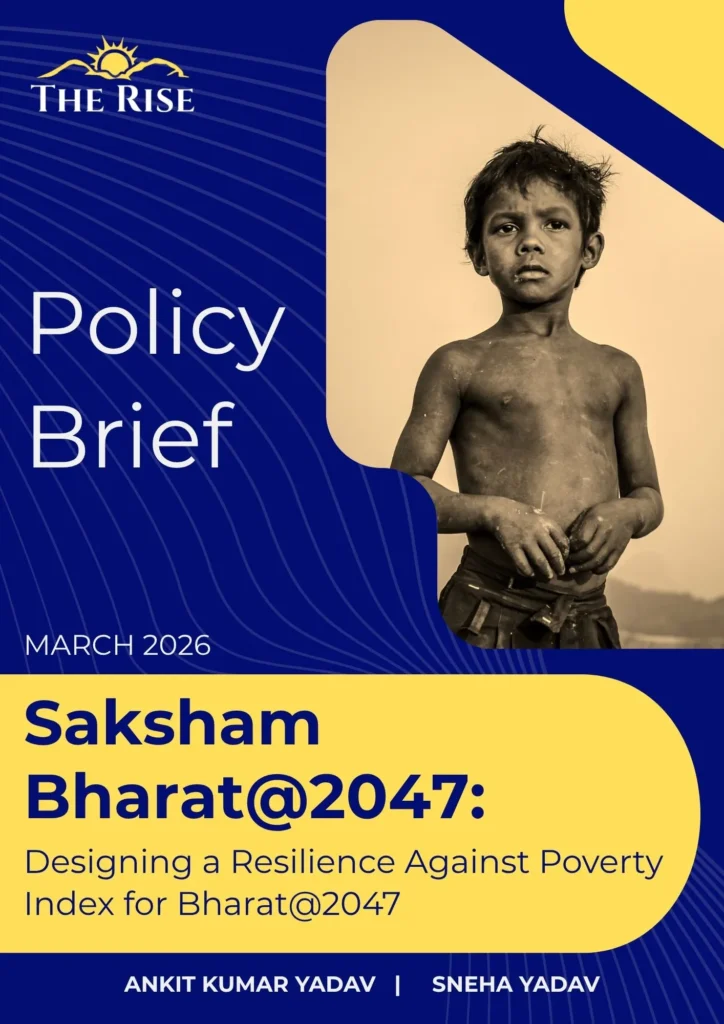
India has witnessed a historic decline in headcount poverty, lifting nearly 25 crore people out of multidimensional deprivation between 2013 and 2023. However, as the nation moves toward the goal of Viksit Bharat@2047, the nature of deprivation is evolving. In 2026, being “not poor” by income standards does not equate to being resilient against systemic shocks. This brief argues for a Resilience Against Poverty Index (RAPI), in which six new resilience-based parameters are introduced to measure a household’s capacity to tide over poverty vulnerabilities.
The evolution of poverty measurement in India is a century-long narrative of moving from a focus on biological survival to a broader understanding of human capability. This journey began in 1867 with Dadabhai Naoroji, who introduced the “jail cost” model—a subsistence line based purely on the bare minimum food required for physical survival. Following independence, the methodology entered a “Calorie-Centric Era” defined by nutritional deficits, where committees like the Alagh Committee (1979) and the Lakdawala Committee (1993) set poverty lines based strictly on daily caloric intake—2,400 calories for rural populations and 2,100 calories for urban populations.[1][2] However, this methodology reduced the measurement of poverty largely to caloric consumption, thereby ignoring the broader dimensions of well-being.
A historic shift occurred with the Tendulkar Committee (2009), which finally moved beyond nutrition-based metrics to incorporate private expenditures on health and education.[3] This evolution culminated in the current NITI Aayog National Multidimensional Poverty Index (NMPI), which tracks 12 indicators across health, education, and living standards, recognising poverty as a deprivation of essential services rather than merely a lack of income.
While comprehensive, the NMPI remains largely static, measuring existing deprivation rather than the vulnerability of households falling into poverty. In this sense, NMPI falls short of being a leading indicator that enables pre-emptive policy tweaks to diffuse the poverty stress points. Further, it also fails to account for emerging structural challenges such as climate change, digital transformation, AI permeation, and other systemic shifts.[4]
To achieve Viksit Bharat@2047, India needs a dynamic index that acts as an early-warning signal against the poverty stress accumulating in the system. This will enable timely policy action to protect households from volatility by accounting for their dynamic vulnerabilities and resilience capacities.
To achieve this, the brief proposes a Resilience Against Poverty Index (RAPI), a forward-looking framework that introduces six resilience-based parameters designed to address the “Invisible Pillars of Future Deprivations”. These indicators include the MSME Ecosystem Health, the Resilience to Climate Shocks, the Productive-Time Poverty for Women, Digital Capability, the Informal Indebtedness, and the Income Diversification Score.
Get a hard copy delivered at your doorstep:
Terms & Conditions:
- Order cancellation procedure: Mail at support@therise.co.in requesting order cancellation with a valid reason within the first 24 hours of order placement. The payment receipt must be mandatorily attached, without which no order cancellation request will be entertained.
- Returns/Replacement: No return/replacement is possible
- Refunds: The complete amount is refundable if the order cancellation request is received at support@therise.co.in within the first 24 hours of the order placement. Refund will be issued in 5-7 working days.