


The Northern Sea Route matters because it shortens the maritime connection between the Russian Arctic and Asian consumers, making Arctic LNG and oil projects more commercially relevant. Overall, the Arctic energy politics will no longer be defined mainly by a Euro–Atlantic framework; instead, Asian demand centres and Eurasian trade dynamics will increasingly shape how Arctic resources are developed and transported.
The Arctic has become a battleground for power and rivalry, and Arctic states must adjust to this new reality. The region contains the biggest concentration of the world’s unexplored oil and gas, as well as uranium, gold, diamonds, and rare earth minerals like phosphate, bauxite, iron ore, copper and nickel.[i]
The average temperature in the region has since risen at nearly three times the world average, increasing more rapidly than any other location on Earth.[ii] Because melting sea ice and innovations in technology have made the region more accessible, Arctic states and multinational corporations see exploration of its hydrocarbon resources as appealing commercial opportunities and long-term capital investments that would greatly boost their reserves.[iii]

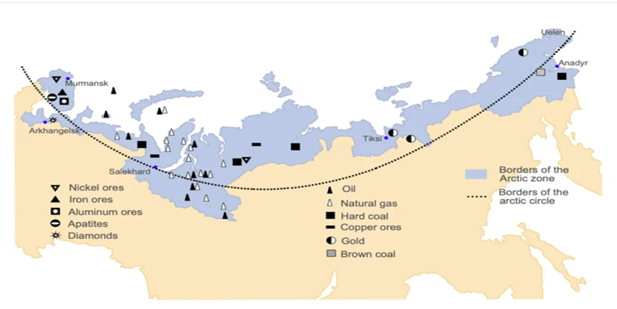
Fig.1. Minerals deposit in the Russian Arctic
Image Source: Research Gate
Russia currently tops the world in solid mineral mining in the Arctic, contributing nearly 40% of the worldwide production of copper, nickel, and diamonds, according to statistics reported by the Institute of Geology of Ore Deposits, Petrography, Mineralogy, and Geochemistry of the Russian Academy of Sciences.[iv]

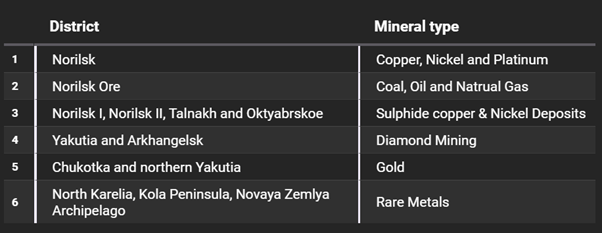
Image Source – Investment Portal of the Arctic Zone of the Russian Federation
Overall, the Arctic terrain is blessed with astonishingly generous quantities of rare-earth elements, ranging from neodymium and praseodymium to terbium and dysprosium, all of which are important to the energy transition, and these are present across Canada, the USA, Russia, and the Nordic Countries, etc.

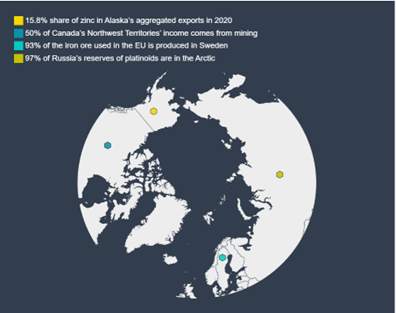
Image Source – Arctic Review – Minerals and Mining
As the primary transportation route for Russia’s Arctic Oil and LNG ambitions, the Northern Sea Route (NSR) is crucial to Arctic Energy Politics. Control over the NSR influences who can export Arctic hydrocarbons because this route connects Arctic resource zones to European and Asian markets. Energy Information Administration (EIA) of the United States, in its analysis of Russia’s energy sector, shows that Arctic pipelines and terminals are being developed to support projects like Vostok Oil, while sanctions have directly impacted Arctic LNG projects because the route is at the nexus of export logistics, geopolitics, and energy production.[v]
Also Read: Middle East Conflict Tests India’s BRICS Leadership
The NSR is strategically vital for Russia, enabling energy exports to Asia while bypassing traditional maritime chokepoints. According to the USS Energy Information Administration, avoiding these chokepoints is essential for energy security to prevent supply delays and price spikes. Politically, the NSR serves as a critical northern alternative to longer conventional southern trade routes.[vi] This has become especially important as Russia has reoriented its energy exports after Western sanctions, with Russian oil flows increasingly shifting towards Asian buyers such as China and India.[vii]
The Northern Sea Route matters because it shortens the maritime connection between the Russian Arctic and Asian consumers, making Arctic LNG and oil projects more commercially relevant than they would be if they depended only on longer southern routes. Research in Communications Earth & Environment notes that Arctic passageways can reduce maritime distance and time between Europe and northwest Asia by 40% and 30%, respectively, when compared to established sea routes such as the Suez Canal.[viii]
Another way the NSR will shape the future is by pushing Arctic energy politics more decisively toward Asia. This shift is visible not only in strategy but also in cargo patterns: Bellona’s January 2026 Arctic monitoring notes that 37.02 million tonnes of cargo moved along the NSR in 2025, of which 58% was LNG, and 24% was crude oil and petroleum products, showing that the route is increasingly tied to energy flows rather than general trade.[ix]
As sanctions strained Russia’s energy relationship with Europe, the commercial logic of Arctic shipping shifted eastward. In 2025, Arctic LNG 2 delivered 23 cargoes totalling around 1.3 million metric tonnes, with all end-user deliveries going to China, indicating that Russia’s sanctioned Arctic gas is already being absorbed by Asian markets.[x]
Overall, the Arctic energy politics will no longer be defined mainly by a Euro–Atlantic framework; instead, Asian demand centres and Eurasian trade dynamics will increasingly shape how Arctic resources are developed and transported. This shift is already visible in the structure of the Arctic Shipping and energy flows. By 2023, around 95% of NSR transit cargo consisted of Russia – China trade, largely involving eastbound oil shipments, highlighting how the corridor is becoming closely tied to Asian markets rather than traditional European ones.[xi] As a result, the NSR is evolving from a regionally constrained shipping lane into a Eurasian energy corridor, where Asian demand will have a growing role in determining both the direction and the political economy of Arctic hydrocarbon exports.
The NSR matters for India primarily as an energy security hedge rather than a full substitute for existing maritime routes. India’s structural dependence on imported hydrocarbons remains high, with imports accounting for more than 90% of its oil needs and roughly half of its gas requirements, making supply diversification a strategic necessity rather than a policy preference.[xii] The significance of the NSR for India lies in its potential to widen access to Arctic and Russian energy flows over time, even if southern routes remain dominant in the foreseeable future. India’s demand for gas is projected by the IEA to rise nearly 60% by 2030, which will increase the importance of secure and diversified import channels.[xiii]
The NSR matters strategically because it aligns with India’s own Arctic policy and energy security outlook. India’s Arctic Policy explicitly states that the Arctic can potentially address India’s Energy Security Needs alongside access to critical and strategic minerals. That makes the Northern Sea Route relevant not just as a shipping corridor but as part of wider Indian calculations about future energy access, Arctic governance, and strategic presence in an emerging region of global competition.[xiv] In addition, the rapid expansion of India-Russia trade, including Russian crude exports to India rising from US $1.221 Billion in 2018 to US $24.988 billion in 2022, suggests that the Northern Sea Route could, over time, support a broader Eurasian commercial logic that goes beyond energy alone.[xv]
Disclaimer: The views expressed in this article are those of the author solely. TheRise.co.in neither endorses nor is responsible for them. Reproducing this content without permission is prohibited.
References
[i] Marsili, M. (2022, September 14). Arctic Security: a global challenge. https://journals.sagepub.com/doi/10.1177/09735984221120299
[ii] Climate change – WWF Arctic. (2025, July 7). WWF Arctic. https://www.arcticwwf.org/threats/climate-change/
[iii] Kondratiev, V. B. (2020, February 9). Mineral resources and future of the Arctic. https://mining-media.ru/en/articles/original-paper/15542-mineral-resources-and-future-of-the-arctic
[iv] Not only gas: gold, diamonds and metals in the Arctic. (2020b, December 8). Arctic Russia. https://arctic-russia.ru/en/article/not-only-gas-gold-diamonds-and-metals-in-the-arctic/
[v] Country Analysis Brief: Russia. (2025, July 24). US Energy Information Administration. https://www.eia.gov/international/content/analysis/countries_long/Russia/pdf/Russia%20CAB_2025.pdf
[vi] World Oil Transit chokepoints. (2026, March 3). US Energy Information Administration. https://www.eia.gov/international/analysis/special-topics/World_Oil_Transit_Chokepoints?utm_source=chatgpt.com
[vii] Soldatkin, V., & Astakhova, O. (2023, December 27). Russia exports almost all its oil to China and India – Novak. https://www.reuters.com/business/energy/half-russias-2023-oil-petroleum-exports-went-china-russias-novak-2023-12-27/
[viii] Zhao, P., Zhang, Y., & Li, Y. (2024, July 30). Ships are projected to navigate whole year-round along the North Sea route by 2100. https://www.nature.com/articles/s43247-024-01557-7
[ix] Monthly Highlights from the Russian Arctic, January 2026. (2026, March 17). Bellona Environmental Transparency Center. https://etc.bellona.org/2026/03/17/monthly-highlights-from-the-russian-arctic-january-2026/
[x] Russia delivered LNG to China from the sanctioned Arctic LNG-2 for the first time since the beginning of the year. (2026, January 27). Ukrainian Shipping Magazine (USM). https://en.usm.media/russia-delivered-lng-to-china-from-the-sanctioned-arctic-lng-2-for-the-first-time-since-the-beginning-of-the-year/?
[xi] Karjee, M. (2025, August 20). Russia’s Arctic Corridor: Between Ice and isolation. https://www.e-ir.info/2025/08/20/russias-arctic-corridor-between-ice-and-isolation/
[xii] Verma, N. (2026, March 19). India, a major energy consumer and refiner, assesses domestic availability. https://www.reuters.com/business/energy/india-major-energy-consumer-refiner-assesses-domestic-availability-2026-03-19/
[xiii] India’s natural gas demand set for 60% rise by 2030, supported by upcoming global LNG supply wave. (2025, February 12). IEA. https://www.iea.org/news/indias-natural-gas-demand-set-for-60-rise-by-2030-supported-by-upcoming-global-lng-supply-wave
[xiv] Bisen, A. (2022, March 17). India’s Arctic policy: Building a partnership for sustainable development. MP – IDSA. https://idsa.in/system/files/issuebrief/ib-india-arctic-policy-abisen-170322.pdf
[xv] Singh, S. (2021, September 5). CO23125 | India, Russia, and the Northern Sea Route: Navigating a shifting strategic environment. S Rajaratinam School of International Relations. https://rsis.edu.sg/rsis-publication/rsis/india-russia-and-the-northern-sea-route-navigating-a-shifting-strategic-environment