


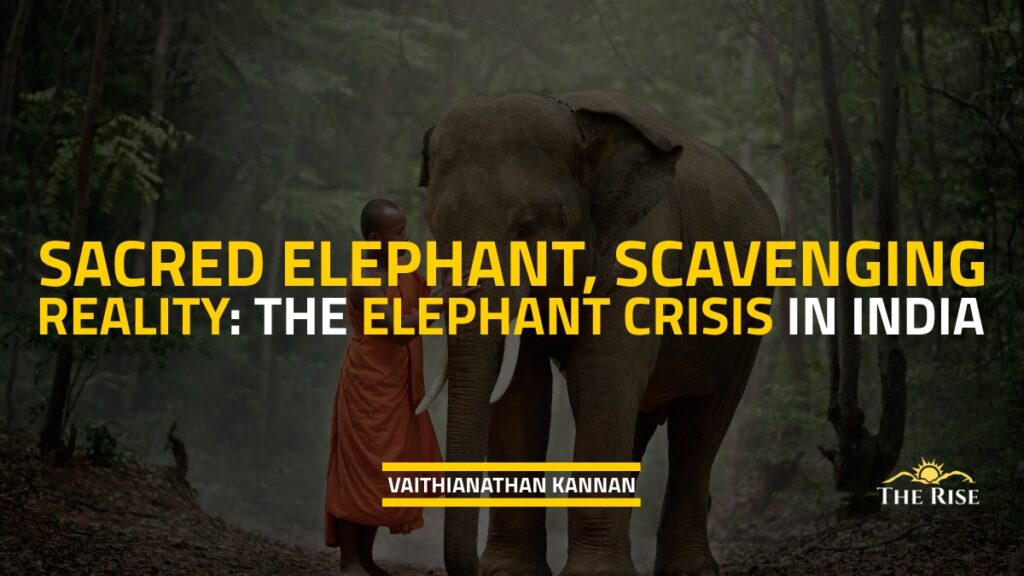
The elephants of India have consistently been intertwined with our spiritual heritage. Yet in the transformed terrains of the Western Ghats, their sacred likeness has faded into a symbolic form, a deity reduced to a scavenger. From broken corridors to unauthorised dumping sites near forests, elephants are more frequently observed consuming food scraps, plastics, and biomedical waste discarded by visitors, farms, or vacation resorts.
A single deity rules with a calm smile and the head of an elephant, Lord Ganesha, the obstacle remover, the god of new beginnings, the fountain of wisdom. In every Indian household, a statue of this Elephant God rests calmly on a shelf or altar. Individuals place their hands on his feet before enterprises, nuptial ceremonies, and travels. They invoke his name before beginning a book or initiating a prayer. Ganesha, known for his large ears and curved trunk, represents more than a symbol; he serves as a continuous, spiritual presence in the everyday lives of the subcontinent.
Yet while incense smoke coils around clay statues in climate-controlled spaces, actual elephants, vibrant representations of that same divine essence, tread softly through a much different India. They do not stroll in temples. They stroll among trash. They do not eliminate barriers; they are treated as obstacles. They do not give blessings to devotees. They are chased away with rocks and shouts. The contrast is shocking in a place where the elephant is revered, yet the elephant is also abandoned.
In the dim green hills of the Western Ghats, one of the oldest and most ecologically diverse mountain ranges globally, this irony is exposed. Elephants used to inhabit these slopes in large groups, shaping the forests through their migration routes, spreading seeds, and performing ecological functions that no other species could. Their herds, guided by the matriarch, embodied the essence of these wild, rain-soaked hills. For the indigenous groups, Irulas, Kurumbas, and Kattunayakans, they were neither adversaries nor deities to be revered, but rather neighbours. The forest was spacious enough for all. However, circumstances have evolved. And swiftly.
Currently, numerous elephants in the Ghats are not wild in the way we envision. They are confined not only by chains or hunters but also by barriers, highways, and the unyielding human desire for additional territory. More tea cultivations. More resorts. Increasingly, roads fragment what were once uninterrupted forests. Elephants now confront electric fences, canals, train tracks, and mountain roads that were previously shrouded in mist and forest paths. They have adjusted, unfortunately, so. Across various regions of Tamil Nadu, Kerala, and Karnataka, elephants have figured out how to scavenge from waste heaps on the outskirts of towns and forest communities. They are often seen extracting plastic bags from public garbage, munching on leftover biryani combined with batteries, foil, and food packaging. Certain calves have never experienced a forest free from plastic. Their faeces now reveal traces of aluminium, plastic, and glass. Yet, Ganesha continues to smile.
Also Read: Puttenahalli Lake: A Model for Urban Lake Restoration in Bengaluru
This cultural disconnection is profoundly disturbing. The individuals who stand in line for hours during Ganesh Chaturthi to present sweets to the idol are frequently quiet or even complicit when real elephants are electrocuted by fences, struck by trains, or poisoned to protect crops. Captive elephants continue to be displayed in temples, their spirits shattered beneath a long-standing tradition that has transformed into cruelty. Their wild relatives, in contrast, are labelled a nuisance when they emerge from forests that have steadily vanished. Beyond the myths, beyond the conservation politics and human-wildlife conflict, and even beyond the symbolism, what defines elephants?
To address this question, we need to accompany them not as tourists with cameras, nor as worshippers with incense, but as modest witnesses. Observers of their intellect, their sorrow, their memory, and their capacity to forgive. Witnesses also to our capacity for destruction, to how we have altered landscapes for profit instead of reverence. If Ganesha embodies wisdom, then wisdom must start with recognising the divine in the living rather than in the sculpted. If elephants are revered, then the habitats they require, such as forests, rivers, and migration routes, should be safeguarded with the same fervour we reserve for festivals.
God on Garbage
In the dusky haze of the Western Ghats, an elephant wanders. Not with grandeur, nor with the respect of the “living god” worshipped, but with a shredded plastic bag caught in her tusks, searching through the remnants of what was once a forest and is now the detritus of human consumption. This is not a fable. This is the sacred irony of India
Sacred Species or Scavenging Shadows?
The elephants of India have consistently been intertwined with our spiritual heritage. In the temples of Tamil Nadu and the forest legends of Kerala, they were honoured as emblems of knowledge, power, and favourable beginnings. Yet in the transformed terrains of the Western Ghats, their sacred likeness has faded into a symbolic form, a deity reduced to a scavenger. From broken corridors to unauthorised dumping sites near forests, elephants are more frequently observed consuming food scraps, plastics, and biomedical waste discarded by visitors, farms, or vacation resorts
The Western Ghats: A Shrine Turned Slaughterhouse
The Western Ghats, classified as one of the planet’s eight “hottest hotspots” of biodiversity, have turned into a harsh irony. These 1,600 km of undulating, wooded hills that once resonated with the sounds of wild herds are now divided by highways, railroads, resorts, dams, and barriers. The final haven for elephants in southern India is being threatened not just by poachers, but also by bulldozers, pavement, and plastic. Take into account the following:
- Karnataka’s coffee plantations and Kerala’s spice farms hinder elephant migration, substituting indigenous vegetation with single-crop cash crops frequently secured by electric fences.
- The pilgrimage paths in Tamil Nadu, like the Sabarimala trail, generate more waste than respect, with plastic food containers, liquor bottles, and charred offerings cluttering the forest ground.
- Tourism in eco-sensitive areas has turned more exploitative than educational. Resorts advertise “elephant views” from their balconies while erecting barriers that disrupt migration paths.
From Megafauna to Megagarbage
Elephants possess remarkable memories, yet ours appear alarmingly brief. Originally regarded as symbols of ecological strength and forest engineers who influenced plant life and seed distribution, they have now become unwilling participants in the waste economy. Research conducted in the Nilgiris and Anamalai Hills has verified the existence of microplastics, aluminium foil, and glass in elephant faeces. They scavenge at roadside trash heaps because their natural paths are obstructed by urban developments. They invade sugarcane fields not due to aggression, but because the shrinking forest can no longer sustain them. They are shot at, electrocuted, or frightened away with firecrackers, and when they respond, we term it “man-animal conflict.”
The Sin of Sacred Hypocrisy
India celebrates Lord Ganesha annually with great splendour. Crores are invested in idols, parades, and communal celebrations. Yet the species that inspired this deity endures in misery. In regions such as Kerala and Tamil Nadu, captive elephants are still showcased in the scorching sun during festivals, shackled for months, forced into obedience, and subsequently overlooked. Captive elephants represent the clearest embodiment of this sacred hypocrisy. Yet wild elephants bear the quieter and heavier burden.
Conservation that Consumes
Even conservation efforts are not free from scrutiny. Bureaucratic approaches to elephant management frequently depend on translocation, radio-collaring, or barriers and enclosures, prioritising control over coexistence. When elephants are viewed as “issues” to be moved, sedated, or kept within artificial limits, we overlook their cognitive abilities, their recollections, and their intricate social connections.
In the interest of preservation:
● We separate matriarchs from groups.
● We interfere with long-standing migratory routes using solar barriers.
● We idealise “man-animal conflict” in policy discussions, yet fail to adequately finance meaningful long-term mitigation on the ground.
Local communities, Adivasis, and people residing in forests who have coexisted with elephants for generations are rarely included in the discussion. The solutions are frequently designed without compassion.
Toward a New Devotion: From Worship to Respect
We must shift our perspective on elephants from being stone-carved deities to living, conscious creatures. The path to justice is found not in ceremonies or superficial gestures, but in legislation, compassion, and reparation; conversely, corridor restoration and land-use planning should be prioritised nationally, with enforceable laws and community involvement. The essential requirement is the modernisation of waste management near forests, particularly in pilgrimage towns and tourist hotspots, which must be implemented as strictly as anti-poaching regulations, with substantial fines as penalties.
Epilogue: The Trunk as Mirror
In the thoughtful gaze of a searching elephant calf, there is no trace of revenge. There is bewilderment, sadness, and maybe a hint of curiosity still lingering. She is unsure why plastic tastes like banana, or why her mother limps from an old wire-snare injury, or why humans shout when she strays too close. Yet she recalls. The group recalls. And the Ghats recall. In every ravaged terrain, in every desecrated temple, the elephant now mirrors us not as deity, but as a spectre, as a scavenger, as a mourning relative.
Disclaimer: The views expressed in this article are those of the author solely. TheRise.co.in neither endorses nor is responsible for them. Reproducing this content without permission is prohibited.