


India has chosen an incremental approach with clear national objectives to expand its naval power. Consistent growth builds credibility and trust among partners in maritime exercises. However, India will require accelerated naval expansion and modernisation in response to growing threats in the Indo-Pacific region and advancements in technology, such as artificial intelligence
In the twenty-first century, countries began to invest in and expand their naval sectors. The growing importance of seas and oceans has led to heightened concerns around maritime security. India has a strategic edge due to its maritime geostrategic position, including a 7,500-kilometre-long coastline in the Indian Ocean region. With critical sea lanes, checkpoints, and nearly 90% of India’s global trade by volume dependent on maritime routes, maritime security has become an inseparable component of India’s economic strategy. Naval expansion is crucial for India’s economic growth, international prospects, and enhanced deterrence. To evaluate a country’s naval capabilities, it is necessary to examine the investment in modernisation and fleet expansion.
Overview: Indian Submarine Fleet
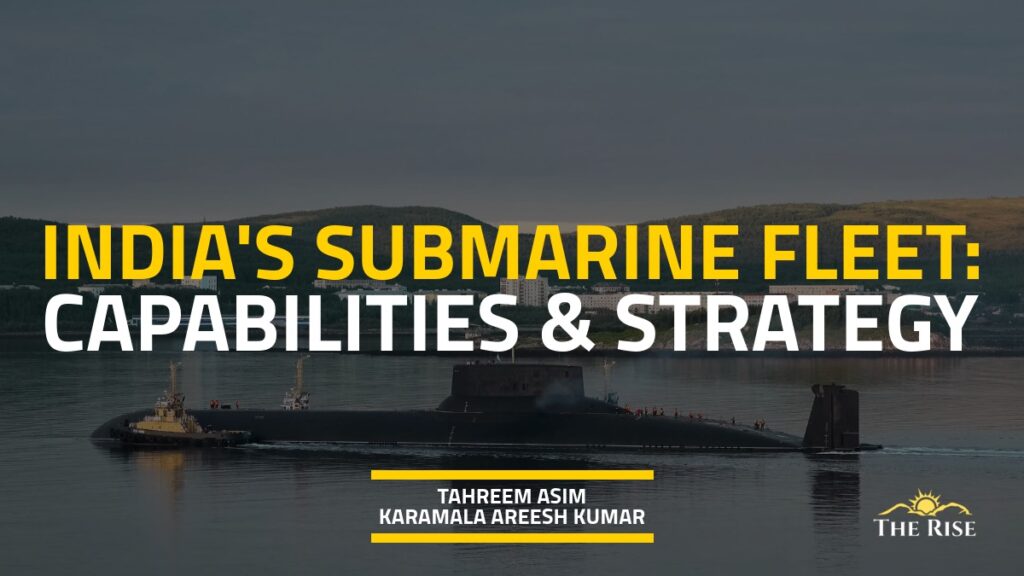
Indian submarines play a crucial role in maritime security and nuclear deterrence and are often referred to as the “silent service.” As of March 2025, India has four SSBNs (nuclear-powered ballistic missile submarines) and 17 diesel-electric attack submarines.
Among nuclear-armed missiles, India has INS Arihant (S2) and INS Arighat (S3), which joined the Indian Navy on 29th August 2024. INS Aridhman (S4) is currently undergoing final trials, while S4* (yet to be named) is expected to be commissioned by 2027.
Diesel-electric submarines, the Sindhughosh class (Kilo Class-Type 877EM), originated in Russia and have been a significant support system for the Indian Navy. The Sindhughosh class has a weapon capability comprising torpedoes and cruise missiles. The Shishumar Class (Type 209/1500) was designed by Germany and upgraded by ThyssenKrupp Marine Systems. It has torpedo capabilities. The Shishumar class included modern upgrades such as advanced combat systems and Boeing anti-ship missile systems, enhancing its strike capability.
The Kalvari Class (Scorpene Project 75), built by Mazagon Dock Limited in collaboration with the French Naval Group, plays a crucial role in anti-surface, anti-submarine, intelligence, surveillance, reconnaissance(ISR), and mine-laying operations. The commissioned vessels include INS Kalvari, INS Khanderi, INS Karanj, INS Vela, INS Vagir, and INS Vagsheer. These enhance India’s undersea warfare strength. The Kalvari Class features Air-Independent Propulsion (AIP), enabling submarines to remain underwater for extended periods.
The Advanced Technology Vessel (ATV) programme, launched in 1983, involves the DRDO, Department of Atomic Energy (DAE), and the Indian Navy, under which India has planned four SSBNs. India has also leased nuclear submarines, such as the Akula class (Project 971 Schuka-B) from Russia, which are crucial for SSBN protection and weapon integration, such as advanced torpedoes and cruise missiles. The Chakra III lease deal is now expected to become operational.
Recent Developments and Maritime Engagements
In February 2025, the Indian Navy and Thyssenkrupp Marine Systems signed a contract to develop the Project 75(I) and Project 75 Alpha, which will include six new diesel-electric submarines. These submarines will be designed in Germany and assembled in India. The new submarine investment benefits both the Make In India initiative and India’s conventional submarine fleet.
Initially, China and Pakistan possessed advanced Air-Independent Propulsion (AIP) capabilities, such as China’s Type 039 Yuan-class submarine, Pakistan’s Hangor-class submarines and the CM-302 missile, which created a strategic vulnerability. However, Project 75(I) and 75 Alpha address this gap, providing India with greater strategic autonomy and increasing its underwater combat capabilities.
On December 25, 2025, India tested the nuclear-capable K-4/Kalam 4 submarine-launched ballistic missile, manufactured by DRDO, in the Bay of Bengal. K-4 is named in honour of Dr APJ Abdul Kalam. The missile was deployed from INS Arighat, demonstrating India’s nuclear maturity and ability to retaliate. While India continues to expand its maritime capabilities through submarines and missiles, conventional submarines remain the backbone of the Indian Navy.
Also Read: Trump’s Tariffs, China’s Surplus, and a Shifting Global Order
India has also expanded its maritime engagements through exercises such as Malabar, QUAD, MILAN, SIMBEX, JIMEX, and others. Diversification of maritime multilateral engagement promises stability. India has expanded its MAHASAGAR vision to include Global South nations, reinforcing its role as a net security provider in the Indian Ocean Region (IOR).
To counter China and Pakistan, India has strengthened its naval presence in the Indian Ocean Region while investing in HADR (Humanitarian Assistance and Disaster Relief), during cyclones, as well as in anti-submarine warfare capabilities. India portrays itself as a leader in the Indo-Pacific region by integrating diplomacy with relief. Naval modernisation has emerged as a key instrument for strategic partnerships and regional stability.
As technology continues to evolve, the modernisation of naval power will always be an ongoing project. India has chosen an incremental approach with clear national objectives to expand its naval power. Consistent growth builds credibility and trust among partners in maritime exercises. However, India will require accelerated naval expansion and modernisation in response to growing threats in the Indo-Pacific region and advancements in technology, such as artificial intelligence. In conclusion, India’s maritime modernisation reflects broader strategic development. As competition in the waters increases, naval expansion will enable India to reshape the maritime order.
Disclaimer: The views expressed in this article are those of the author solely. TheRise.co.in neither endorses nor is responsible for them. Reproducing this content without permission is prohibited.