


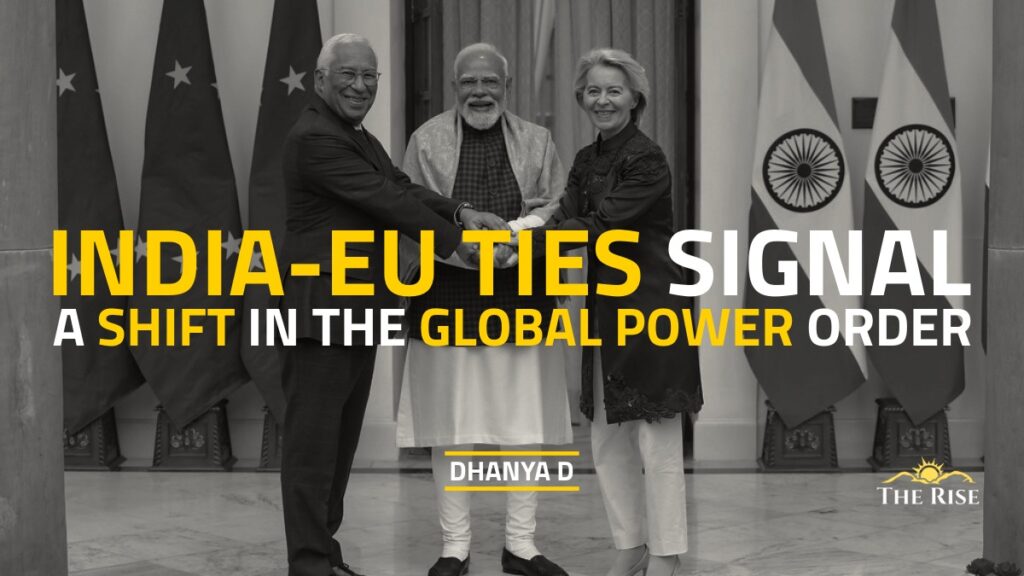
The India-EU partnership is increasingly shared by democratic values and mutual benefit, contributing to an emerging architecture of international order built not on rigid blocs but on flexible coalitions.
The unprecedented participation of the top EU leaders as chief guests at the Republic Day Celebrations in India marks Europe’s paradigm shift in viewing India as an ally and an able partner in the enduring new global order with the vision of inclusivity, partnership and shared values.
What has changed?
Amidst US belligerence towards its allies in Europe and the invasion and capture of the Venezuelan leader, trust in the US is slowly diminishing in maintaining the rules-based order in international relations.
As the saying goes, “there are no permanent allies or enemies in International Relations.” India’s placement in the current geopolitical churn has become strategically opportune.
With America’s trade war with China, Europe’s energy crisis and supply chain rerouting because of US President Trump’s tariffs, middle-power countries like India play a balancing role amid the great power competition.
India’s strategic autonomy amidst an unpredictable global order gives it the leverage of freedom of choice. India’s foreign policy of “multi-alignment”, a term coined by External Affairs Minister S. Jaishankar (as opposed to Nehru’s non-alignment ), proposes mini-lateralism and coalitions among countries with shared values, inclusive decision-making and cooperation. India holding memberships in contradictory groupings like Quad comprising the US, Japan, Australia, and BRICS (with China, Russia, South Africa, later expanded to include Ethiopia, Brazil, Egypt, Indonesia, Saudi Arabia and UAE) shows the multi-alignment strategy of India and its well-calibrated foreign policy approach.
Also Read: Middle East Turmoil and Its Impact on India’s Strategic Interests
The discussions of the Free Trade Agreement between India and the EU leaders also paves way for enhanced security and defence partnership, as well as energy cooperation. India’s defence partnerships remain unique in that its cooperation with the EU does not impact its long-enduring partnership with Russia, despite Moscow facing Europe’s 16th sanctions package targeting its energy and defence sectors.
Maritime Security
EU leaders’ growing emphasis on the enhancement of maritime security and the protection of freedom of navigation stems from rising geopolitical competition marked by rapid military modernization and increased naval deployments. These dynamics increase the risk of escalation of conflicts in the maritime flashpoints such as the Taiwan nexus, South China sea and the Korean Peninsula as well as asymmetric threats such as piracy, transnational crimes, terrorism and drug trafficking. With approximately 90 percent of world trade passing through the Indo-Pacific, safeguarding these vital sea lanes has become imperative for global economic stability and European interests.
India’s geographic position and its role as a first responder in the Indian Ocean have given assurance and credibility that Europe seeks in Indo-Pacific maritime partnership. India and the EU have further reiterated their shared commitment to promoting a free, open, peaceful and prosperous Indo-Pacific, in accordance with international law. The leaders welcomed closer engagement in the region through the inaugural edition of India-EU Consultations on the Indo-Pacific in New Delhi, joint activities under the Indo-Pacific Oceans Initiative (IPOI), and strengthened cooperation within the Indian Ocean Rim Association (IORA) under India’s chairship.
India’s balancing act between these competing powers is akin to walking a tightrope, yet New Delhi has remained steady in its approach. The Republic Day presence of European Council President Antonio Costa and European Commission President Ursula von der Leyen symbolizes a fundamental shift in global power dynamics where India’s strategic choices carry weight that few middle powers can claim. The India-EU partnership is increasingly shared by democratic values and mutual benefit, contributing to an emerging architecture of international order built not on rigid blocs but on flexible coalitions.
In a transitioning and turbulent world order, India’s place is one of growth, optimism, resilience and an unwavering commitment to its national interests.
Disclaimer: The views expressed in this article are those of the author solely. TheRise.co.in neither endorses nor is responsible for them. Reproducing this content without permission is prohibited.