


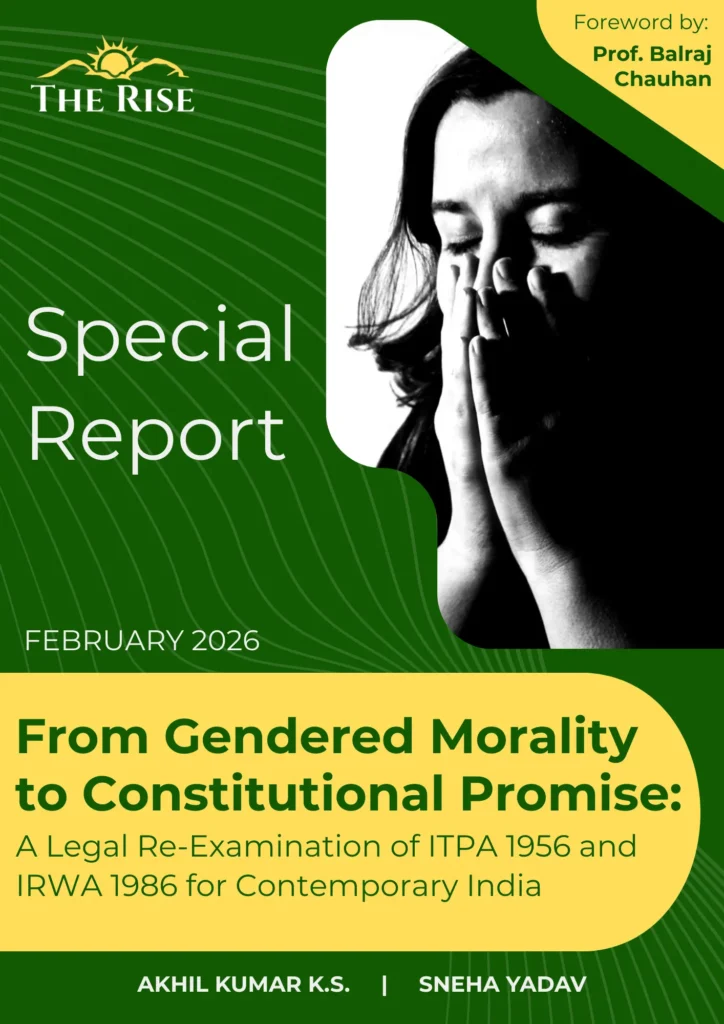
India’s constitutional and legal landscape is replete with provisions for gender justice. Of these, the decades-old legal architecture on trafficking and gender representation in media are especially getting challenged with the evolving societal aspirations, jurisprudential principles, and technological advancements. Re-examining these laws to align them with contemporary realities, thus, becomes vital. This report undertakes a comprehensive legal analysis of the anti-trafficking and gender representation architecture under Indian law, with a primary focus on the Immoral Traffic (Prevention) Act, 1956 (ITPA) and the Indecent Representation of Women (Prohibition) Act, 1986 (IRWA). Anchored in constitutional principles of equality, dignity, autonomy, and freedom from exploitation, the study evaluates whether India’s statutory and institutional responses adequately address the gendered and intersectional realities of trafficking and representation in contemporary society.
The analysis reveals a persistent disconnect between constitutional guarantees under Articles 14, 15, 19, 21, and 23 and their statutory implementation. While constitutional jurisprudence has progressively expanded notions of personal liberty, decisional autonomy, and dignity, both the ITPA and IRWA continue to operate within morality-driven and paternalistic legal frameworks. The ITPA, in particular, fails to clearly distinguish between trafficking and consensual adult sex work, resulting in the indirect criminalization of sex workers and the re-victimization of survivors through coercive rescue operations, arbitrary raids, and compulsory institutional detention. Such practices undermine autonomy, privacy, and due process, thereby contravening constitutional mandates.
The report further highlights the gender-exclusionary nature of India’s anti-trafficking framework. Despite judicial recognition of transgender rights, the statutory provisions remain largely women-centric, rendering transgender persons, gay men, and other LGBTQIA+ individuals invisible and vulnerable to discriminatory enforcement. Fragmentation and overlap among multiple statutes, such as the ITPA, Bharatiya Nyaya Sanhita (BNS), and the Information Technology Act (IT Act), further exacerbate inconsistencies in definitions, enforcement standards, and survivor protection.
In relation to gender representation, the IRWA is found to be outdated, vague, and ill-equipped to address contemporary digital and algorithm-driven media ecosystems. Its reliance on undefined notions of “indecency” enables moral policing, arbitrary censorship, and chilling effects on free speech, while failing to adopt a harm-based or consent-sensitive approach.
The report concludes by emphasizing the urgent need for comprehensive legal reform. It advocates a survivor-centric, gender-inclusive, and rights-based framework that clearly differentiates trafficking from consensual activity, harmonizes overlapping laws, incorporates digital realities, and aligns domestic legislation with constitutional values and international standards such as the Palermo Protocol and CEDAW.
Get a hard copy delivered at your doorstep:
Terms & Conditions:
- Order cancellation procedure: Mail at support@therise.co.in requesting order cancellation with a valid reason within the first 24 hours of order placement. The payment receipt must be mandatorily attached, without which no order cancellation request will be entertained.
- Returns/Replacement: No return/replacement is possible
- Refunds: The complete amount is refundable if the order cancellation request is received at support@therise.co.in within the first 24 hours of the order placement. Refund will be issued in 5-7 working days.