


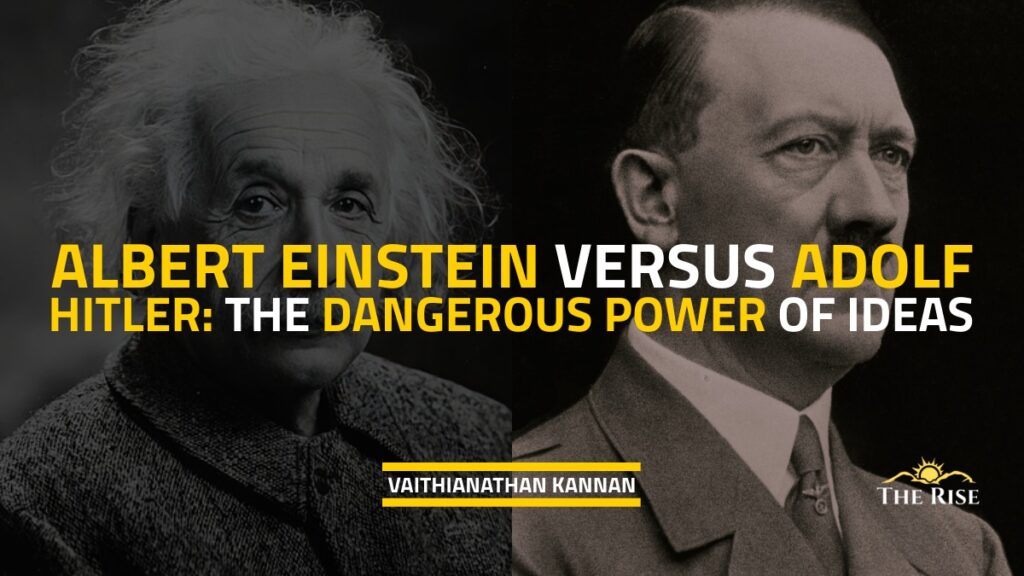
Hitler and Einstein represented two extremities of human potential. Hitler embodied the danger of hatred, ideology, and misuse of power. Einstein – the danger of knowledge, brilliance, and unintended consequences. Adolf Hitler’s evil was deliberate, yet bound in time. Einstein’s brilliance was innocent, yet boundless in consequence.
The question sounds too shocking for the reader: “Why is Einstein more dangerous than Hitler?” How could a gentle, wild-haired genius of The Theory of Relativity be compared to the dictator responsible for one of history’s darkest genocides? However, lurking beneath the surface of history is a paradox: Adolf Hitler wielded immediate and visible power, one that destroyed millions of lives during his reign. Albert Einstein, in contrast, did not command armies, nor did he preside over death camps. However, the seeds of his ideas, scribbled on chalkboards, physics explored through abstract equations, helped reshape the destiny of humanity in ways far more enduring than Hitler ever could.
Danger here does not mean evil intentions; rather, it refers to a potential and invisible kind of danger, the kind that alters civilization itself. This essay delves into that paradox: how Einstein, through science and the unintended consequences of his ideas, might be considered more dangerous than Hitler. It is an inquiry into the powers of knowledge versus brute force, intellect versus ideology, and the long shadow cast by ideas that changed not just wars, but the future of mankind itself.
Also Read: Queen Tomyris: The Myth, The Legend of Massagetae
Hitler’s Power: Visible and Finite
Adolf Hitler’s danger lay in the immediacy of his actions. He rose to power in 1933, manipulated German nationalism, and ignited a war that consumed Europe and beyond. His atrocities of World War II, the Holocaust, racial persecutions, and mass violence left scars that humanity still studies with horror. However, his influence was bound by time. Hitler’s Reich collapsed in 1945. The Nazi ideology, though surviving in fragments, never again held comparable global power. His danger was monstrous, yet ultimately mortal.
Hitler’s reign of terror can be measured: six years of war, twelve years of dictatorship, and tens of millions of lives lost. The question, however, is whether Hitler’s brand of destruction ended when he died in his Berlin bunker. The answer is essentially yes; his danger was extinguished with his fall. His violence was rooted in ideology; nevertheless, ideology without armies is a fading echo.
Einstein’s Danger: Invisible and Infinite
Now consider Einstein. Unlike Hitler, he never sought political power. However, his scientific genius produced intellectual revolutions with infinite consequences. The theory of relativity seemed abstract: curved spacetime, the speed of light as a cosmic speed limit. Nevertheless, hidden within those equations lay a terrifying truth: energy and matter are interchangeable, expressed in the deceptively simple equation: E = mc².
That equation unlocked the possibility of nuclear power and nuclear weapons. Einstein himself did not invent the atomic bomb; yet, his ideas laid the groundwork. When the Manhattan Project scientists split the atom, it was Einstein’s physics that made the weapon possible. Einstein’s intellectual legacy became far more dangerous than Hitler’s armies. Hitler’s bullets killed millions, but Einstein’s formula enabled weapons that could end civilization itself. Hiroshima and Nagasaki were only the beginning—humanity entered an age where one could potentially trigger global annihilation. Unlike Hitler’s danger, Einstein’s danger did not end in 1945. It continues to haunt humanity in the 21st century.
Also Read: Rani Abbakka of Ullal: The Admiral Queen Who Fought Portuguese
Case Study I: Hiroshima and Nagasaki
In August 1945, the world saw Einstein’s shadow materialise in fire. The U.S. dropped two atomic bombs on Japan. While in Hiroshima (6 August 1945), “Little Boy” killed an estimated 140,000 people by the end of the year, in Nagasaki (9 August 1945), “Fat Man” killed another 70,000–80,000. The bombs incinerated cities in seconds. Survivors bore burns, radiation sickness, and genetic scars that lasted generations. The mushroom cloud became the new symbol of human power and peril. Though Einstein himself did not work on the Manhattan Project, in his 1939 letter to President Roosevelt (co-signed with Leó Szilárd), he had warned of Nazi Germany’s potential nuclear program, thereby spurring the U.S. effort. He later lamented: “If I had known that the Germans would not succeed, I would never have lifted a finger.”
Here lies the paradox: Hitler slaughtered with intent. Einstein enabled slaughter without intending to. Nevertheless, the bombs of Hiroshima and Nagasaki demonstrated how his ideas, not Hitler’s armies, introduced humanity to the possibility of instantaneous apocalypse.
Case Study II: The Cold War and Mutually Assured Destruction
After 1945, Einstein’s danger multiplied. The U.S. monopoly on nuclear weapons ended in 1949 when the Soviet Union tested its first atomic bomb. Thus began the nuclear arms race. By the 1960s, both superpowers stockpiled thousands of warheads, many far more powerful than those dropped on Japan. The doctrine of Mutually Assured Destruction (MAD) meant that any nuclear war would annihilate both attacker and defender. The world teetered on the edge of Einstein’s equation.
The most chilling moment came during the Cuban Missile Crisis (1962). The U.S. and USSR stood minutes away from launching nuclear strikes that could have killed hundreds of millions. Unlike Hitler’s six-year war, Einstein’s nuclear shadow haunted humanity for decades, with the constant threat of extinction hanging over every life. Even today, nearly 80 years after Hiroshima, nuclear weapons amount to some 12,500 warheads across nine countries. Hitler’s Reich is gone, buried in the bunker; Einstein’s danger is alive.
Also Read: Razia Sultan: The Only Woman Ruler of Delhi
Case Study III: Chernobyl and Fukushima – Peaceful Atoms, Deadly Consequences
Einstein’s danger was not confined to war. His equation also made nuclear power possible, hailed as a clean energy revolution. Nevertheless, peaceful atoms can be as dangerous as weaponised ones. Chernobyl (1986, Ukraine): A reactor exploded, releasing radioactive material across Europe. The entire region became uninhabitable, thousands died or suffered cancers, and ecosystems remain poisoned decades later. Fukushima (2011, Japan): An earthquake and tsunami triggered reactor meltdowns, again scattering radiation, forcing mass evacuations, and raising global fear of nuclear safety. Here we see Einstein’s double-edged legacy. The exact science that lights homes can also poison landscapes. Nuclear accidents may not rival Hitler’s deliberate crimes; nevertheless, their long-term, trans-generational scale of impact renders Einstein’s ideas perpetually dangerous.
The Paradox of the Pacifist Genius
Einstein, ironically, was a pacifist. He hated violence and opposed war. Yet, he also feared Hitler. In 1939, together with physicist Leó Szilárd, Einstein wrote a famous letter to U.S. President Franklin Roosevelt. They warned that Germany might build an atomic bomb and urged America to pursue research. That letter sparked the Manhattan Project, leading to the first nuclear weapons. Einstein, though, later regretted signing the letter.
Also Read: Exploring the Intersection of AI, Web Data Scraping, and Copyright: Legal and Ethical Considerations
Nevertheless, by then, the genie was out of the bottle. Knowledge cannot be unlearned. This makes Einstein’s danger different from Hitler’s: it was unintended, almost tragic. He armed humanity with tools far deadlier than Hitler’s tanks and gas chambers. He did not destroy cities himself; yet, his ideas ensured that cities could be destroyed, over and over again, across generations.
Knowledge vs. Power: Which is More Dangerous?
To compare Hitler and Einstein is to compare two forms of power. Hitler’s power was political, ideological, and violent. He used charisma, fear, and propaganda to bend people into instruments of war. His danger ended when his power collapsed. Einstein’s power was intellectual and scientific. He revealed truths about the universe that gave rise to technologies far beyond his lifetime. His danger still persists because knowledge outlives its discoverer. One would argue that Einstein is more dangerous, precisely because knowledge is irreversible. The atomic bomb, nuclear energy, space travel, GPS, and lasers all stem from Albert Einstein’s theories. Some of these technologies have brought significant progress. Others keep humanity teetering on the edge of self-destruction.
The Nuclear Shadow
Post 1945, Einstein’s shadow loomed and did not spare the world. The Cold War became a standoff built on nuclear weapons. The United States and the Soviet Union amassed arsenals capable of destroying the Earth many times over. Mutually Assured Destruction (MAD) became the doctrine of survival. Hitler terrified a generation. Einstein’s physics terrifies every generation since.
The nuclear shadow extends into today’s conflicts; any war among nuclear powers risks apocalyptic escalation. North Korea, India, Pakistan, Israel, and others wield weapons born out of Einstein’s formula. This is why some historians regard and consider Einstein’s danger far exceeded Hitler’s: Hitler could kill millions. Einstein’s equation could kill billions, or all.
Beyond Nukes: The Other Side of Einstein’s Danger or Einstein’s Expanding Shadow
The danger of Einstein does not end with atoms. His theories have rippled into technologies that reshape modern life. Einstein’s theories were not limited to atomic power. They reshaped all of modern science. Consider these examples:
- Nuclear power plants – Though considered peaceful energy, disasters like Chernobyl and Fukushima have shown their monstrous sides
- Space Technology – Relativity allows GPS to function. Nevertheless, similar satellites guide intercontinental ballistic missiles.
- Artificial Intelligence and Quantum Physics– Though indirect, Einstein’s breakthroughs accelerated the physics that underpin today’s AI race, which itself poses hidden dangers.
- Surveillance and Military Technology- Applications of relativity and quantum mechanics have fuelled defence systems, precision targeting, and global surveillance. Thus, Einstein’s danger lies not only in nuclear bombs but also in how his science continuously fuels human capacity to dominate, control, and destroy. Therefore, Einstein’s danger is cumulative; it keeps expanding as science evolves.
Also Read: Mula Gabharu: The Woman Who Fought to Avenge Her Love
The Morality of Danger
Nevertheless, here lies the deeper philosophical question: is Einstein truly “dangerous,” or is it humanity’s use of his ideas that is dangerous? Einstein himself never built a bomb, never launched a missile, and never ordered destruction. Hitler did. However, the uncomfortable truth is that knowledge is inherently devoid of morality. Once discovered, it exists, waiting to be used. The responsibility shifts from the scientist to the statesman, from Einstein to the Hitlers of the future. However, the scientist bears a share of the burden because revealing knowledge is to unleash it, regardless of the intent.
This is why Albert Einstein feared his own discoveries. At this point, we must ask: Is Einstein himself truly dangerous, or is it humanity’s use of his ideas? Hitler intended his crimes. Einstein intended discovery. Nevertheless, knowledge has no morality. Once revealed, it cannot be hidden. Scientists may warn, but politicians and generals decide. Einstein himself foresaw this tragedy, warning: “The unleashed power of the atom has changed everything save our modes of thinking, and thus we drift toward unparalleled catastrophe.” He understood that danger is not in the idea, but in the minds of men who wield it. Here lies the haunting truth – Albert Einstein’s danger is not in his ideas alone, but in humanity’s inability to handle them wisely.
Hitler and Einstein: Two Faces of Human Potential
The most intriguing way to answer the question is this: Hitler and Einstein represented two extremities of human potential. Hitler embodied the danger of hatred, ideology, and misuse of power. Einstein embodied the danger of knowledge, brilliance, and unintended consequences. Adolf Hitler’s evil was deliberate, yet bound in time. Einstein’s brilliance was innocent, yet boundless in consequence. Both show that danger does not come only from an evil tyrant, but also from pure curiosity, a mind that sees too far, from ideas too powerful for humanity to control.
Which is More Dangerous?
Hitler destroyed millions of lives; yet, Einstein’s work could potentially destroy civilisation itself. Hitler’s danger ended in 1945; Einstein’s danger began in 1905 and still continues. Thus, in the cold logic of history, one might argue that Einstein is even more dangerous, not because he chose destruction, but because his discoveries gave humanity the power to choose destruction again and again.
However, there is a twist: Albert Einstein also gave humanity the tools for survival, progress, and enlightenment. Nuclear medicine, clean energy, and space exploration all owe their existence to him. His danger is double-edged: creation and destruction, salvation and annihilation. Thus, one may argue that Einstein is “more dangerous” not because he was evil, but because his legacy is infinite. His discoveries were double-edged: he gave us weapons of annihilation, but also tools for progress in nuclear medicine, renewable energy, and space exploration.
This paradox makes Albert Einstein not a villain, but a tragic hero, a man whose vision outpaced humanity’s morality. In simple terms, Hitler destroyed millions. Einstein’s ideas could destroy all. Hitler’s danger ended with his death. Einstein’s danger grows with time.
Also Read: Heritage Sovereignty: The Legal Labyrinth India Navigates for UNESCO Glory
The Real Question
So, why is Albert Einstein still considered more dangerous than Adolf Hitler? It is even trickier to wisely answer this realistic question. Albert Einstein, or rather his discoveries, were a double-edged sword. It also depends on the individual’s perspective who is answering the question. We know Hitler’s war was fought with tanks and guns, while Einstein’s war, if it ever comes, would be fought with atoms and annihilation. Adolf Hitler’s terror belonged to one century, whereas Einstein’s shadow stretches into successive centuries. Hitler’s destruction was finite; Einstein’s discoveries armed humanity with destructive tools that could end civilization itself. Hiroshima, the Cold War, Chernobyl, Fukushima all testify to how his shadow lingers, longer and darker than Hitler’s Reich.
However, the truth is deeper. Neither Einstein nor Hitler is the true danger. The danger lies in us, in humanity’s choices, in our greed, ambition, and inability to wield power responsibly. The real danger was neither Einstein nor Hitler. It is the question we must confront: What do we do with knowledge? Do we use it for peace or war? For life or death? Einstein himself once warned: “The world is a dangerous place, not because of those who do evil, but because of those who look on and do nothing.”
Hitler’s evil was visible. Einstein’s danger is invisible. Nevertheless, both are mirrors, warning us of our own potential to create or to destroy. Ultimately, it is humanity’s eternal struggle with its own power, its own self.
Disclaimer: The views expressed in this article are those of the author solely. TheRise.co.in neither endorses nor is responsible for them. Reproducing this content without permission is prohibited.