


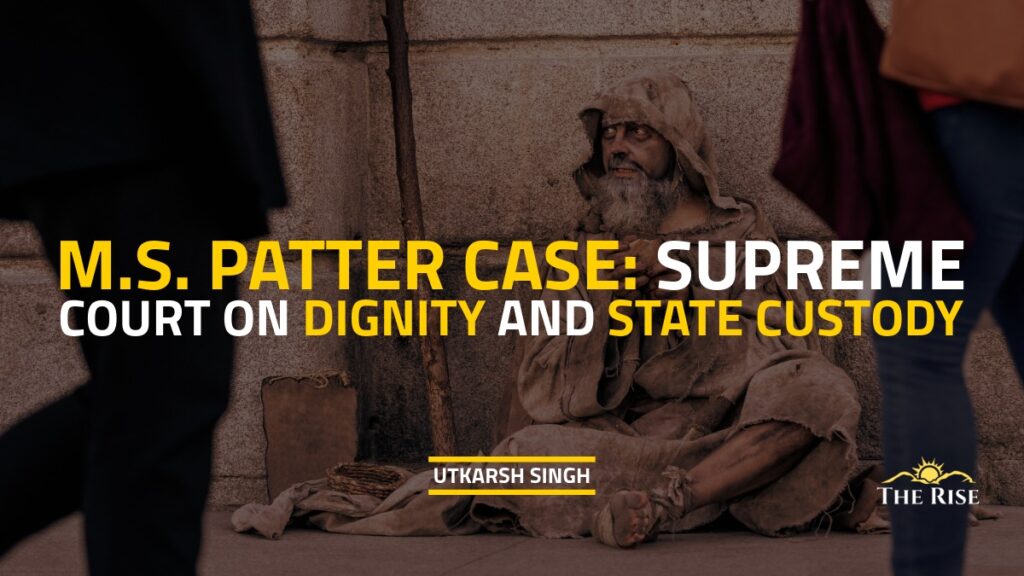
One of the most significant contributions of this judgment is its re-conceptualisation of beggars’ homes. The Court made it clear that these institutions are not quasi-prisons. They are meant to function as spaces of care and rehabilitation, with the State acting as a trustee of the fundamental rights of those confined within them.
The Supreme Court’s decision in M.S. Patter v. State of NCT of Delhi is a powerful reminder that constitutional law is not merely about abstract rights but about how those rights operate in the everyday lives of people pushed to society’s margins. This judgment confronts one of the most uncomfortable truths of governance in India: the State’s treatment of its poorest and most invisible citizens, those confined in beggars’ homes not because of crime, but because of poverty.
At its heart, the judgment declares that poverty cannot be punished, neglect cannot be justified, and human dignity does not stop at the doors of State-run institutions.
Deaths, Denial, and the Long Road to Justice
The case traces its origin to the year 2000, when newspaper reports revealed that several inmates of the Beggars’ Home at Lampur (Narela), Delhi, had died following an outbreak of cholera and gastroenteritis. These were not isolated or unavoidable deaths; official inquiries later attributed them to contaminated drinking water, faecal pollution, non-functional sanitation systems, and deep administrative neglect[1].
What followed was equally disturbing. Authorities attempted to downplay the incident, claiming the deaths were “natural.” Conflicting explanations were offered, responsibility was diffused, and the lives lost were reduced to mere statistics. It was against this backdrop that a Public Interest Litigation was filed, asserting that even those confined in beggars’ homes are entitled to the protection of Article 21 of the Constitution.
The matter travelled from the Delhi High Court to the Supreme Court, where it remained under judicial scrutiny for over two decades. During this period, rather than treating the case as a one-time violation, the Court maintained continuous engagement, appointing committees, amicus curiae, legal services authorities, and medical experts. This sustained oversight transformed the case into a rare instance of judicial intervention addressing long-term, structural injustice.
When Poverty Meets Criminalisation: Why This Case Speaks to India’s Poor
This judgment is relevant far beyond the walls of a single institution in Delhi. It speaks to a deeper constitutional failure. The anti-begging laws in India, inherited from colonial rule, were designed less to rehabilitate and more to control. Beggars were viewed as public nuisances rather than individuals displaced by structural inequality.
The Supreme Court squarely confronted this mindset. It observed that India’s constitutional framework, particularly the Directive Principles of State Policy, envisions a welfare state committed to social justice, health, and dignity. Within such a framework, institutions meant for the poor cannot function as spaces of punishment or abandonment.
The judgment thus repositions poverty not as a moral failing, but as a social condition demanding compassion, policy intervention, and constitutional accountability.
Reimagining Beggars’ Homes Through Constitutional Morality
One of the most significant contributions of this judgment is its re-conceptualisation of beggars’ homes. The Court made it clear that these institutions are not quasi-prisons. They are meant to function as spaces of care and rehabilitation, with the State acting as a trustee of the fundamental rights of those confined within them.
Drawing on established jurisprudence regarding Article 21, the Court reaffirmed that the right to life encompasses the right to live with dignity, which includes access to adequate nutrition, clean water, sanitation, healthcare, mental well-being, and humane treatment. Any institutional arrangement that denies these essentials amounts to a direct constitutional violation.
Importantly, the Court moved beyond declaratory principles. It issued detailed, enforceable directions relating to food quality and quantity, appointment of medical personnel, hygiene standards, drainage and ventilation, counselling services, vocational training, security mechanisms, and regular inspections.
Law in Action: Legal and Social Consequences of the Decision
Legal Impact
From a legal standpoint, the judgment strengthens Article 21 jurisprudence by extending its protective umbrella to those detained solely due to poverty. It reinforces the principle that State custody, irrespective of whether it arises from criminal detention or welfare-based confinement, creates an enhanced duty of care.
The ruling also legitimises sustained judicial oversight in cases involving structural rights violations, affirming that constitutional remedies do not end with the passing of an order. Compliance, accountability, and lived outcomes remain judicial concerns.
Societal Impact
Socially, the judgment challenges entrenched prejudices surrounding beggary. By insisting on dignity, nutrition, healthcare, and rehabilitation for beggars, the Court humanises a population long viewed with suspicion or apathy. It reframes beggars’ homes as spaces where lives must be rebuilt, not merely contained.
The focus on skill development and achieving economic self-reliance is particularly significant. It acknowledges that dignity is inseparable from the ability to earn, to choose, and to reintegrate into society.
A Constitution that Refuses to Look Away: Concluding Reflections
M.S. Patter v. State of NCT of Delhi is ultimately a judgment about constitutional courage. It confronts the uncomfortable truth that the gravest violations of human rights often occur not through overt brutality, but through prolonged neglect.
By holding the State accountable for the lives of those it shelters, confines, and governs, the Supreme Court reaffirmed a foundational promise of the Constitution that dignity is not conditional on wealth, status, or social usefulness. Poverty may strip a person of resources, but it cannot strip them of their humanity.
In refusing to look away, the Court ensured that the Constitution continues to speak even for those who are rarely heard.
Utkarsh Singh is a TRIP intern
Mentored and Edited by Sneha Yadav
References
[1] 2025 SCC Online SC 1970