


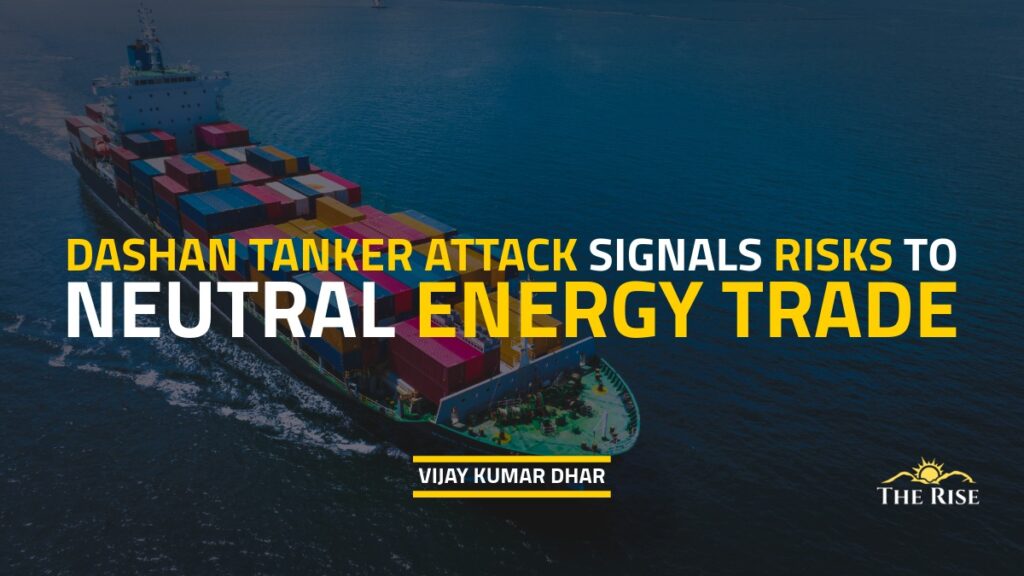
The strike was not solely a tactical military action, but also a broader geopolitical signal with the potential to exert pressure on countries that have maintained neutrality while engaging in lawful commercial trade with Russia.
The Security Service of Ukraine (SBU) conducted a naval-drone strike on the crude-oil tanker Dashan on 10 December 2025, raising fresh concerns about the safety of international commercial shipping amid already stressed global energy markets. According to maritime monitor services, the vessel was en route to the Russian port of Novorossiysk when it was hit, and preliminary assessments indicated that the tanker was put out of service.
This incident occurred shortly after Dashan had delivered a cargo of Russian crude oil to India’s Sikka port and just weeks after Russian President Vladimir Putin visited New Delhi, during which both sides emphasised the strategic importance of ongoing energy cooperation. Taken together, these developments might imply that the strike was not solely a tactical military action, but also a broader geopolitical signal with the potential to exert pressure on countries that have maintained neutrality while engaging in lawful commercial trade with Russia.
The “shadow fleet” and the context of sanctions
The Dashan occupies a notable position within India’s energy supply chain. Although flying the flag of Gambia, the tanker is certified by the Indian Register of Shipping, reflecting its integration into recognised maritime safety and compliance frameworks. In 2025, the vessel made 38 documented port calls worldwide, seven of which were to India. This accounts for over 18% of its global activity and makes India one of its primary destinations outside Russia’s export terminals.
The majority of these calls were concentrated at Sikka, which functions as the maritime gateway for Reliance Industries’ Jamnagar refinery complex and supports logistics networks for other Indian refiners, including Bharat Petroleum. It is estimated that the Dashan typically carried between 6,50,000 and 7,50,000 barrels of crude per voyage, meaning that approximately 5 million barrels of Russian crude reached India through this single vessel in 2025.
At the same time, the Dashan is generally perceived as part of Russia’s so-called “shadow fleet”, a network of vessels that operate beyond the scope of conventional Western insurance and compliance systems, yet continue to transport Russian crude through alternative logistical channels. This label, however, does not alter the ship’s civilian character. Under international maritime law, including the provisions of the United Nations Convention on the Law of the Sea, merchant vessels engaged in commercial activity are protected from attack when operating outside zones of active hostilities.
It is important to note that, regardless of its cargo history or commercial links, targeting such a vessel risks violating long-standing principles that safeguard neutral shipping and global trade.
An incident with the strategic messaging
The attack on the Dashan is a part of Ukrainian operations against commercial tankers linked to Russia’s energy trade. While Ukraine argues that such actions disrupt Russia’s wartime financing, they also affect vessels sailing under neutral flags and supplying neutral states. Maritime law experts have expressed concern that such incidents erode protections that have traditionally underpinned stability in sea-borne commerce.
For India, the timing of the attack is particularly significant. This unfortunate incident occurred shortly after renewed high-level pledges to strengthen energy cooperation with Russia, at a time when Russian crude constitutes a substantial share of India’s total oil imports. Indian refiners depend on predictable maritime supply routes to ensure price stability and maintain refinery throughput. Any action that injects uncertainty into shipping lanes could therefore have direct implications for India’s energy security and broader market stability.
The international implications of the strike are equally worth noting. If commercial tankers can be targeted because of the political sensitivity surrounding their cargoes or trade routes, it is possible that other regions marked by territorial disputes or sanctions could also face similar risks. Potential flashpoints include the South China Sea, the Caribbean basin surrounding Venezuela, or even parts of the Red Sea.
Such a shift might potentially expose neutral countries and commercial operators to threats arising from conflicts in which they are not participants, ultimately undermining confidence in freedom of navigation and the rules-based maritime order.
The incident involving the Dashan could be viewed as more than an isolated attack on a single vessel. It potentially challenges recognised maritime norms, introduces uncertainty into the energy-supply routes of a major importer, and sends a troubling signal to all nations that depend on predictable and depoliticised commercial shipping.
In this context, it would be prudent for India and the wider international community to reaffirm their commitment to the principles that safeguard civilian maritime operations. Upholding these norms is essential not only for India’s energy stability but also for the preservation of global economic security and the protection of all states that rely on secure and lawful maritime passage.
Disclaimer: The views expressed in this article are those of the author solely. TheRise.co.in neither endorses nor is responsible for them. Reproducing this content without permission is prohibited.
References:
2. https://www.un.org/depts/los/convention_agreements/texts/unclos/unclos_e.pdf
4. https://magicport.ai/vessels/tanker/dashan-mmsi-620999986